 Whalesbook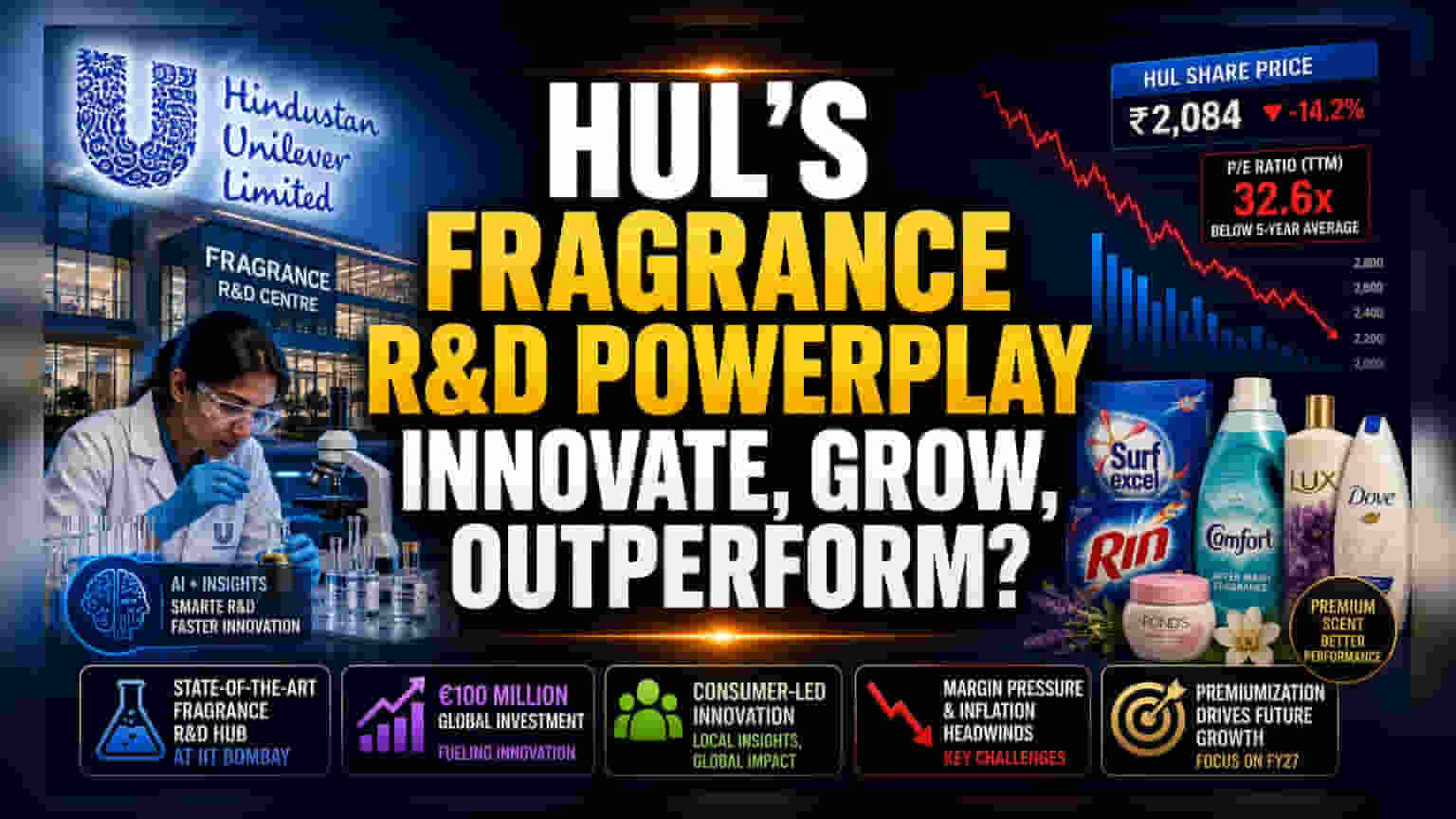


The Innovation Mandate
Hindustan Unilever Limited (HUL) has inaugurated a sophisticated fragrance R&D facility within the IIT Bombay campus. This hub, part of a broader €100 million international investment, is engineered to synthesize consumer insights with artificial intelligence to catalyze product development. By embedding these capabilities directly into the Indian market, the company aims to expedite its premiumization strategy, ensuring that scent-driven product performance—spanning home care and personal care—can be tailored for local preferences while achieving global scalability.
The Valuation and Market Context
This R&D push arrives at a sensitive juncture for the company’s stock. As of early June 2026, HUL’s shares have faced downward momentum, recently trading near ₹2,084 with a trailing P/E ratio of approximately 32.6. This valuation sits below its historical five-year average, suggesting that investors are currently discounting the company’s potential growth amidst broader sector headwinds. Unlike competitors such as Nestlé India or Godrej Consumer Products, which have faced varying degrees of inflationary pressure, HUL is heavily reliant on its massive distribution network to navigate a domestic market where rural consumption recovery remains a critical, yet uneven, variable.
The Forensic Bear Case
While the new facility bolsters HUL’s long-term technical moat, institutional skepticism persists regarding the company’s short-term margin profile. Recent quarterly results revealed that despite a revenue increase, profitability metrics have been squeezed by persistent inflation in raw materials, particularly crude-linked inputs and palm oil. Management has been forced to implement calibrated price hikes of 2% to 5% to shield margins, a move that carries the inherent risk of tempering volume growth in price-sensitive segments. Furthermore, the company’s reliance on international commodity pricing leaves it vulnerable to geopolitical swings, particularly those originating from the Middle East. Unlike leaner peers, HUL’s extensive scale means that even minor supply chain disruptions can have disproportionate impacts on operating margins, a reality that has contributed to the stock's recent volatility.
Future Outlook
Looking ahead, HUL’s leadership is banking on its 'premiumization' strategy to offset the dual threats of rising input costs and increased competitive intensity. The integration of AI and advanced compounding technologies at the new Mumbai hub is expected to support this pivot by creating higher-margin products that justify premium pricing. Analysts maintain a cautious watch on whether these technological advancements can effectively decouple product desirability from raw material cost volatility. Success in FY27 will likely depend on the company's ability to maintain high volume growth—which recently hit multi-quarter highs—while successfully navigating the projected inflationary environment.