 Whalesbook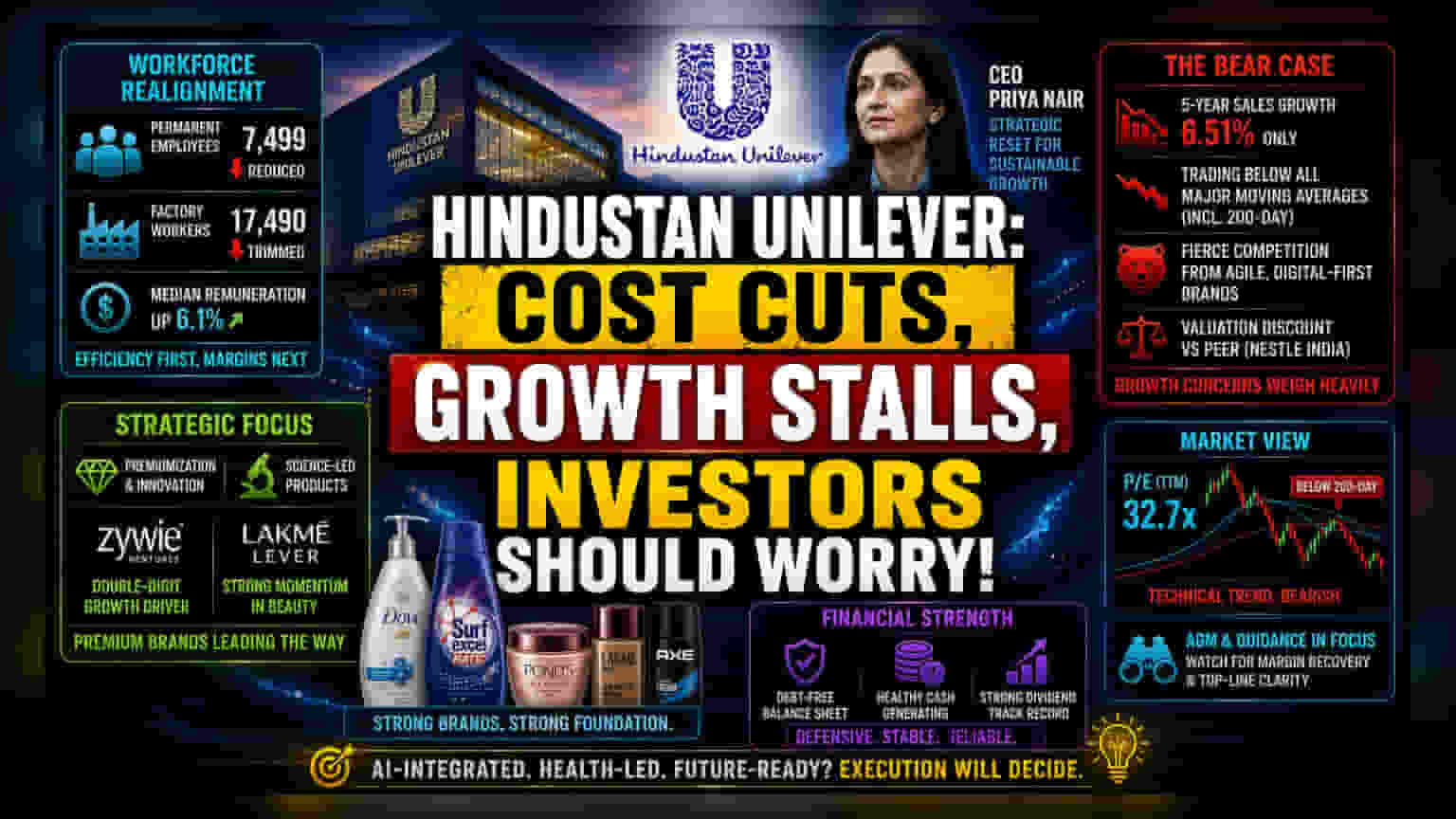


The Efficiency Pivot
The workforce reductions at Hindustan Unilever mark a decisive attempt to preserve margins in an environment where volume growth remains stubbornly muted. By trimming its permanent employee base to 7,499 and factory worker headcount to 17,490, the company is stripping away operational fat to insulate its bottom line from the dual threats of flat profits and sector-wide consumption sluggishness. Despite a modest 6.1% increase in median employee remuneration, the headcount contraction underscores a broader, defensive reallocation of resources aimed at protecting operating margins from eroding further.
Strategic Realignment Under Nair
Since assuming the helm in late 2025, CEO Priya Nair has moved to reorganize the company’s internal structure, aiming to reduce bureaucratic layers and refocus on high-margin segments. The current strategy leans heavily into premiumization and scientific product innovation, particularly within the beauty and wellbeing categories. High-growth vehicles such as Zywie Ventures and Lakme Lever serve as the primary engines of revenue momentum, with recent performance figures showing significant double-digit growth. However, this is largely an attempt to offset the broader stagnation in the company’s massive, core staple portfolio which remains highly sensitive to rural economic volatility.
The Forensic Bear Case
From a risk-averse institutional lens, the optimism surrounding HUL’s restructuring efforts must be tempered by persistent structural headwinds. While the company maintains an almost debt-free balance sheet and a strong dividend payout, its five-year sales growth of 6.51% reveals a company struggling to find its footing in a changing market. The stock currently faces significant technical pressure, trading below all major moving averages—including the 200-day—signaling a bearish consensus that persists despite periodic recovery rallies. Furthermore, the firm operates in a sector increasingly crowded by well-funded, agile, digital-first competitors. Unlike rivals such as Nestle India, which has historically commanded higher valuation multiples due to consistent earnings expansion, HUL is contending with a re-rating cycle where its premium valuation is being compressed by consistent market underperformance.
Future Outlook
Analysts are watching the upcoming Annual General Meeting closely, where board-level decisions and forward-looking guidance may provide clarity on whether the productivity drive is sufficient to revive growth. With the stock currently trading at a P/E multiple of approximately 32.7x, investors are balancing the company’s defensive stability against the lack of immediate top-line triggers. As the firm navigates this transition, the success of its premium-focused, AI-integrated fragrance, and health-led product pipeline will be the critical barometer for institutional sentiment in the coming quarters.