

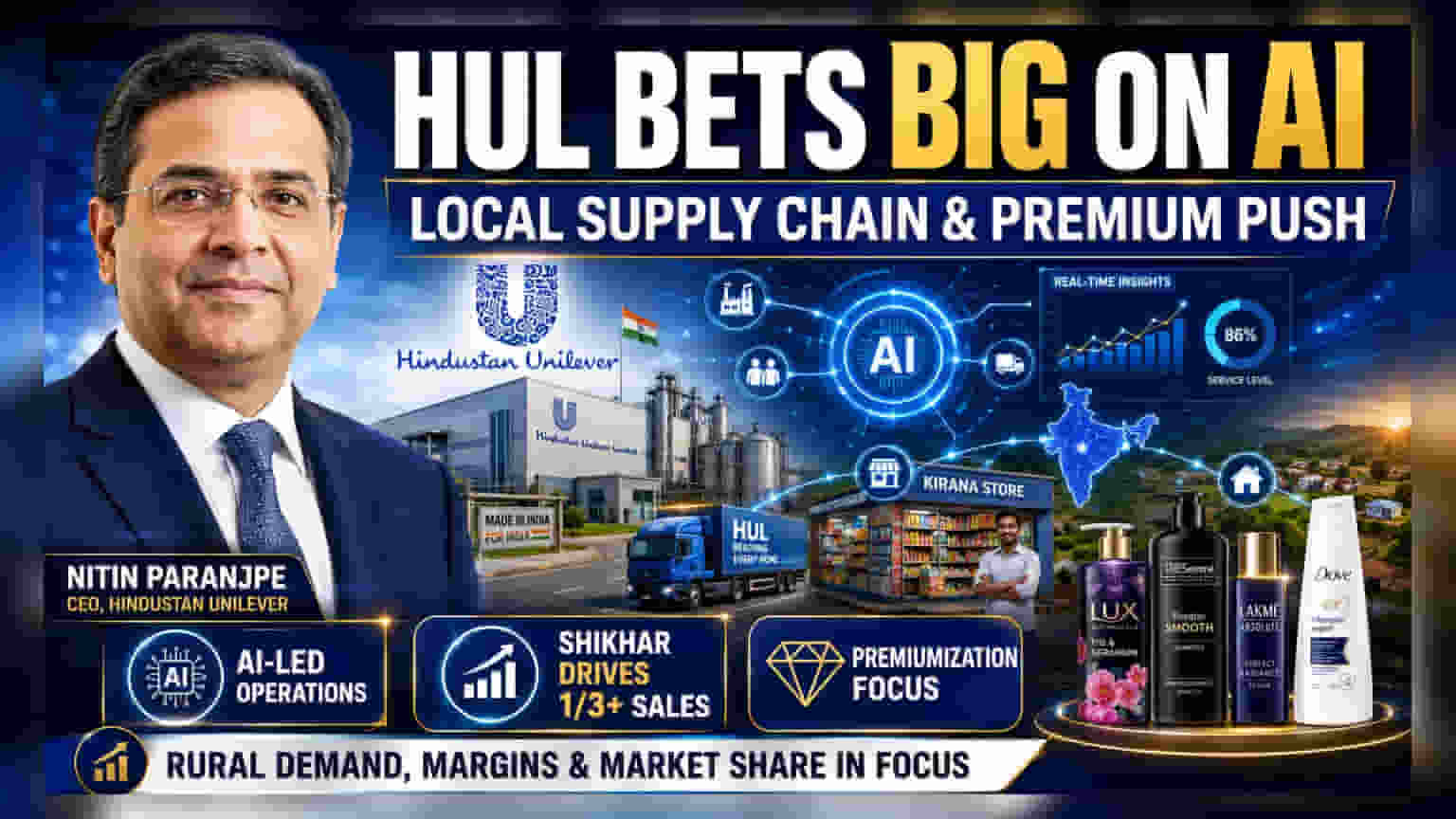
Hindustan Unilever is accelerating investments in AI, localized supply chains, and premium products to build resilience amidst market volatility. Chairman Nitin Paranjpe highlighted these moves at the company's 93rd AGM, aiming to capture shifting consumer behavior. Investors are watching how these initiatives improve operational efficiency and margin protection against intense competition.
What Happened
Hindustan Unilever (HUL) Chairman Nitin Paranjpe outlined the company’s strategic roadmap at its 93rd Annual General Meeting held on June 30, 2026. Addressing shareholders, Paranjpe emphasized that the FMCG giant is moving beyond traditional efficiency measures, focusing instead on building a highly connected operating system. This system integrates artificial intelligence (AI), real-time data, and localized supply chain models to navigate global economic volatility and localized demand shifts. HUL is prioritizing three core pillars: deepening AI integration across its value chain, expanding local manufacturing to reduce import dependency, and capturing premium market opportunities.
Scaling Digital and Supply Chain Resilience
The company is betting heavily on technology to link media planning, kirana store orders, and last-mile delivery into one cohesive system. A key component is the Shikhar e-B2B platform, which continues to be a central part of HUL’s operations, contributing to over one-third of total sales. This platform provides the company with real-time visibility into demand patterns across millions of retail outlets.
Beyond just digital ordering, HUL is leveraging AI-powered tools like 'Sangam' for media optimization to ensure that marketing spending is highly effective. On the manufacturing front, HUL is expanding its network of 'Lighthouse' factories—six of which are now recognized by the World Economic Forum. By utilizing models like 'Nakshatra' for supply chain flexibility, the company aims to move production closer to demand centers, thereby reducing costs and delivery timelines, which are critical for supporting quick-commerce and urban distribution.
Targeting the 'Dual-Speed' Indian Consumer
Paranjpe noted that Indian consumers are currently exhibiting “dual-speed behaviour.” This refers to a trend where consumers remain value-conscious in many categories while simultaneously experimenting with premium offerings and new formats. To manage this, HUL is continuing its premiumization journey—expanding categories like body wash and high-end hair care—while keeping its value-focused portfolio accessible to a wider demographic. This strategy is supported by an ongoing investment program, including significant capital spending aimed at scaling manufacturing for premium segments. By tailoring its portfolio to meet both ends of the consumption spectrum, the company is attempting to safeguard its growth from a single-sided reliance on either mass or premium demand.
The Competitive and Demand Landscape
While the company’s long-term outlook remains tied to India’s growth, the FMCG sector faces distinct challenges in 2026. Competitive intensity from regional and emerging local brands has put pressure on market share in several categories. Furthermore, the sector is navigating the risks of commodity price inflation and potential weather-related disruptions, which often impact rural income and consumption. While rural India has structurally emerged as a key growth engine for the sector over the past few years, any fluctuation in rural purchasing power remains a vital risk factor for FMCG volumes.
What Investors Should Monitor
Investors may look for updates on how effectively these digital and supply chain investments translate into margin stability. Key monitorables include the recovery pace of rural consumption volumes, the ability of HUL to maintain market share against increasing competition, and the impact of raw material price volatility on operating margins. Additionally, the execution of the company's capital spending in premium segments will be important to track as these categories are expected to be the primary drivers of future margin expansion.