

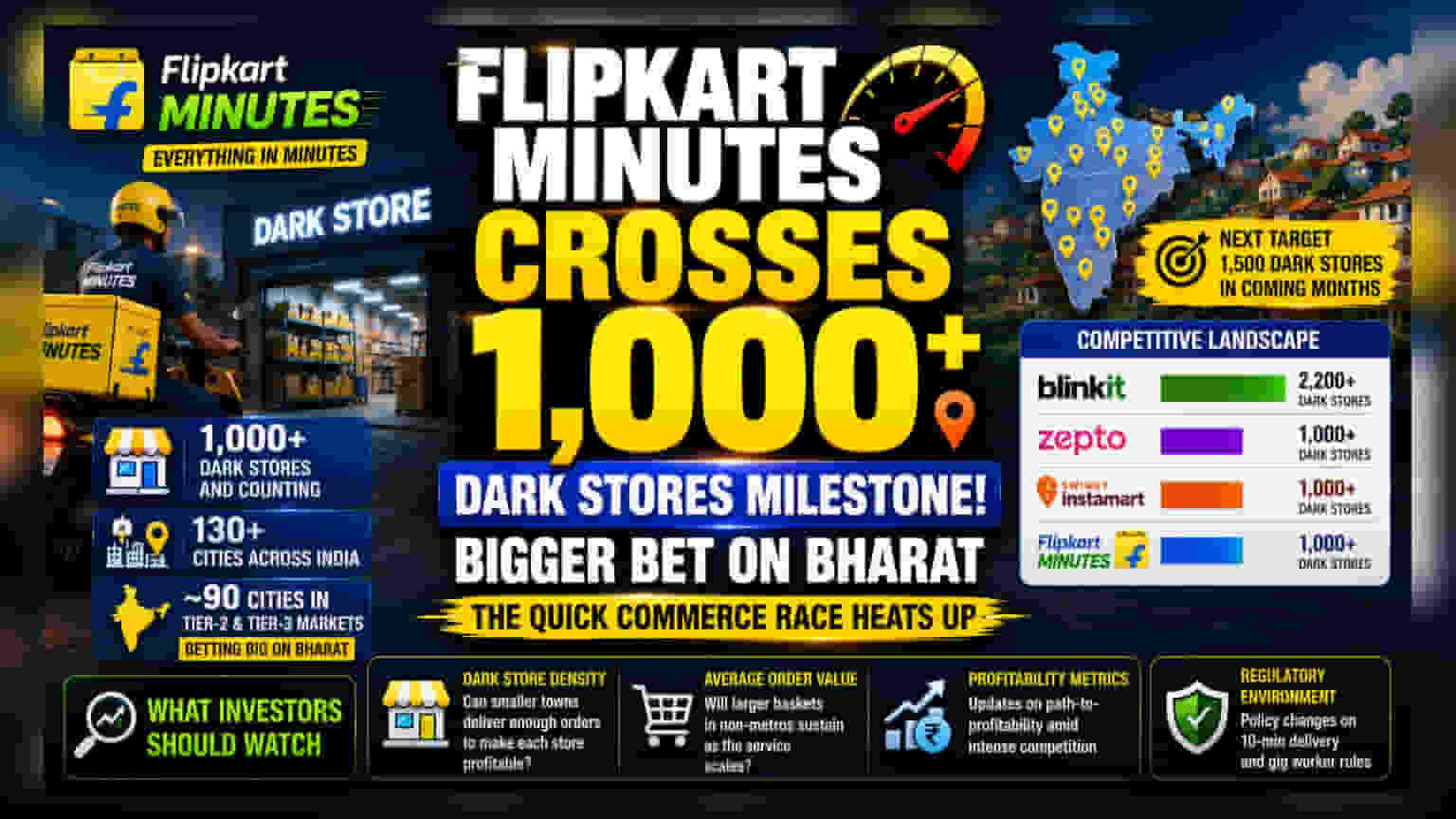
Flipkart Minutes has reached 1,000 micro-fulfillment centres and plans to scale to 1,500, focusing on expansion in Tier-2 and Tier-3 cities. This strategy differentiates the quick commerce player from rivals who are heavily concentrated in metro markets, aiming to capture untapped demand in smaller Indian towns.
What Happened
Flipkart Minutes, the quick commerce arm of the Walmart-backed e-commerce giant, has crossed the milestone of 1,000 micro-fulfillment centers, also known as dark stores. The company now operates across more than 130 cities and aims to scale its network to 1,500 stores in the coming months. A distinctive aspect of this expansion is its geographical focus: approximately 90 of these operational cities are in smaller, non-metro markets, signaling a strategic bet on "Bharat"—India’s Tier-2 and Tier-3 towns—to drive future growth.
The Shift Toward 'Bharat'
While market rivals like Blinkit, Swiggy Instamart, and Zepto have largely concentrated their efforts on dense, high-consumption metro corridors, Flipkart Minutes is pursuing a contrarian strategy. The company reports that its business in smaller towns has seen rapid adoption, supported by observations of larger basket sizes in these regions compared to some metro counterparts. By targeting these underserved areas, Flipkart is attempting to build a broader national footprint that leverages its existing supply chain and logistics capabilities.
Competitive Landscape
The quick commerce sector in India is currently defined by intense competition and a rapid build-out of dark store networks. Market leaders like Blinkit have a significantly larger footprint, with over 2,200 dark stores, while Zepto and Swiggy Instamart also maintain extensive networks. For Flipkart, the challenge lies in balancing this aggressive infrastructure build-out with the cost of operations. The company's strategy relies on its existing fulfillment ecosystem, which it is adapting to accommodate quick commerce, potentially providing a logistical advantage in terms of cost and speed.
The Business Reality Check
For investors and market observers, the core question remains the unit economics of this model in smaller cities. Quick commerce is capital-intensive, requiring heavy investment in dark store rent, inventory management, and last-mile delivery teams. In metro cities, high population density supports frequent orders, which helps spread these fixed costs. In Tier-2 and Tier-3 markets, achieving similar order density and frequency remains a hurdle. Success will depend on the company's ability to maintain healthy average order values (AOV) and control delivery costs while expanding its reach.
Risks and Execution Challenges
The quick commerce industry also faces regulatory scrutiny regarding delivery speed promises and rider safety. Additionally, the operational complexity of managing perishable inventory across a distributed network in smaller towns can lead to higher wastage and supply chain friction. While the potential for volume growth in non-metro markets is high, the financial sustainability of this expansion will depend on whether these new regions can generate sufficient profit per order to offset the significant upfront capital expenditure.
What Investors Should Track Next
The key monitorables for the quick commerce sector include:
- Dark Store Density: Whether the company can achieve sufficient order density in smaller towns to make each store profitable.
- Average Order Value: Monitoring if the trend of larger grocery baskets in non-metros holds up as the service scales.
- Profitability Metrics: Any updates on path-to-profitability for the quick commerce vertical, especially as it competes with established incumbents.
- Regulatory Environment: Any policy shifts regarding 10-minute delivery promises or gig worker regulations that could affect operational costs.