

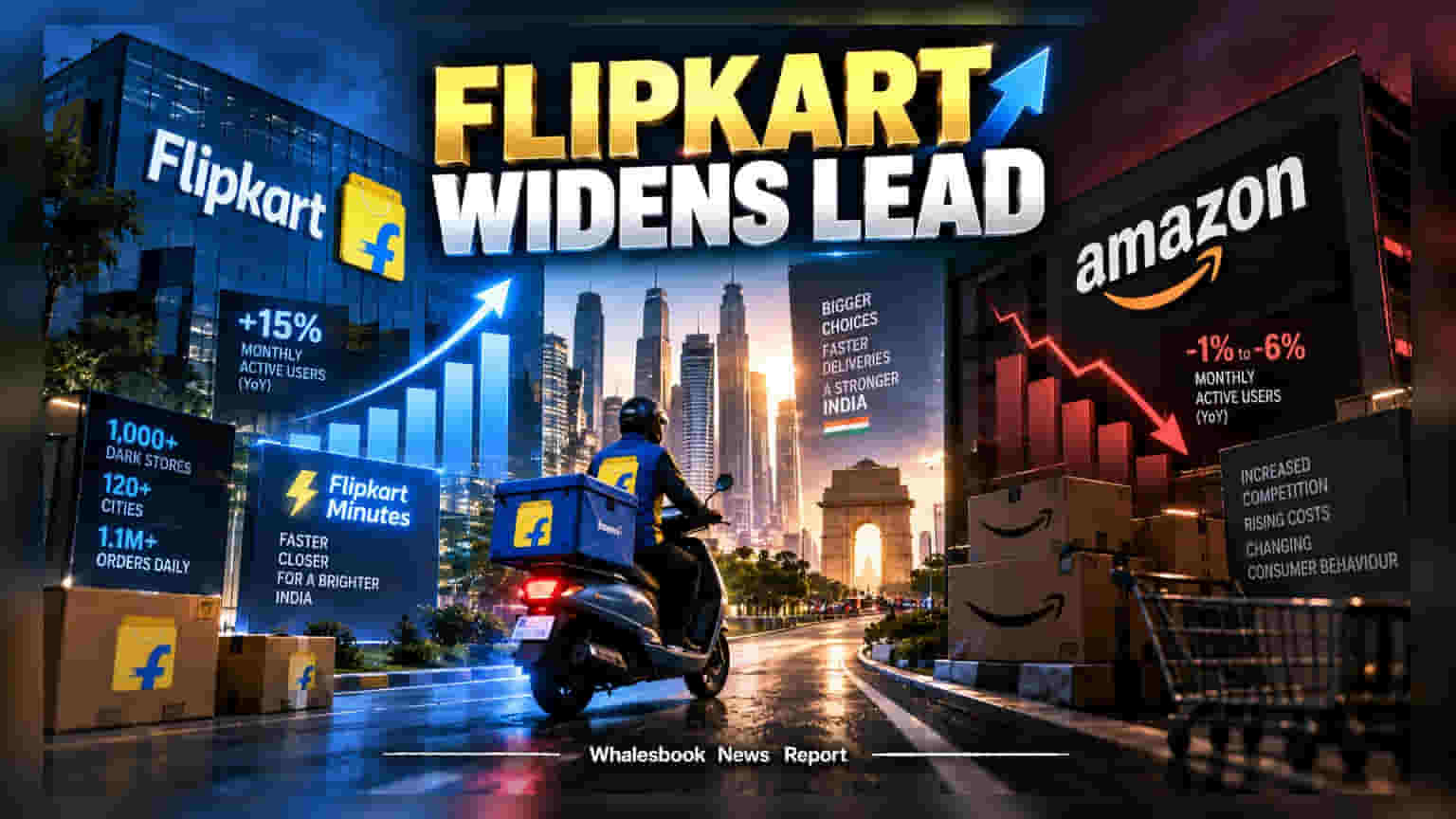
Flipkart and its subsidiary Myntra have expanded their lead over Amazon in the Indian e-commerce market, with the monthly active user gap widening to 17 percentage points. While Flipkart recorded 15% user growth in July 2026, Amazon faced a decline in engagement. The rapid scaling of the quick-commerce service, Flipkart Minutes, has emerged as a major factor in this shifting competitive dynamic.
Flipkart, including its fashion platform Myntra, has consolidated its position as the market leader in Indian e-commerce. Recent data indicates the gap in monthly active user share against its primary rival, Amazon, has widened significantly, reaching 17 percentage points compared to a 9-point difference in 2022.
In July 2026, Flipkart reported a 15% year-on-year increase in monthly active users, a strong recovery from trends seen in the final quarter of the previous fiscal year. In contrast, Amazon has seen its user base contract, with data showing a consistent decline of 1% to 6% year-on-year across the same period. This divergence in growth trajectories highlights a change in consumer engagement preferences within the digital retail space, where Flipkart has maintained a steady lead in gross merchandise value.
A key driver for this shift is the aggressive expansion of Flipkart Minutes. Launched in late 2024, the service now operates over 1,000 dark stores across more than 120 cities in India. The platform is currently processing 1.1 million to 1.2 million orders daily, placing it in direct competition with established quick-commerce players like Swiggy Instamart, Blinkit, and Zepto. The speed of this scale-up has forced a re-evaluation of how horizontal e-commerce marketplaces capture daily consumer spending.
It is important to note for market observers that Flipkart remains an unlisted company. The firm has completed the process of moving its domicile from Singapore to India, a significant step widely viewed by analysts as a precursor to a potential domestic initial public offering. While the company is not tradable on Indian stock exchanges, its performance and strategic shifts significantly influence the valuation and competitive landscape of the broader Indian internet and retail sector.
Despite the rapid growth, the quick-commerce segment remains capital-intensive. Operational challenges, including the need to maintain supply chain efficiency and manage inventory costs, remain critical for all participants. As the company prepares for its next phase of growth, market analysts are monitoring how these expansion costs impact the overall financial profile and the ability to maintain the current market share lead against both established and emerging competition.