

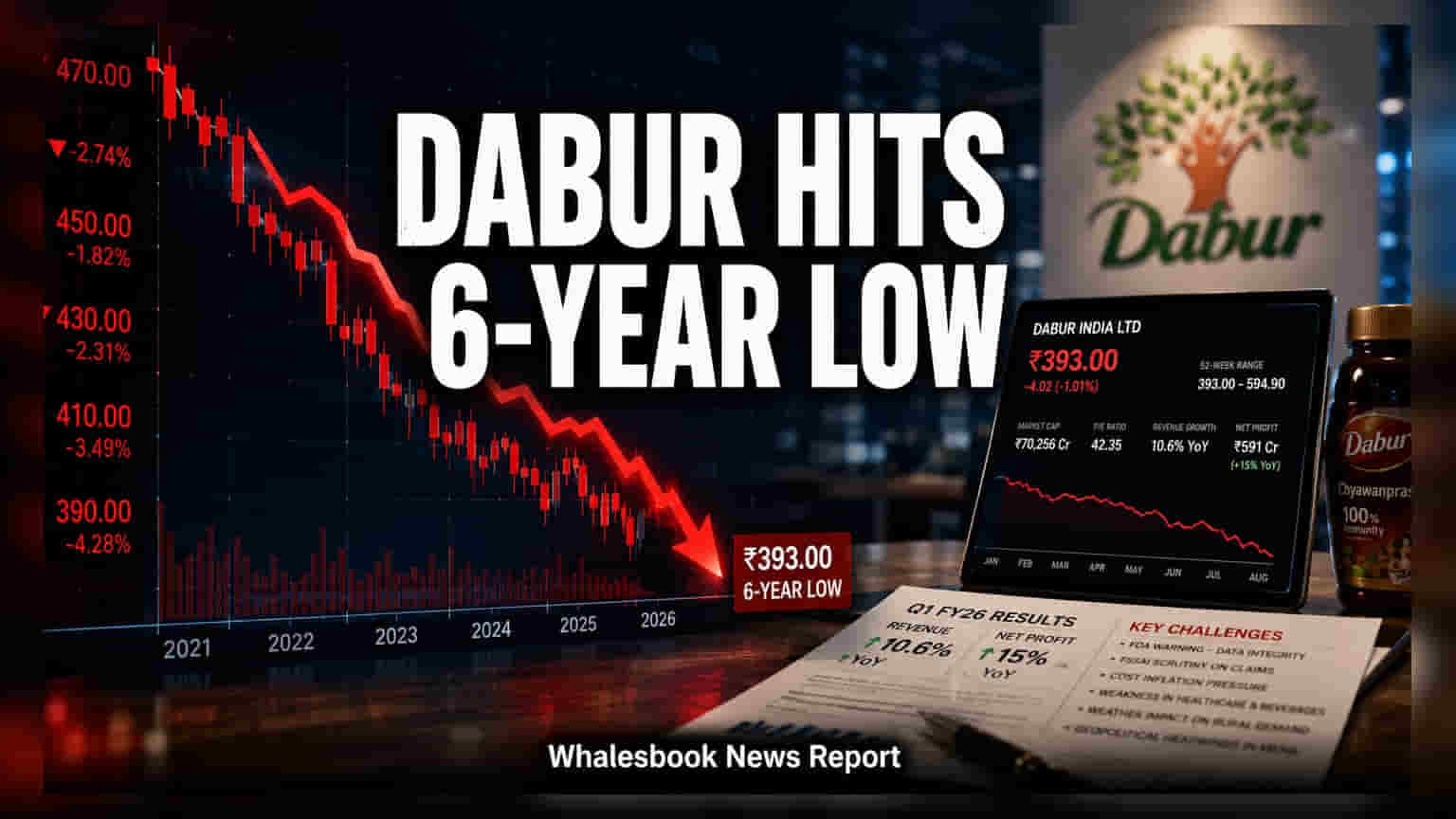
Dabur India shares have fallen to a six-and-a-half-year low at ₹393, despite a 10.6% revenue growth in the June 2026 quarter. The company faces significant investor caution due to US FDA warning letters, FSSAI labeling scrutiny, and ongoing volatility in rural demand and commodity costs.
Dabur India’s stock has touched a six-and-a-half-year low, recently trading around ₹393. This decline reflects growing investor caution despite the company reporting its strongest revenue growth in twelve quarters during the period ended June 2026. While the firm delivered a 10.6% year-on-year revenue increase and a 15% rise in net profit to ₹591 crore, the market appears focused on the mounting operational and regulatory challenges that could impact future performance.
A key factor weighing on sentiment is the company's recent regulatory run-ins. In July 2026, Dabur received a warning letter from the US FDA citing data integrity concerns at its Saily, Silvassa manufacturing facility. Furthermore, the company faced scrutiny from the FSSAI regarding the validity of '100% natural' or 'pure' claims on its product labels. Although the Delhi High Court later stayed the FSSAI’s prohibitory order due to procedural lapses, the episode has increased uncertainty regarding compliance and product marketing, making investors wary of potential operational disruptions.
Operationally, the company is seeing uneven performance across its segments. The domestic FMCG business grew by 9.5% with a 5% volume increase, and the food division surged by 29.2%, largely supported by the integration of Badshah Masala. However, the healthcare and beverage portfolios have struggled, with management attributing the weakness to unseasonal rainfall patterns. This highlights the company's reliance on stable weather conditions to drive demand, particularly in the rural sector which remains price-sensitive.
Cost pressures also continue to impact the business. While initiatives like 'Project Samriddhi' have helped maintain operational efficiency, the company faces persistent inflation in agricultural inputs and crude-linked packaging materials. This creates a difficult balance between maintaining profit margins and keeping products affordable for consumers who are already dealing with high inflation.
On the international front, the company’s business is geographically segmented. Markets in sub-Saharan Africa, Turkey, and the UK have shown strong double-digit growth, providing a buffer against sluggishness. However, the company continues to face headwinds in the Middle East and North Africa (MENA) region due to geopolitical instability, which adds volatility to the company's export-led revenue.
Looking ahead, management remains committed to achieving double-digit consolidated revenue growth by FY27. For shareholders, the key monitorables will be the company’s progress in resolving the US FDA compliance issues at the Silvassa plant, the impact of commodity price fluctuations on gross margins, and the speed of recovery in rural demand. Whether the company can sustain its volume growth in an inflationary environment remains the critical question for the stock's trajectory in the coming quarters.