

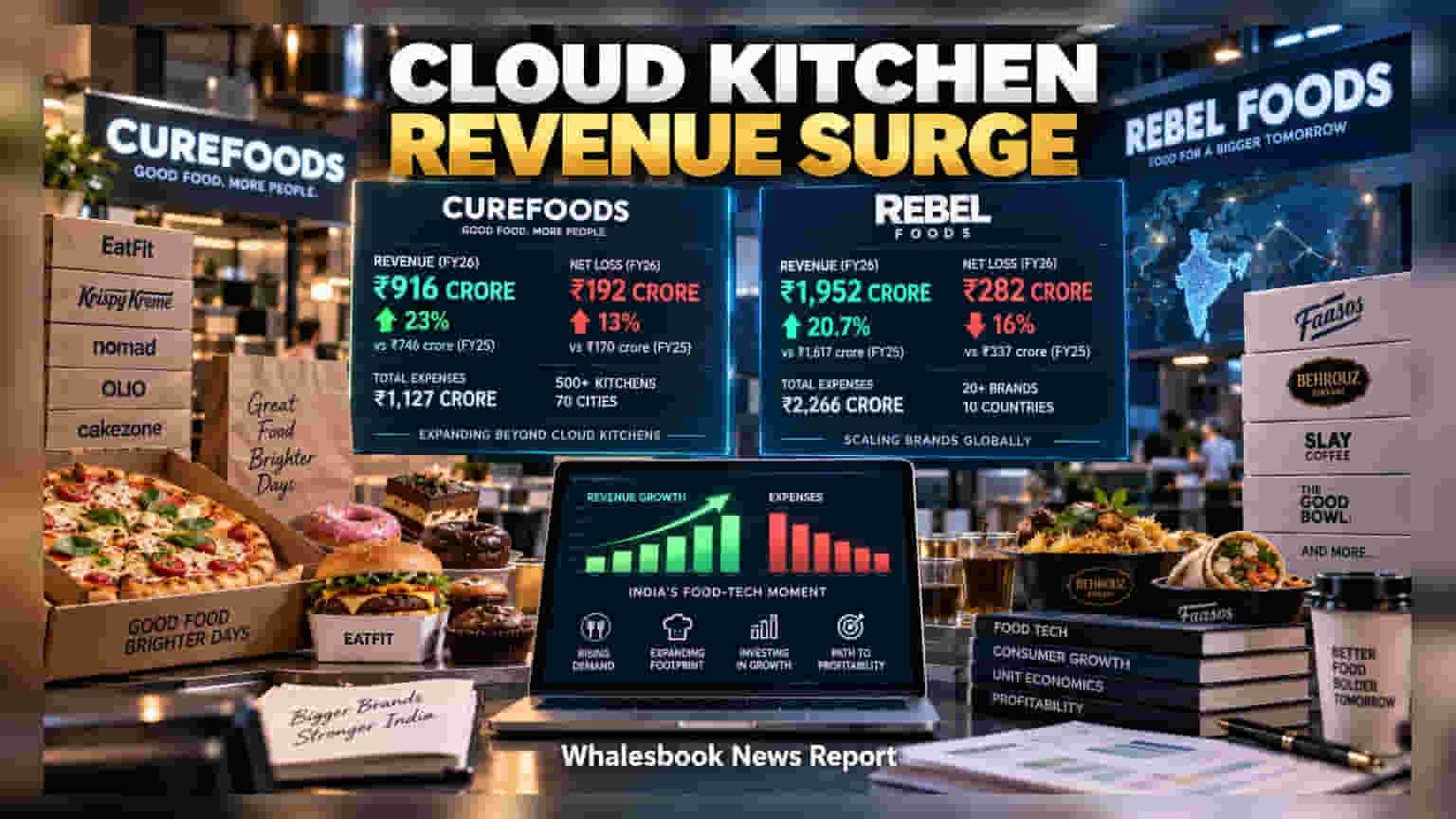
Both cloud kitchen giants posted over 20% revenue growth in FY26, but their bottom lines show different trends. Curefoods saw losses widen, while Rebel Foods successfully narrowed its net loss. This highlights the ongoing challenge of achieving profitability in the cash-intensive food-tech sector as firms balance rapid expansion with cost management.
The fiscal year 2026 performance of India's leading cloud kitchen operators, Curefoods and Rebel Foods, reveals a clear divide in how companies in this sector are balancing rapid growth against the need for profitability. Both firms maintained strong revenue momentum, crossing the 20% growth mark, but their financial health shows different trajectories.
Curefoods: Expansion and Widening Losses
Curefoods reported operating revenue of Rs 916 crore for FY26, a 23% jump from the previous year's Rs 746 crore. Despite the top-line growth, the company’s path to profitability remains a work in progress. Net losses expanded by 13% to Rs 192 crore, up from Rs 170 crore in FY25. Total expenses for the year stood at Rs 1,127 crore, driven by higher spending on raw materials, staffing, and depreciation for its infrastructure. Currently operating over 500 kitchens in 70 cities, Curefoods has been diversifying its model to include offline dining, notably through the acquisition of rights for Krispy Kreme in India. Investors are also noting that the company recently opted to defer its planned Rs 800 crore public offering, despite having received regulatory clearance from SEBI.
Rebel Foods: Scaling and Narrowing Losses
In contrast, Rebel Foods demonstrated a shift toward potential operational efficiency. The company reported operating revenue of Rs 1,952 crore, representing a 20.7% increase from Rs 1,617 crore in FY25. More importantly, it successfully reduced its net loss by 16%, bringing the figure down to Rs 282 crore from Rs 337 crore in the previous year. Total expenses rose by 14% to Rs 2,266 crore, a trend the company attributed to rising logistics and food costs, which continue to pressure margins across the food-tech industry. Rebel Foods maintains an extensive portfolio of over 20 brands, such as Faasos and Behrouz Biryani, with operations spanning 10 countries.
Capital-Intensive Sector Challenges
The cloud kitchen model is famously capital-intensive, requiring high investment in kitchen infrastructure and brand marketing to secure market share. The divergent results of these two major players underscore the difficulty of managing the burn rate in this space. While Curefoods is investing heavily to diversify its presence, Rebel Foods is focusing on scaling its multi-brand international strategy while attempting to improve its unit economics.
For investors, the key monitorable remains how these companies manage their capital outlays in the coming quarters. While revenue growth validates the consumer demand for these platforms, the ability to control expenses amid rising raw material and logistics costs will be crucial for narrowing losses further. As both entities continue to refine their models, shareholders and potential investors will be watching for signs of sustainable margins and the potential for a return to public market plans.