

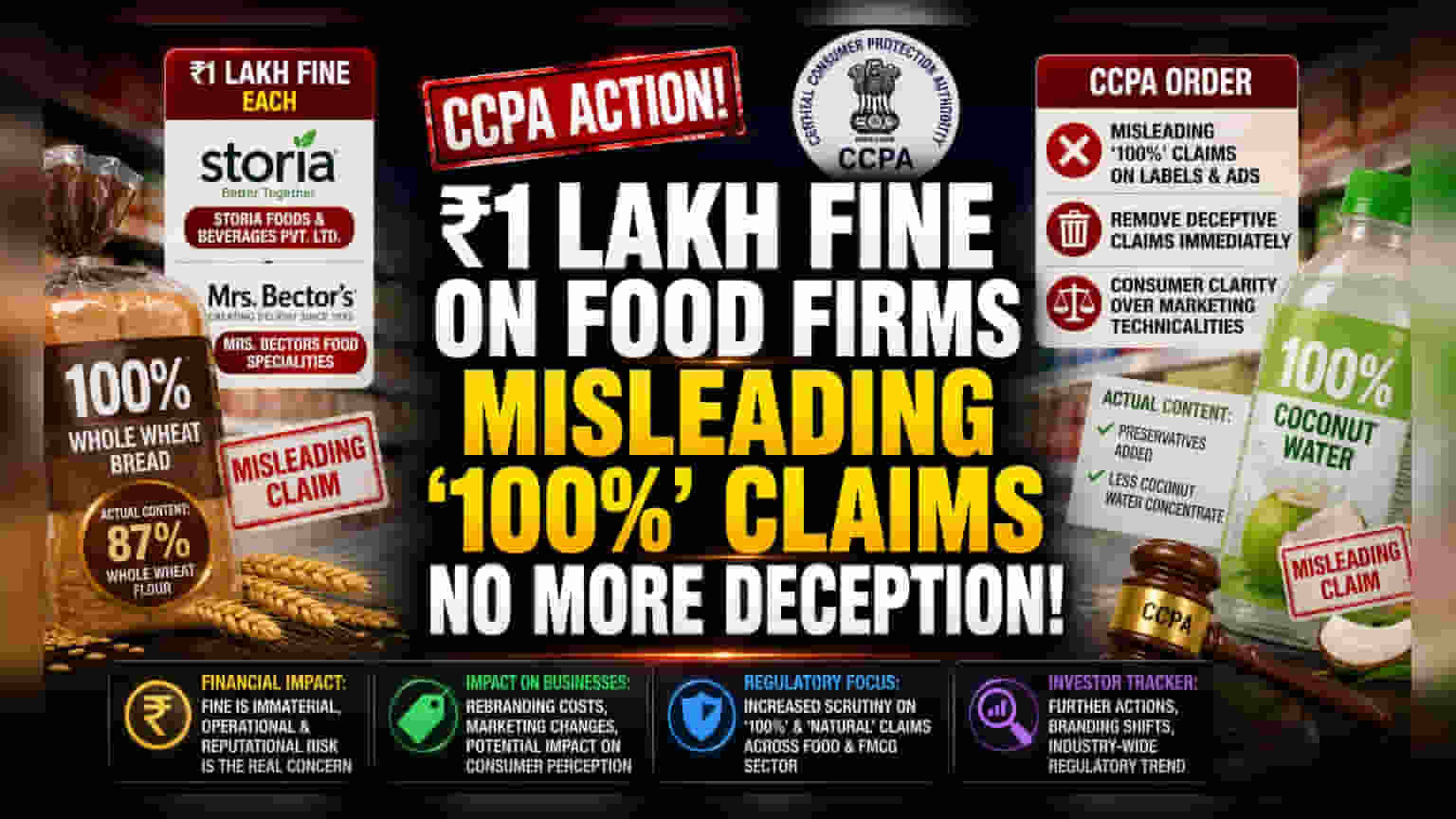
The Central Consumer Protection Authority has penalized Mrs. Bectors Food Specialities and Storia Foods ₹1 lakh each for misleading '100%' marketing claims. While the financial impact of this fine is minimal for a listed company like Mrs. Bectors, investors may monitor how increased regulatory scrutiny on product labeling affects consumer trust and marketing costs for FMCG brands.
What Happened
The Central Consumer Protection Authority (CCPA) has imposed a penalty of ₹1 lakh each on Storia Foods and Beverages Private Limited and Mrs. Bectors Food Specialities. The regulator found that both companies used misleading '100%' claims on their product labels and promotional materials. The authority has ordered these companies to immediately remove the deceptive claims from their packaging and marketing channels.
The Financial Impact Assessment
For a listed entity like Mrs. Bectors Food Specialities (Bectorfood), a fine of ₹1 lakh is financially immaterial. The amount is negligible when compared to the company’s annual revenue and overall business operations. The primary concern for investors here is not the penalty amount, but the operational and reputational challenge.
Companies often use '100%' labels, such as '100% Whole Wheat' or '100% Coconut Water,' to command a premium in the market. The CCPA order forces the companies to change their packaging and marketing strategies. This could lead to a temporary impact on marketing effectiveness or require costs to rebrand the products to comply with regulatory standards.
The Issue With '100%' Claims
The CCPA investigation revealed a gap between the claims made and the actual composition of the products. In the case of Mrs. Bectors, the authority noted that bread products advertised as '100% Whole Wheat' contained only 87% whole wheat flour. Similarly, the regulator found that Storia Foods' coconut water products contained preservatives and a lower percentage of actual coconut water concentrate than what the '100%' claim suggested to a reasonable consumer.
The regulator has clearly stated that it will look at products from the perspective of an average buyer. Technical explanations about why a label was used do not hold up if the buyer is misled by the marketing. This indicates a shift where regulators are prioritising consumer clarity over technical marketing definitions.
Regulatory Focus on Food Labels
The food and beverage industry in India is under increasing pressure to be transparent about ingredients and composition. The Consumer Protection Act, 2019, gives the CCPA the power to act against misleading advertisements. Investors should note that the regulator is actively scrutinizing the 'natural' and '100%' labels that many FMCG brands use to differentiate their products from competitors.
When regulators crack down on such practices, it impacts the entire sector. Other companies using similar marketing strategies may now face increased scrutiny, which could force them to be more cautious with their advertising claims to avoid similar penalties or negative publicity.
What Investors Should Track
For investors, the key monitorables are not the fine itself, but the broader implications for the company's brand and compliance.
First, monitor if the company faces any further regulatory action regarding product packaging or marketing. Second, watch for any shifts in how the company communicates its product benefits to consumers. If the company is forced to change its branding, it could impact consumer perception or the premium the product enjoys. Finally, keep an eye on how other players in the processed food sector adjust their labeling, as this will determine if this is a company-specific issue or a wider regulatory trend affecting the whole industry.