 Whalesbook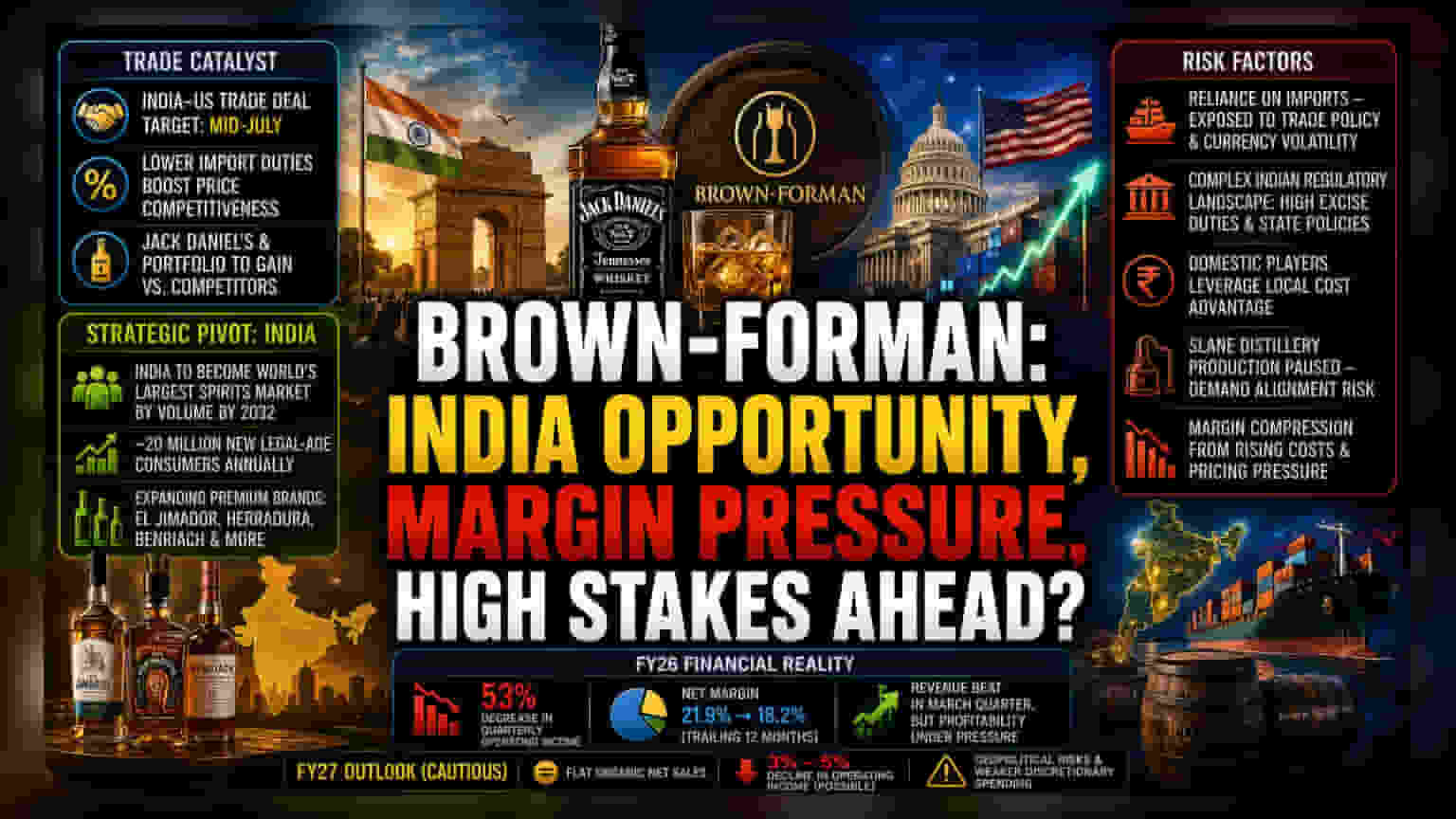


The Trade Catalyst
The potential mid-July finalization of an India-US bilateral trade agreement represents a vital turning point for Brown-Forman’s international strategy. Currently, the company operates as a wholly-owned subsidiary in India, relying entirely on imported stock. Management is closely tracking these negotiations, as any reduction in import duties would directly enhance the price competitiveness of its American whiskey portfolio, including its flagship Jack Daniel’s brand, against domestic and other imported competitors.
Strategic Pivot Toward India
With the company’s US operations grappling with a cooling whiskey boom and shifting consumer demographics, management is increasingly looking toward India to drive long-term volume growth. India is projected to become the world’s largest spirits market by volume by 2032, with roughly 20 million new consumers reaching legal drinking age annually. Brown-Forman has explicitly signaled its intention to expand its local presence by launching additional premium brands such as El Jimador, Herradura, and Benriach over the next few years. This push is intended to capture the burgeoning segment of affluent Indian consumers who are increasingly diversifying their drinking repertoire toward premium spirits.
Margin Compression and Operational Realities
Despite the optimism surrounding emerging markets, recent fiscal 2026 results reveal significant structural challenges. The company reported a 53% decrease in quarterly operating income, with net margins contracting from 21.9% to 18.2% over the trailing 12 months. This compression illustrates that rising costs and pricing pressure are currently outstripping the benefits of its premiumization strategy. While revenue slightly exceeded analyst expectations in the March quarter, the company has issued a cautious guidance for fiscal year 2027, projecting flat organic net sales and a potential 3% to 5% decline in operating income due to persistent geopolitical instability and cooling discretionary spending in developed markets.
The Risk Factors
Investors should remain wary of the gap between the company’s growth aspirations and its current financial health. Brown-Forman’s reliance on imports in India makes it acutely sensitive to shifts in trade policy and currency volatility. Furthermore, the Indian regulatory environment remains complex, characterized by high excise duties and restrictive, state-specific liquor policies that create a steep barrier to entry. Beyond policy risks, the company’s decision to pause production at its Slane Irish Whiskey distillery suggests that even premium-focused players are struggling to align output with fluctuating global demand. Management must now navigate a landscape where domestic Indian players, such as Radico Khaitan, continue to leverage local manufacturing advantages, potentially undermining the growth narrative if premiumization momentum stalls.