 Whalesbook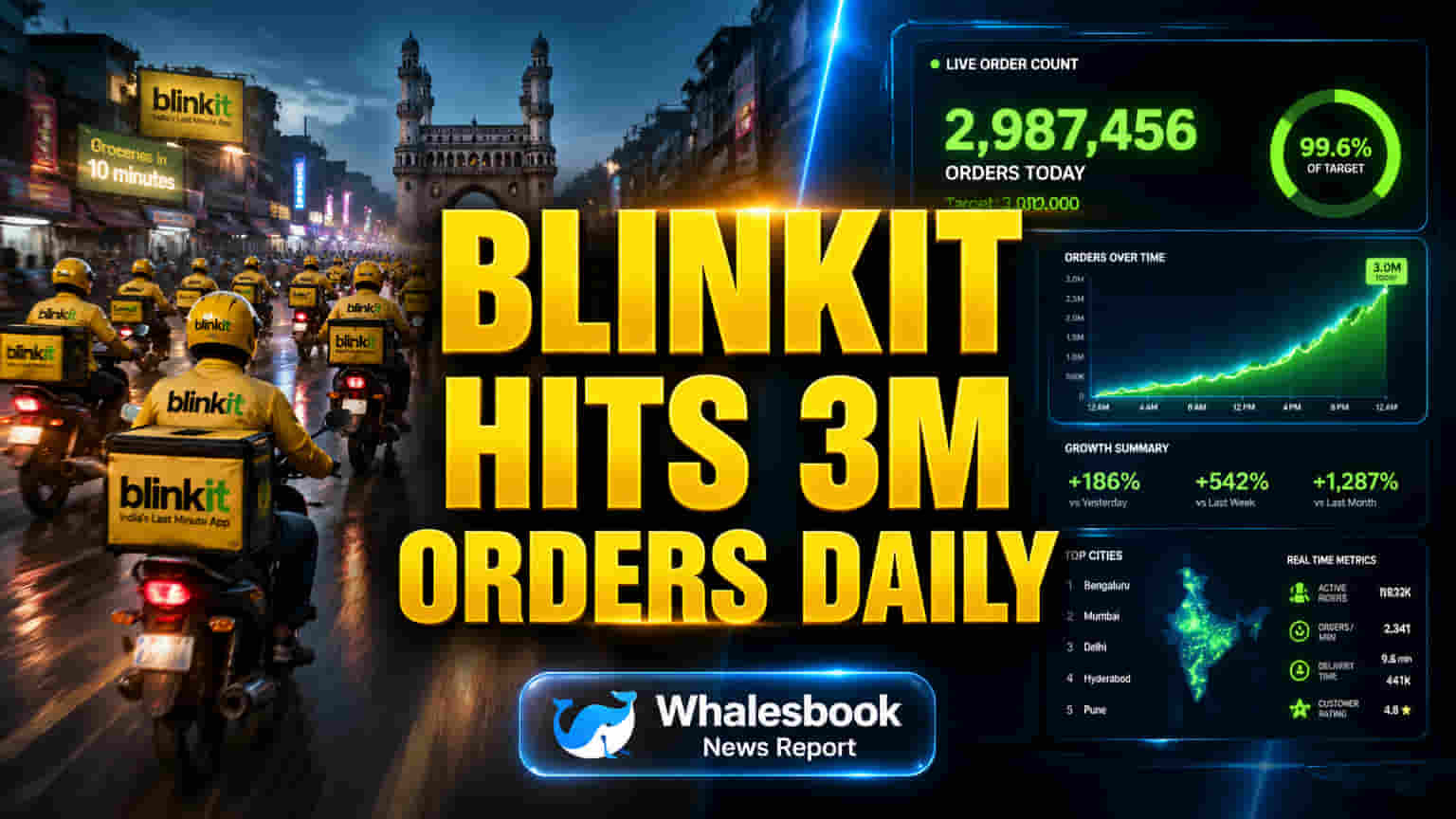


Blinkit's Rapid Rise
Blinkit's daily order volume has surged past three million, marking a rapid ascent in India's quick commerce market. Navigating complex local operational challenges, often called 'pigeon poop' problems, the company has built significant capacity. However, beneath these strong top-line numbers, investors question the cost of this growth and its impact on Zomato's overall profitability.
Record Orders, Mixed Financials
Blinkit is processing three million orders daily, with its Net Order Value (NOV) for quick commerce even exceeding food delivery for the first time in Q1 FY26, generating ₹2,400 crore in revenue. This growth helped Zomato's consolidated revenue reach ₹7,167 crore in Q1 FY26, up 70% year-on-year. However, the expansion came at a cost, as net profit fell 90% year-on-year to ₹25 crore that quarter. More recent Q4 FY26 results show a stronger recovery: net profit surged 346% to ₹174 crore with revenue up 196.5% to ₹17,292 crore. While these figures signal improving financial performance, they also underscore the capital-intensive nature of quick commerce. The market remains cautious, with Zomato's shares fluctuating ahead of earnings reports.
Market Position and Profit Challenges
Blinkit holds a leading 46% market share in India's quick commerce sector, followed by Zepto (29%) and Swiggy Instamart (25%). Although Zepto generates more revenue, profitability is a widespread issue across the sector due to high operational and delivery expenses that reduce margins. Blinkit's Adjusted EBITDA margin was around 0.3% in Q1 FY26. Swiggy Instamart uses its existing logistics, while Zepto prioritizes rapid growth in busy city markets. India's quick commerce market is expected to grow 75-100% annually until 2027, offering expansion potential but also fiercer competition. Zomato acquired Blinkit for ₹4,447 crore in June 2022 to strengthen its market position. However, this investment continues to pressure profitability, prioritizing scale over immediate profit.
The High Cost of Scale
The focus on solving complex operational hurdles, like the 'pigeon poop' challenges unique to India, often distracts from the thin profit margins inherent in quick commerce. Blinkit's high order volume is driven by aggressive investment, leading to substantial operating costs that offset revenue increases. Zomato's traditional food delivery segment, once its profit driver, is seeing moderating growth, with Q4 FY26 revenue expected to be flat. The quick commerce segment, despite being a growth engine, has very tight unit economics, requiring continuous funding to compete with rivals like Zepto and Swiggy Instamart. This focus on scale risks delaying profitability, especially if discounting or customer acquisition costs increase. Zomato has also faced regulatory reviews regarding past business practices that might have favored certain restaurants. High P/E ratios, sometimes exceeding 600x, indicate an optimistic market valuation that depends heavily on future profit from quick commerce, which is still developing.
Analyst Views and Zomato's Goals
Analysts remain cautiously optimistic despite profitability hurdles, with a consensus 'Moderate Buy' rating for Zomato. Brokerages like JM Financial and Motilal Oswal set price targets between ₹340 and ₹400, suggesting potential upside based on growth forecasts and improving economics. Zomato targets over 60% annual NOV growth and aims for around 5% margins for Blinkit. The company expects quick commerce to maintain its strong growth, with double-digit NOV increases and eventual margin expansion from maturing stores and operational improvements. Zomato's success hinges on turning Blinkit's large scale into consistent profitability, a challenging task in the competitive quick commerce market.