

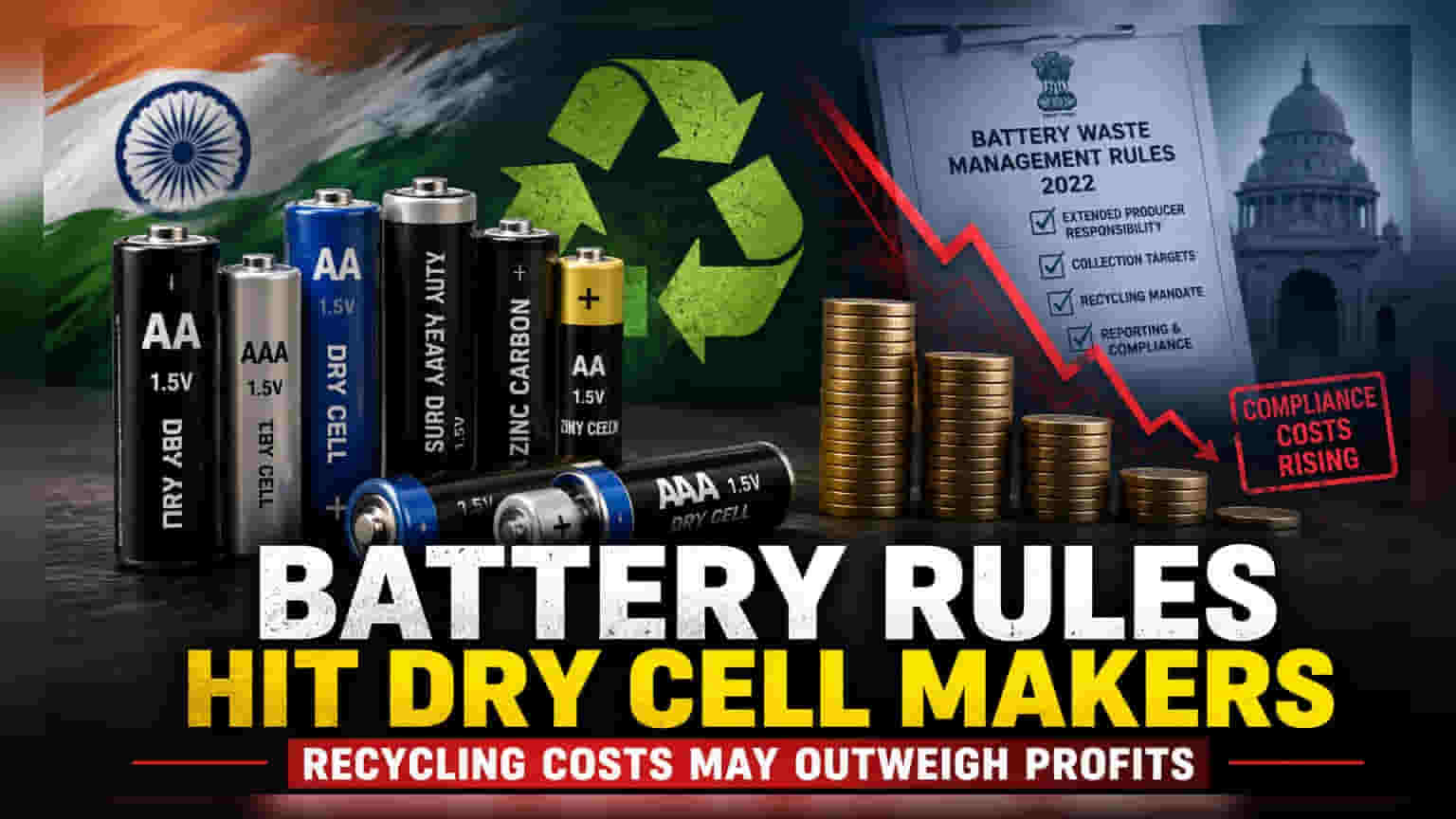
Major battery manufacturers, including Panasonic Energy India and Eveready, have raised concerns that current recycling mandates are financially unviable. The industry argues that rules designed for high-value lithium-ion batteries are being applied to zinc-carbon cells, creating compliance costs that could significantly outweigh company profits.
What Happened
India’s dry cell battery manufacturers are sounding the alarm over the implementation of the Battery Waste Management Rules, 2022. Companies like Panasonic Energy India, Eveready Industries, and Indo National, which produces Nippo batteries, have cautioned that the new government recycling mandates are creating a financial crisis for the sector. The core issue lies in the application of strict recycling targets and pricing benchmarks to zinc-carbon batteries, which currently dominate the Indian market. Industry leaders argue these regulations were designed for lithium-ion batteries and do not account for the economic reality of low-value, household dry cell batteries.
The Financial Impact of Compliance
The primary concern involves the Extended Producer Responsibility (EPR) system, which mandates that manufacturers ensure a specific percentage of their batteries are recycled. To comply, companies must purchase digital EPR certificates from authorized recyclers. According to industry submissions, the cost of these certificates is extremely high. For instance, Panasonic Energy India reportedly indicated that meeting a 50% collection mandate could require an investment in EPR certificates of approximately ₹50 crore, a figure that is significantly higher than its expected profit of ₹6 crore for the financial year 2026. This creates a scenario where compliance costs could potentially dwarf the profit margins of these companies.
Why Collection is Challenging
The industry points to a fundamental difference between lithium-ion batteries and traditional dry cells. Lithium-ion batteries used in electric vehicles and electronics have high scrap value, making them profitable to collect and recycle. In contrast, standard zinc-carbon dry cells have very low residual value. Because they are often discarded in general household waste, building a specialized collection network is expensive and logistically difficult. Executives note that without a viable collection infrastructure, manufacturers are forced to pay for certificates without a realistic way to recover the actual waste, effectively turning a compliance requirement into a recurring operational expense.
Business and Margin Pressures
The industry is currently facing a situation where compliance costs are pegged to economics meant for a different type of technology. With zinc-carbon cells accounting for roughly 85% of the market, the impact of these rules is widespread. If these costs remain at current levels, companies may face pressure on their operating margins. For investors, this creates uncertainty regarding future profitability and the potential need for management to adjust pricing, which could affect demand. The companies are advocating for regulatory adjustments that better reflect the nature of their specific product segment.
What Investors Should Track
The most important factor to monitor is whether the government provides any relaxation or amendments to the rules specifically for zinc-carbon battery manufacturers. Investors should watch for official updates or circulars from the Ministry of Environment, Forest and Climate Change regarding these recycling targets. Additionally, management commentary in upcoming quarterly earnings reports will be essential to understand if these companies are setting aside higher provisions for compliance or if they are seeking relief through industry bodies. Changes in the pricing of EPR certificates will also be a key indicator of the potential financial burden on these firms.