 Whalesbook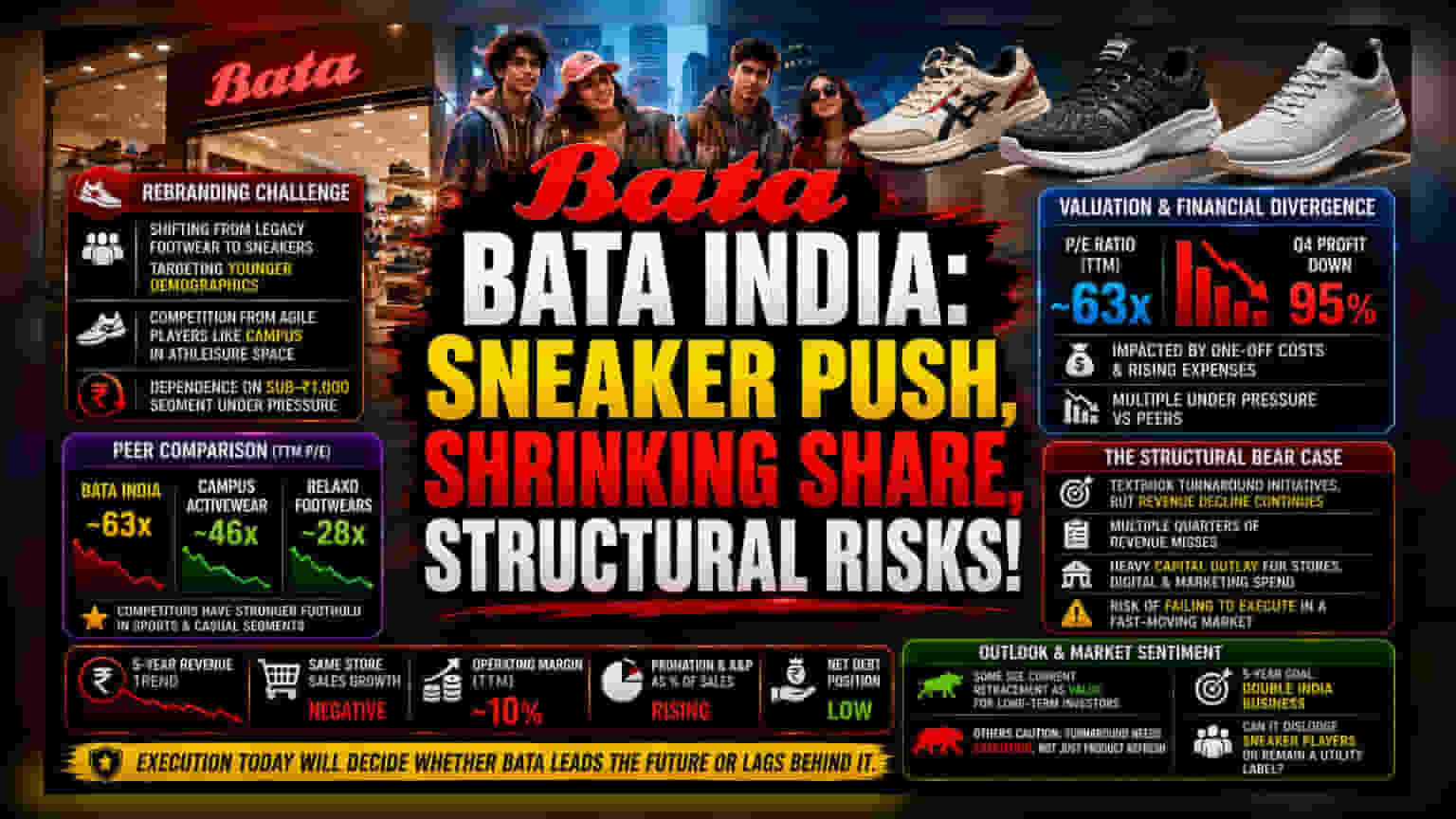


The Competitive Reality of Rebranding
Bata India’s attempt to pivot toward a sneaker-focused portfolio represents a high-stakes effort to move beyond its long-standing identity as a legacy provider of school and formal footwear. While management, led by CEO Gunjan Shah, has publicly identified sneakers as the primary bridge to younger demographics, the move comes amidst persistent market share erosion. The firm’s historical reliance on the sub-₹1,000 price segment has proved vulnerable, as inflation-pressured consumers delayed purchases, allowing agile, trend-focused competitors like Campus Activewear to capture the emerging athleisure market.
Valuation and Financial Divergence
Despite the push into higher-margin premium segments, the company’s financial trajectory has been tepid. With a trailing P/E ratio hovering around 63x, valuations appear disconnected from a reality characterized by recent quarterly results that showed a 95% plunge in profit, largely impacted by one-off costs and rising operational expenses. Compared to peers, Bata’s valuation multiples remain under pressure as analysts question the effectiveness of their "premiumization" strategy. While Campus Activewear and Relaxo Footwears face their own sector-level headwinds, they have established clearer footholds in the sports and casual segments that Bata is now attempting to penetrate.
The Structural Bear Case
From a hedge-fund perspective, the "Bata Paradox" remains: the company continues to execute on textbook turnaround initiatives—redesigning stores, expanding franchise networks, and increasing marketing spend—without seeing a reversal in its long-term revenue decline. Critics point to the fact that the company has missed revenue estimates for multiple consecutive quarters. The risk factor is not just brand perception, but a potential failure to execute in a market that has moved faster than the company’s massive, infrastructure-heavy organization. Investors should note that significant capital outlay for digital transformation and store expansion carries risk, especially if profitability fails to reach pre-COVID levels in the medium term.
Outlook and Market Sentiment
Market sentiment remains split. While some analysts suggest the stock’s current retracement might present value for long-term investors, others caution that a sustained turnaround requires more than just a product-line refresh. The management’s five-year ambition to double the India business will likely be tested by whether it can truly dislodge established players in the sneaker space or if it remains stuck as a utility-focused label struggling to find its footing in the premium, fashion-forward landscape.