 Whalesbook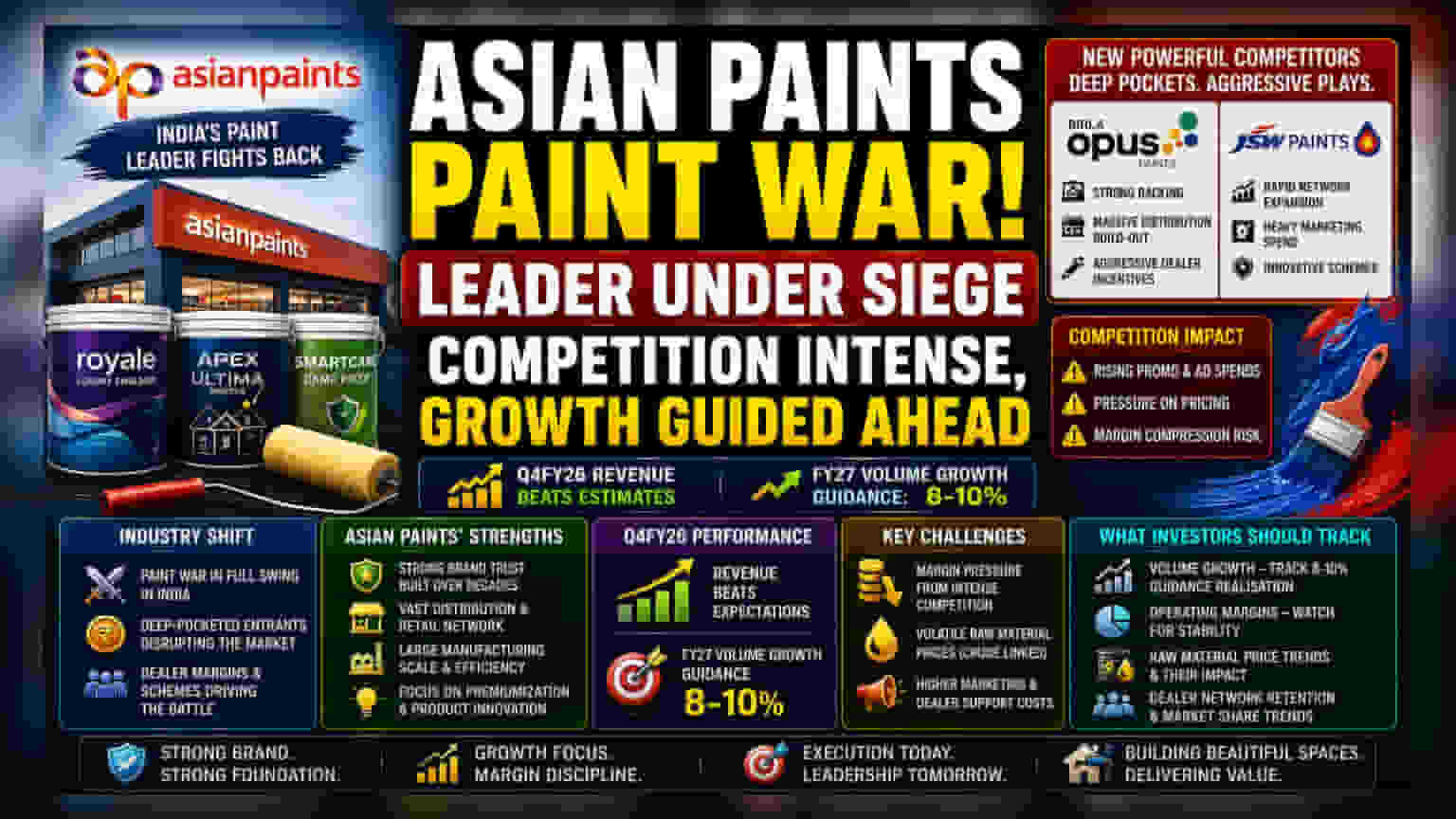


Asian Paints faces a challenging industry landscape as deep-pocketed conglomerates like Birla Opus enter the market, triggering a 'paint war' that has pressured pricing and dealer loyalty. Despite this, the market leader maintains a strong operational footprint and continues to deliver steady volume growth. We look at the key factors investors are tracking: competitive pressure, margin sustainability, and the company's long-term volume guidance in a shifting decorative paints sector.
What Happened
Asian Paints, the long-standing leader in India’s decorative paints market, is navigating a significant shift in industry dynamics. After decades of dominance, the sector is experiencing a competitive 'paint war.' New, deep-pocketed entrants such as Birla Opus (Aditya Birla Group) and JSW Paints have entered the fray, leveraging massive capital to build distribution networks and aggressive promotional strategies. This has forced incumbent players to recalibrate their approach, focusing on defending market share, strengthening dealer relationships, and navigating a more complex pricing environment. Despite these pressures, Asian Paints reported a resilient performance for the quarter ended March 2026 (Q4FY26), with revenue figures beating market expectations and management guiding for 8% to 10% volume growth in FY27.
The Competition and Margin Challenge
The arrival of large-scale competitors has fundamentally altered the industry’s equilibrium. Traditionally, Asian Paints maintained an unmatched moat through its supply chain and massive retail network. New entrants are now challenging this by offering competitive dealer margins, aggressive incentives, and innovative customer schemes. For investors, the primary concern has been whether this intense rivalry will lead to permanent margin compression. The sector has seen promotional and advertising spending rise as companies vie for dealer counters and consumer loyalty. While Asian Paints has effectively utilized its brand strength to hold ground, the reality of the market is that volume growth now comes at a higher cost in terms of marketing and dealer support than it did a few years ago.
Resilience and Operational Strength
It is important to look at the other side of the coin: operational resilience. Asian Paints remains a formidable player with a vast manufacturing capacity and a deep understanding of the Indian consumer. Recent financial data suggests the company is successfully managing the transition. Management’s guidance of 8% to 10% volume growth for FY27 indicates that, despite the competitive noise, the underlying demand for home renovation and decorative painting remains steady. Furthermore, the company continues to focus on premiumization and product innovation, which helps in shielding profitability to some extent from the price-based competition at the lower end of the market.
How Investors May Read This
For investors, the narrative around Asian Paints has shifted from a 'set and forget' compounding story to a more active monitoring exercise. The market is paying close attention to whether the company can protect its market share without sacrificing profit margins. While the balance sheet remains strong, the increased intensity of competition means that investors are scrutinizing every quarterly result for signs of volume loss or margin erosion. The stability of the company’s operating margins in the face of fluctuating crude oil prices—a key input for paint manufacturing—will be a defining factor in its stock performance.
What Investors Should Track
The paint sector is at a crossroads. Investors should monitor a few critical indicators in the coming quarters. First, watch the volume growth figures; 8% to 10% is the target, and any deviation will be a key signal of market share health. Second, observe the trend in operating margins. If competition forces the company to increase discounts or marketing spend further, margins could remain under pressure. Third, monitor raw material price trends, as the cost of petrochemical-based inputs directly impacts profitability. Finally, keep an eye on management commentary regarding dealer network retention, which is the frontline of this industry battle. The ability of the company to balance volume growth with profitability will dictate the long-term outlook for the stock.