

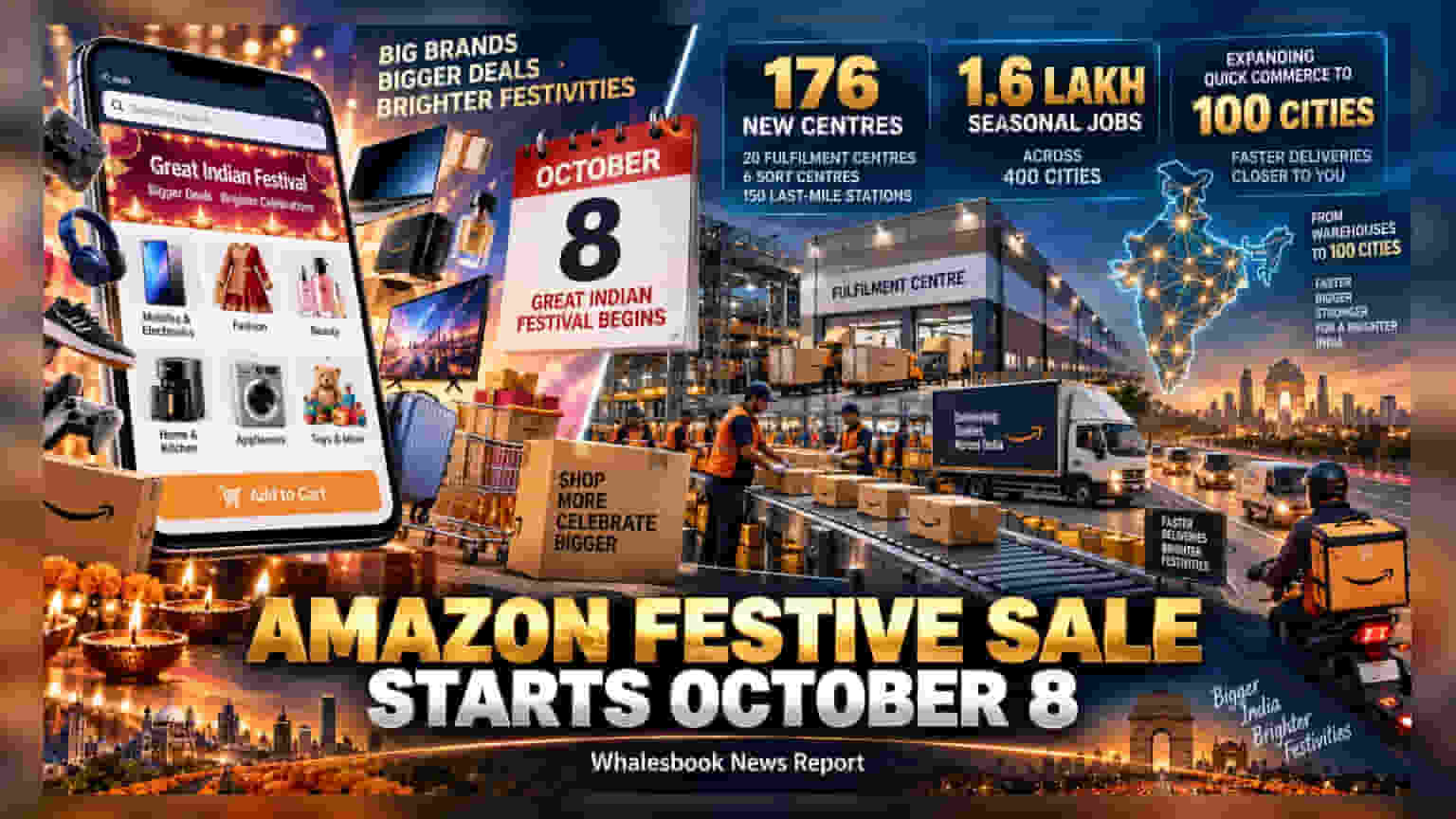
Amazon India will launch its Great Indian Festival on October 8, supported by 176 new logistics facilities and 1.6 lakh seasonal jobs. The aggressive expansion highlights the company's strategy to capture market share in the booming quick commerce segment and defend its position against local rivals in the critical festive shopping season.
Amazon India has announced that its flagship Great Indian Festival sale will begin on October 8. To prepare for the high demand, the e-commerce giant has executed a significant infrastructure expansion, adding 20 fulfillment centers, six sort centers, and 150 last-mile delivery stations. This growth, which adds 176 facilities to its existing network, is designed to handle the anticipated surge in orders during the festive season.
The company is also hiring approximately 1.6 lakh workers on a temporary basis to support operations across 400 cities. This scale of hiring is typical for the festive quarter, as retailers aim to meet delivery commitments—ranging from same-day to next-day service—which are critical for customer retention.
A key investor focus for this year’s sale is the expansion of Amazon Now, the company’s quick-commerce service. Amazon plans to increase its availability to 100 cities before Diwali. This move signals a direct push into the high-velocity delivery market, currently dominated by players like Blinkit, Zepto, and Swiggy Instamart. For investors, the performance of this quick-commerce vertical is a crucial metric to watch, as the segment requires significant operational efficiency and capital spending to maintain tight delivery windows.
Competition remains intense in the Indian festive market. Along with quick commerce, Amazon continues to leverage its vast marketplace, which now supports over 1.7 million sellers. This large seller base provides a wider product selection but also complicates logistics, as the company must manage inventory across a massive, fragmented network. To improve the user experience, Amazon is integrating AI-driven tools for product comparison and price tracking, which could help drive conversion rates during the discount-heavy sale period.
The company is also focusing on financial partnerships, offering a 10% discount on transactions made through State Bank of India cards and EMI options. While these promotions aim to boost transaction volume, the real pressure lies in managing unit economics amid high competition.
Regulatory scrutiny continues to be a factor for major e-commerce platforms in India. Investigations regarding business practices, such as alleged preferential treatment of sellers and pricing strategies, remain a background concern for all large marketplace players, including Amazon and its rival, Flipkart. Investors should monitor how these logistical investments affect the company's operational margins in the coming quarters, particularly given the high cost of maintaining a nationwide rapid-delivery network. The ability to balance volume growth with sustainable profitability in the highly competitive quick-commerce space will be a primary monitorable for analysts and shareholders.