

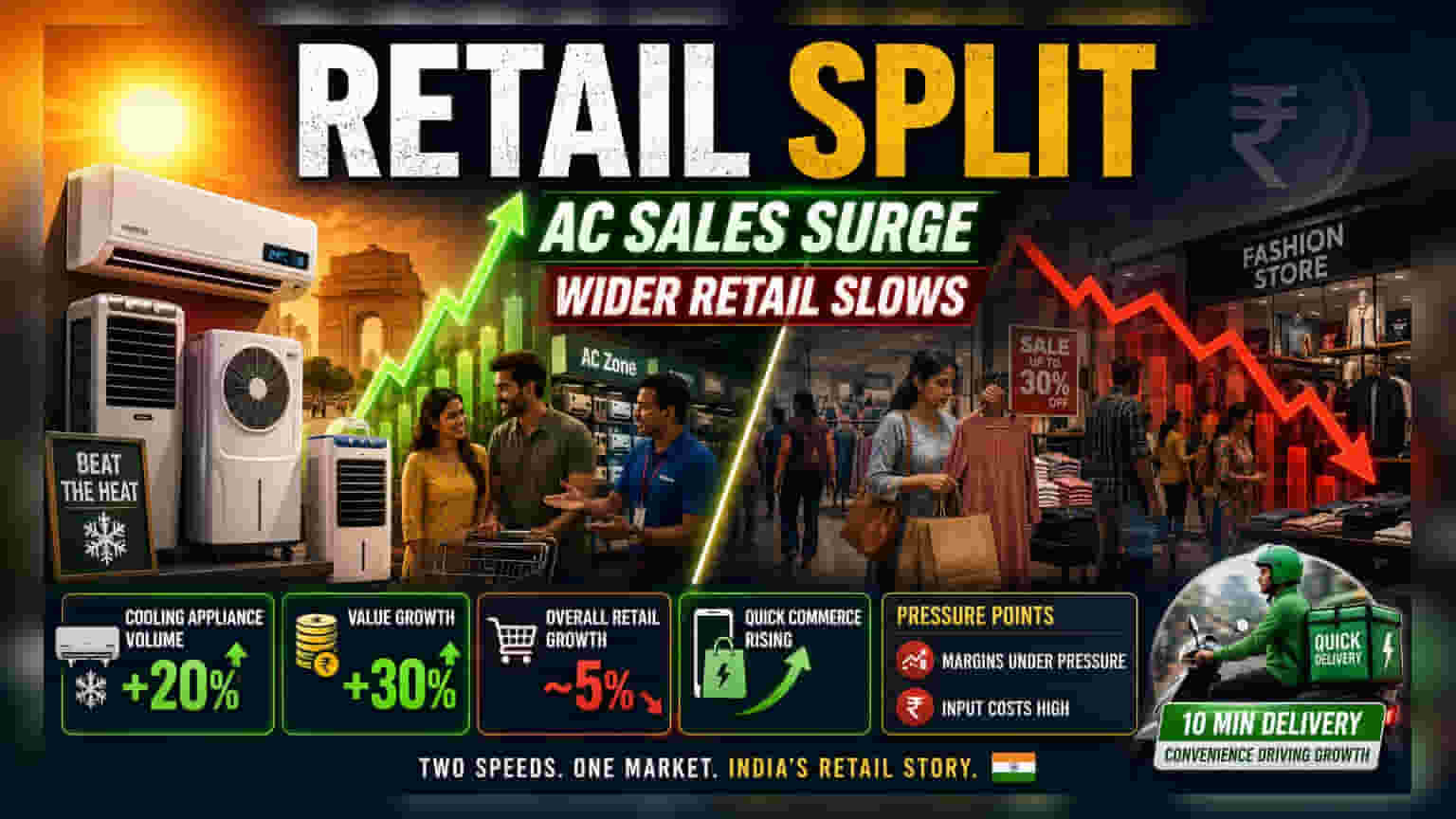
Air conditioner and cooler sales have jumped, with values up 30% due to an extended heatwave. However, the broader retail sector is slowing, with sales growth moderating to 5% in May. Retailers face rising input costs and margin pressure, while quick commerce continues to capture a larger share of the FMCG market.
What Happened
India’s retail sector is currently witnessing a two-speed performance. While cooling appliances are seeing a massive demand boost due to an extended heatwave and a delayed monsoon, the wider retail industry is experiencing a slowdown. Data indicates that sales for air conditioners and air coolers grew by approximately 20% in volume and 30% in value this season. In contrast, the Retailers Association of India (RAI) reported that overall retail sales growth dropped to about 5% in May, down from the 9-10% seen in previous months.
The Cooling Appliance Boom
The surge in air conditioner and cooler sales is a seasonal spike driven by extreme weather. This strong performance has been helped by a lower sales base from last year, which saw more intermittent rain. While cooling appliances led the growth, other electronics also saw demand, though often driven by price increases rather than pure volume growth. Laptops have become 30-35% more expensive in the last three months due to global chip shortages, while television prices have risen by 7-10% for smaller screens.
Margin Pressure and Retail Headwinds
Despite resilient consumer spending, retailers are finding it difficult to maintain profit margins. The industry is grappling with higher costs for essential inputs such as cotton, synthetic materials, and packaging. These increased operational expenses are eating into profitability even as footfall remains steady. The Retailers Association of India noted that the recent retail slowdown is also tied to factors like fewer weekend shopping days in June compared to last year and a shift in festival spending patterns that pulled some sales forward into May.
The Growth of Quick Commerce
Quick commerce has firmly established itself as a major pillar of the Indian retail sector. These platforms now account for about 13% of total e-commerce sales and roughly 6-7% of total FMCG sales. Consumers are increasingly prioritizing speed and convenience over price, forcing traditional retailers to reconsider their business models. Most major retailers are now focused on building integrated strategies that combine their physical stores with rapid online delivery capabilities to stay competitive.
What Investors Should Track
Investors may want to monitor several factors that could influence retail and consumer durable stocks in the coming months. First, the impact of the monsoon remains uncertain; a normal or delayed monsoon could affect rural consumption, which is a key driver for the broader retail sector. Second, the ability of companies to manage margin pressure is critical. If input costs for cotton, packaging, and raw materials remain high, companies may struggle to pass these costs on to price-sensitive consumers, potentially impacting their bottom lines. Finally, watching the growth rate of quick commerce and how traditional FMCG and retail companies adjust their strategies will be important for understanding long-term revenue sustainability.