 Whalesbook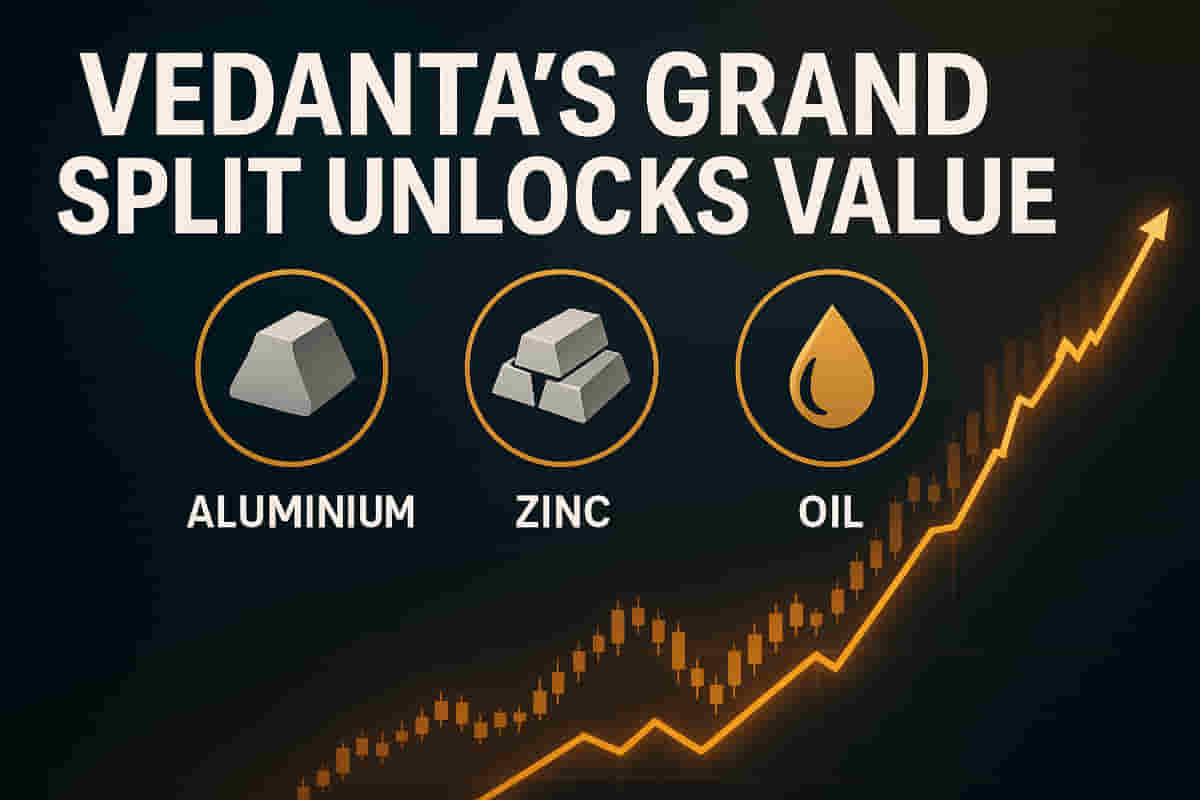


Vedanta Limited is on the verge of a major corporate restructuring, proposing to demerge its diverse business operations into four distinct, independently listed companies. This strategic initiative aims to enhance focus, attract segment-specific investors, and ultimately boost shareholder value.
The proposed demerger plan involves splitting Vedanta into separate entities for aluminium, zinc, energy, and metals. Under the scheme, every existing Vedanta shareholder will receive one additional share in each of the four newly formed companies upon completion. This move is viewed as a significant trigger for the stock, provided it secures the necessary approvals.
Demerger Details
- The plan seeks to create independent listed companies for aluminium, zinc, energy, and metals.
- The objective is to improve operational focus and attract investors interested in specific sectors.
- Shareholders are expected to receive one share in each new entity for their existing Vedanta shares.
- The process is contingent on final approval from the National Company Law Tribunal (NCLT) and government bodies.
- The timeline for completion has been extended, with Vedanta aiming for March 2026.
Demand Tailwinds
- Metals and minerals produced by Vedanta, such as aluminium, zinc, copper, and iron ore, are crucial inputs for India's burgeoning infrastructure sector.
- The growing demand from electric vehicles (EVs) and renewable energy equipment manufacturing also bodes well for the company.
- As India continues its push for economic development and energy transition, demand for these commodities is projected to remain robust.
Company Strengths
- Strong Diversification: Vedanta operates across a wide range of commodities including aluminium, zinc-lead-silver, oil & gas, iron ore, steel, copper, power, and critical minerals, reducing dependence on any single commodity cycle.
- Leadership Positions: The company holds leading positions in several segments, including being India's top aluminium producer and one of the largest private oil & gas producers in India. It also has a significant global presence through Hindustan Zinc.
- Growth Investments: Vedanta is undertaking one of the largest capital expenditure programs in the Indian metals sector, with expansions planned in aluminium, zinc, power, and critical minerals to drive future volume growth.
- Beneficiary of India's Growth: The company's products are integral to sectors like infrastructure, railways, roads, power transmission, EVs, and consumer electronics, directly linking it to India's accelerated capex cycle.
Financial Performance
- In the second quarter of FY26, Vedanta reported a consolidated revenue of Rs 398,680 million, an increase from Rs 376,340 million in the same period last year.
- However, the consolidated net profit saw a significant drop to Rs 34,800 million compared to Rs 56,030 million in the corresponding quarter of the previous fiscal year.
Future Outlook
- The ultimate success and potential value unlocking for Vedanta hinge significantly on the approval and successful execution of the demerger plan.
- Investors are advised to closely monitor the company's fundamentals, corporate governance practices, and the valuations of its stock as key considerations for due diligence.
Impact
- The demerger, if successful, could lead to substantial value unlocking for shareholders, potentially boosting the stock prices of both the parent company and the newly formed independent entities.
- Improved operational focus and specialized management for each business segment are expected to enhance efficiency and financial performance.
- The move could also make it easier for individual demerged businesses to access capital markets and pursue targeted growth strategies.
- Impact Rating: 8/10
Difficult Terms Explained
- Demerger: A corporate restructuring where a company divides its assets and operations into two or more separate and independent companies. Each resulting company is a distinct legal entity.
- Conglomerate: A large corporation formed by the merging of separate and diverse firms that operate in different industries. Vedanta is an example, with interests in mining, metals, oil, power, and more.
- Commodities: Raw materials or primary agricultural products that can be bought and sold, such as metals (aluminium, zinc, copper), oil, and agricultural goods. Their prices are subject to market fluctuations.
- Capex (Capital Expenditure): Funds used by a company to acquire, upgrade, and maintain physical assets such as property, buildings, technology, or equipment. It is an investment for future growth.
- Consolidated Revenue: The total revenue of a parent company and all of its subsidiaries, presented as a single financial statement. It includes revenue from all business units.
- NCLT (National Company Law Tribunal): A quasi-judicial body in India established to resolve corporate disputes and insolvency matters. It has the authority to approve significant corporate actions like demergers.