 Whalesbook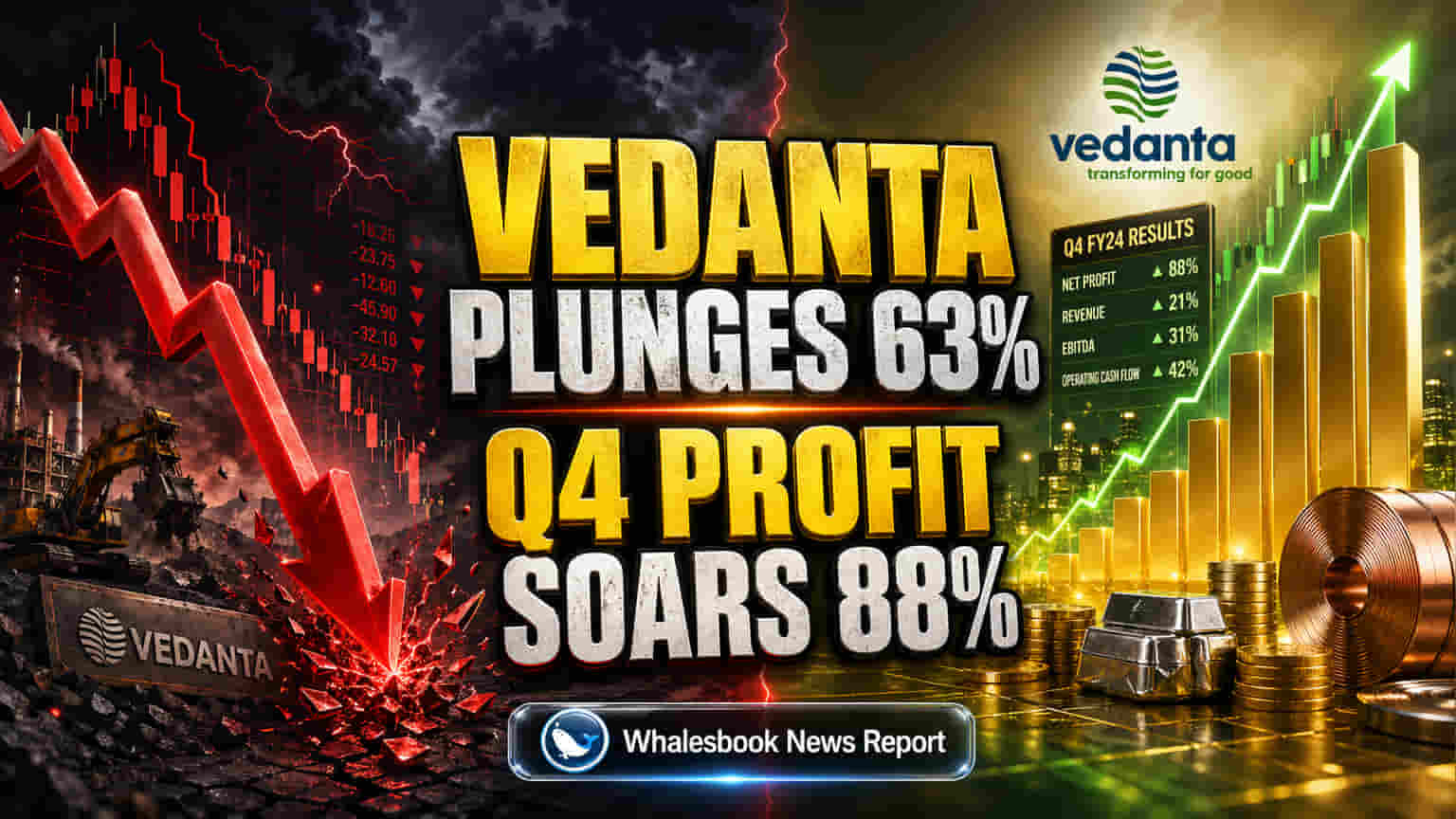


Strong Financials Set Stage for Restructuring
Vedanta reported its strongest-ever financial results for Q4 and full-year FY26, with record revenues and profits. This sets the stage for an ambitious business restructuring plan involving the demerger of its various business segments, a move aimed at unlocking shareholder value. However, the market's immediate reaction, including a significant price adjustment after the demerger announcement, shows investors weighing the strong financials against execution complexities and market conditions.
Demerger Announcement Hits Shares Despite Record Results
Vedanta's stock saw a sharp, technical decline on Thursday as it traded ex-demerger. The share price adjusted significantly to account for the upcoming distribution of shares in its demerged units, overshadowing the strong Q4 FY26 results. Even with revenue up 30.6% year-on-year to ₹52,851 crore and net profit soaring 88.5% to ₹9,352 crore for the quarter, the market focused on the strategic implications and potential execution challenges of the approved restructuring. The stock continued to trade lower even after the adjustment, signaling investor caution.
Vedanta's Performance, Peer Valuations, and Commodity Outlook
Vedanta's FY26 performance showed significant operational strength. Consolidated revenue hit ₹1,77,194 crore, up 15.8% year-on-year, while net profit after tax climbed 22.2% to ₹25,096 crore. The company also maintained its commitment to shareholder returns, declaring a ₹34 per equity share dividend for FY26. Operationally, Vedanta achieved record annual production in aluminium (2,456 kt) and zinc India mined metal (1,114 kt), with costs at multi-year lows.
However, a look at peer valuations shows a mixed picture. Vedanta's P/E ratio, approximately 15.36x-24.0x in April 2026, is higher than NMDC (10.4x-11.58x) and Coal India (8.96x-15.25x), and similar to or slightly above Hindalco (14.34x-14.92x). Vedanta's market capitalization was around ₹3.03 lakh crore on April 29, 2026, making it a large player like Coal India and Hindalco.
The Indian metals and mining sector is expected to gain momentum in 2026, driven by strong domestic demand, infrastructure spending, and policy support. However, global commodity prices face a volatile outlook. Copper is forecast to decline from record highs, averaging between $10,000-$11,000 per tonne in 2026, although some predict higher averages due to demand from AI infrastructure and the energy transition. Aluminium prices are also uncertain, forecast at $2,300-$2,750 per tonne for 2026, influenced by trade issues and new supply. Crude oil prices are a major wildcard. While some forecasts predict an average around $60/bbl based on supply-demand, geopolitical tensions, especially in the Middle East, have pushed predictions higher, with some analysts expecting Brent crude to average $90/bbl in Q4 2026 or even higher if supply shortages emerge. This commodity price volatility directly affects Vedanta's revenue and profits, particularly as its demerged entities will operate in these shifting markets.
Execution Risks and Potential Challenges for Demerged Units
While Vedanta's recent financial results show operational strength, the demerger introduces significant execution risks. Analysts note that the current performance relies heavily on favorable commodity prices rather than structural improvements, raising questions about earnings sustainability post-demerger. The market's subdued reaction to strong financials, focusing instead on the demerger's technical impact, highlights investor caution. The restructuring's success depends on how effectively each demerged entity navigates its market, manages debt, and seizes growth opportunities. Additionally, past operational or financial complexities common in diversified groups can present risks that emerge in separated entities. Increased scrutiny on individual units, their capital allocation, and financial independence could pose challenges, especially given sharp commodity price cycles. Unforeseen regulatory shifts or legal battles could further complicate the demerged entities' paths.
Outlook: Unlocking Value Amid Market Uncertainty
The demerger aims to unlock value by creating more focused, agile entities better positioned for growth and investment. Management sees the demerger as a catalyst for the next growth phase. However, the market's reaction suggests this value realization depends on successful execution amid global economic uncertainty and volatile commodity markets. Investors will closely watch the independent entities as they navigate their sectors, looking for confirmation that the separation translates into tangible, sustainable shareholder returns.