 Whalesbook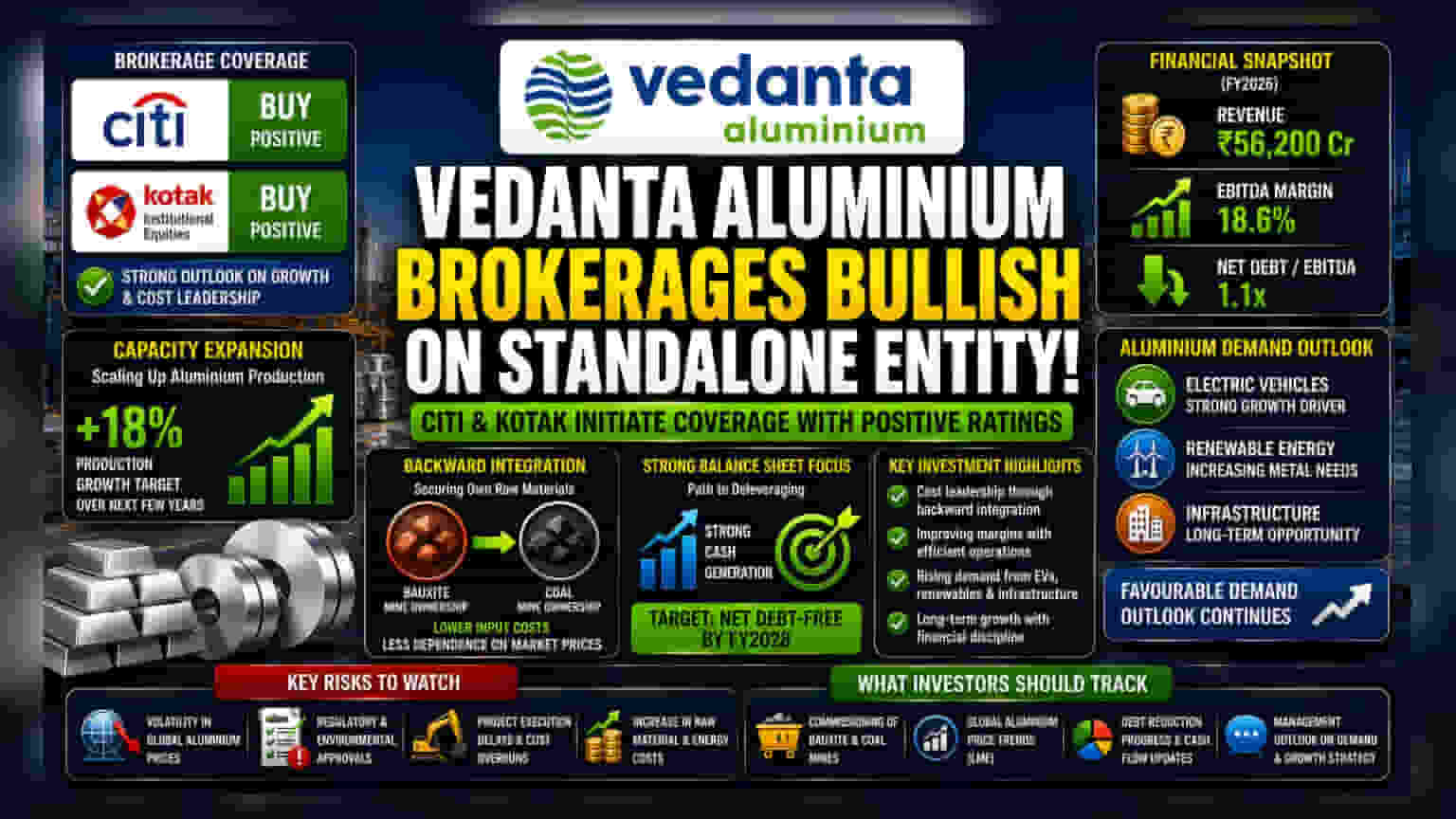
Brokerages like Citi and Kotak have started tracking Vedanta Aluminium following its demerger, highlighting its expansion plans and focus on lowering raw material costs. Analysts see potential in the company’s push to become debt-free by 2028. Investors should note that while cost efficiency is a strength, the company’s performance remains sensitive to global aluminium price swings and the successful launch of its new mining projects.
What Happened
Vedanta Aluminium, following its demerger into a standalone entity, has recently attracted the attention of major brokerage firms. Both Citi and Kotak Institutional Equities have initiated coverage on the company with positive ratings. These reports focus on the company's position as a major aluminium producer and its strategy to increase production capacity while simultaneously lowering operational expenses through new mining projects.
The Investment Angle
Analysts are primarily focused on the company’s strategy to control its input costs. A major part of the investment case centers on "backward integration." This means the company is working to secure its own sources of raw materials—specifically bauxite and coal—rather than relying on external suppliers. By mining its own raw materials, the company aims to reduce its reliance on market-linked fuel and mineral prices, which can be volatile. Analysts expect this move to significantly improve the company’s cost structure, potentially allowing it to maintain better profit margins even if global aluminium prices fluctuate.
The Financial Picture
Beyond cost management, the brokerage reports highlight a strong focus on the company’s balance sheet. Analysts have noted the company’s potential to improve its financial health significantly over the next few years. The projection from these reports suggests that with strong cash generation, the company could work toward becoming net debt-free by fiscal year 2028. This potential deleveraging—the process of paying down debt—is a key monitorable for investors, as it would likely provide the company with more financial flexibility for future growth or shareholder returns.
Risks and Context for Investors
While the brokerage outlook highlights several potential benefits, investors should consider the broader context of the commodity sector. Aluminium is a cyclical commodity, meaning the company’s revenue and profitability are heavily dependent on global aluminium prices, which are determined by supply and demand on the London Metal Exchange.
Furthermore, the success of the current growth strategy depends heavily on execution. The plan to lower costs relies on the timely commissioning of new bauxite and coal mines. Any delays in regulatory approvals, land acquisition, or project construction could result in cost overruns or force the company to continue relying on costlier external suppliers for longer than planned. Additionally, as with any mining and metal processing operation, environmental regulations and social impact assessments remain critical factors that can impact timelines and operational continuity.
What Investors Should Track Next
Investors may want to monitor several key indicators to assess the company’s progress. First, the timeline for the commissioning of the new bauxite and coal mines is essential, as this is the primary driver of the expected cost savings. Second, global aluminium price trends will remain the single largest factor influencing quarterly earnings. Third, updates on debt repayment progress in upcoming quarterly reports will be important to see if the company is on track to meet its deleveraging goals. Finally, management commentary regarding demand from key sectors like electric vehicles and renewable energy will provide insight into whether the global market continues to support the positive demand outlook cited by analysts.

