 Whalesbook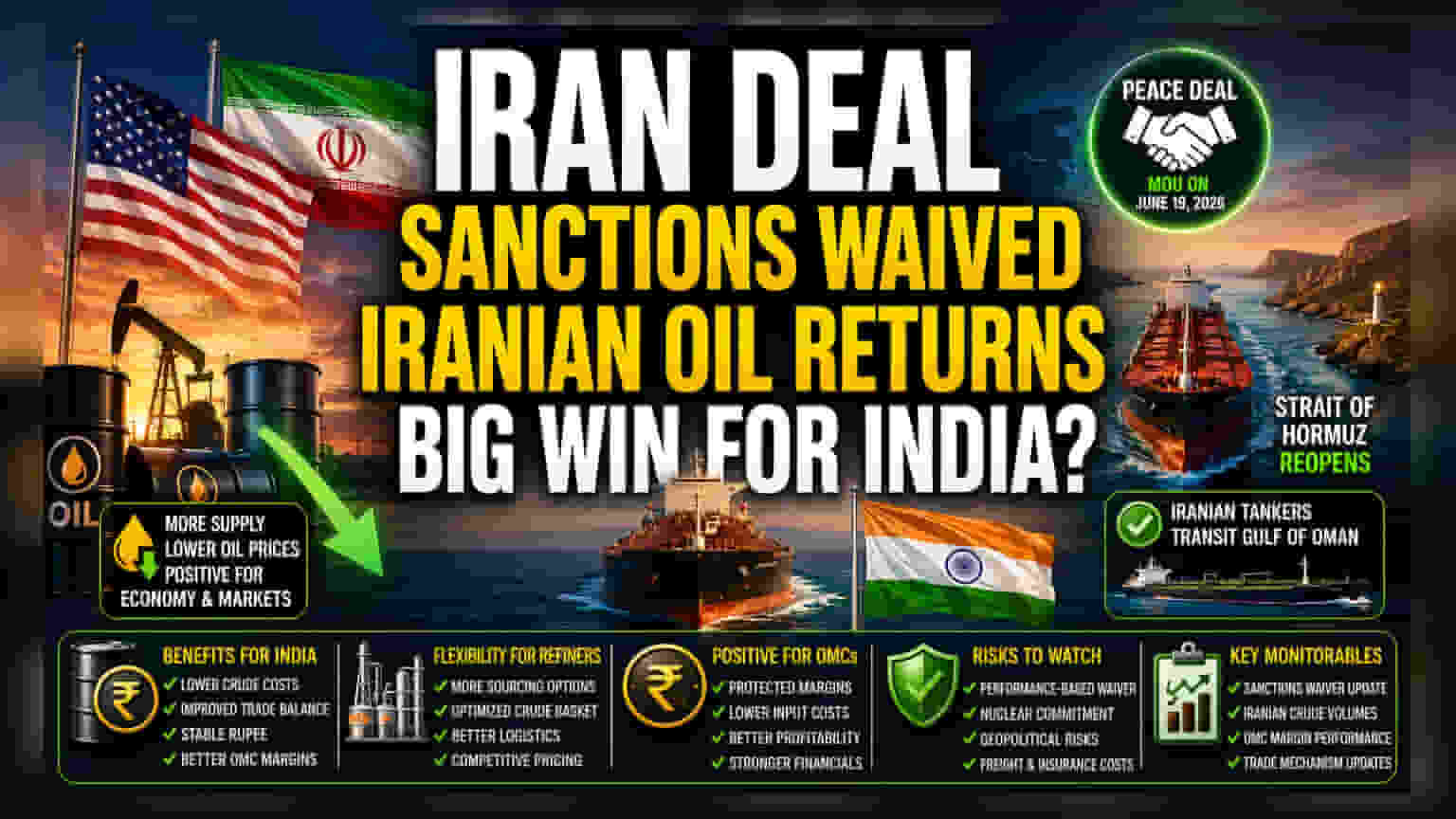


The US-Iran peace framework and potential easing of oil sanctions could reshape India's energy sourcing. As Iran potentially re-enters the global market, Indian Oil Marketing Companies like IOC, BPCL, and HPCL may see benefits from diversified supply and better freight economics. Investors are now watching how this geopolitical shift influences crude prices and national import bills.
What Happened
Following a breakthrough framework agreement to end hostilities, the United States and Iran have moved toward a peace deal, including a memorandum of understanding (MOU) set for signing on June 19, 2026. A key outcome of this development is the reported waiving of US sanctions on Iranian crude oil and fuel exports. Shipping data has already confirmed that Iranian tankers have begun transiting the Gulf of Oman, signaling an initial return of Iranian supply to the global energy market. This deal also includes the reopening of the Strait of Hormuz, a critical maritime corridor through which a significant portion of the world's energy trade passes.
Why This Matters for Investors
For India, which imports over 85% of its crude oil requirements, this is a significant development. Historically, Iran was one of India's top three crude oil suppliers, providing competitive pricing and favorable credit terms before sanctions halted these imports in 2019. The potential return of Iranian crude offers Indian refiners and Oil Marketing Companies (OMCs) like Indian Oil Corporation (IOC), Bharat Petroleum Corporation Limited (BPCL), and Hindustan Petroleum Corporation Limited (HPCL) more sourcing flexibility.
Lower crude prices, driven by an increase in global supply, typically act as a positive trigger for OMCs. Stability in crude costs helps protect marketing margins, which are often squeezed when global oil prices spike. Furthermore, reduced reliance on other specific regions for energy imports can help India improve its trade deficit, as every significant drop in the crude oil import bill supports the national fiscal position and helps stabilize the Indian rupee.
The Energy Diversification Angle
In recent years, India has been actively diversifying its oil import mix to reduce reliance on any single supplier or corridor. The return of Iranian supply allows Indian refiners to optimize their crude basket. Historically, Iranian crude has been attractive not just for its quality but also for the logistical advantage it offers to Indian ports compared to shipments from longer distances. For businesses involved in the energy supply chain, having an additional large-scale supplier can mitigate the impact of supply shocks or geopolitical bottlenecks elsewhere.
What Could Go Wrong
While the market reaction to the potential supply increase has been positive, investors should remain cautious about the conditional nature of the deal. Officials have indicated that the sanctions waiver is performance-based, meaning it is tied to Iran adhering to specific commitments, including the suspension of nuclear weapon development and maintaining the free flow of navigation in the Strait of Hormuz. Any reversal in geopolitical relations or a failure to uphold these terms could lead to a quick re-imposition of restrictions. Additionally, while the Strait of Hormuz is reopening, shipping and war-risk insurance premiums may take time to normalize, meaning freight costs could remain a variable for some time.
What Investors Should Track
Moving forward, the primary monitorables for investors will be the official implementation of the sanctions waiver and the volume of Iranian crude actually arriving at Indian ports. Investors may also watch the quarterly margin performance of OMCs to see if the easing of crude prices translates into better profitability. Furthermore, any updates on bilateral trade mechanisms—such as past rupee-based payment systems that facilitated trade during previous sanctions—will be crucial for understanding how smoothly these imports can be processed.