

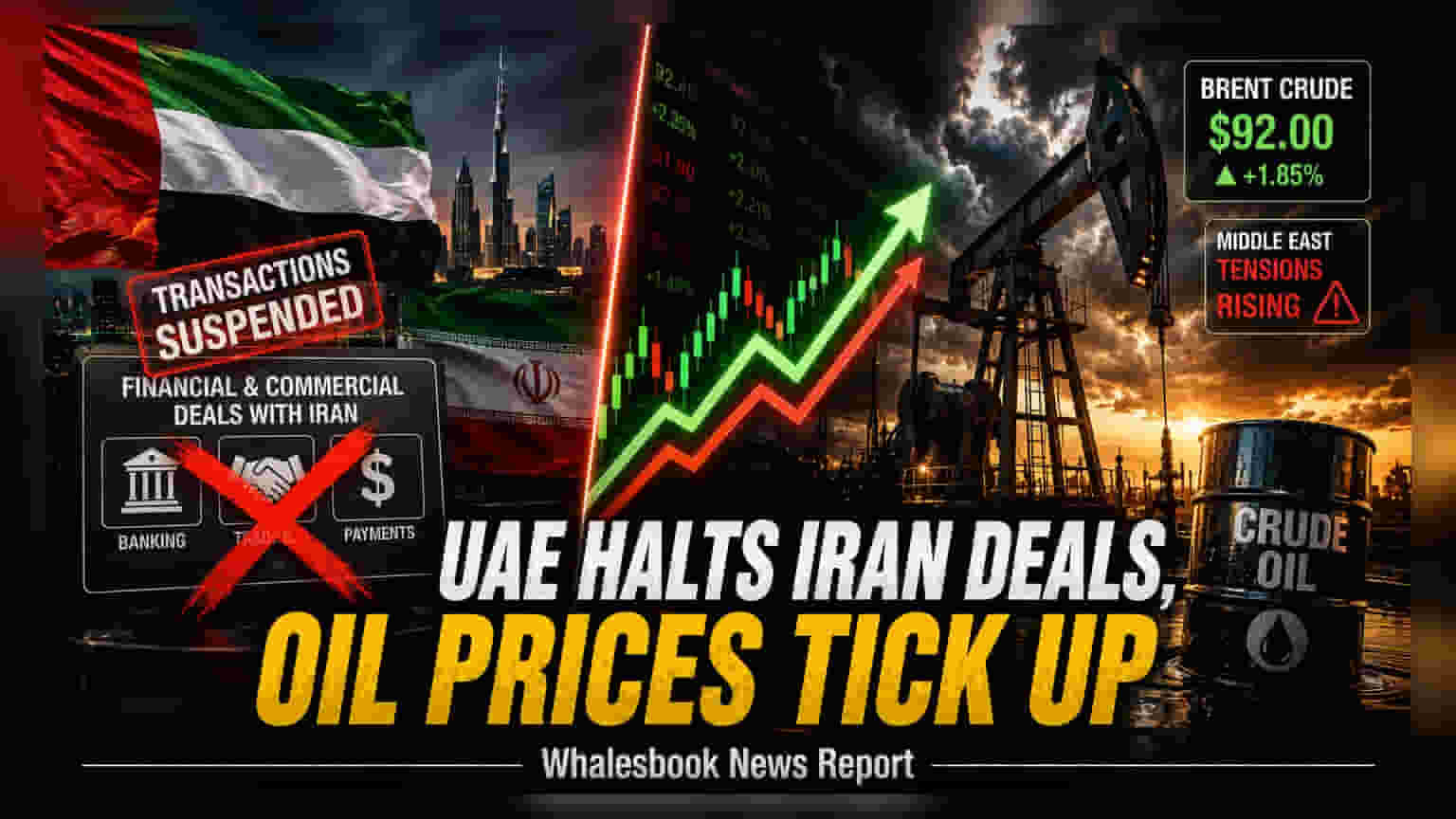
The United Arab Emirates has suspended all commercial and financial transactions with Iran following missile threats. While global oil benchmarks rose due to geopolitical concerns, Indian domestic contracts on the MCX traded lower. Investors are weighing this supply-side uncertainty against a recent increase in U.S. crude inventory levels.
The United Arab Emirates has announced an immediate suspension of all commercial and financial transactions with Iran, citing military escalation after reported ballistic missile launches. The news triggered a rise in global energy prices on Thursday, with Brent crude futures trading around $92 a barrel, as markets reacted to the potential for instability in the Middle East.
Geopolitical Risks in the Strait of Hormuz
The move by the UAE introduces uncertainty to the energy sector, particularly due to the proximity of the Strait of Hormuz. This narrow waterway is one of the world's most critical oil transit routes. Market participants are watching for any disruption to tanker traffic, which could constrain global oil supply and keep energy prices elevated. This anticipation of supply-chain pressure is currently supporting prices, as traders add a risk premium to crude oil contracts.
Divergence Between Global and Indian Markets
While international Brent and WTI futures saw gains, Indian domestic crude oil contracts on the Multi Commodity Exchange (MCX) displayed a different trend. September and October crude futures on the MCX traded lower throughout the morning session. This divergence highlights how domestic commodity markets sometimes react differently to global benchmarks, often influenced by factors like currency fluctuations, local trading volumes, and specific supply-demand expectations among regional traders.
Balancing U.S. Inventory Data
The upward momentum in global prices was tempered by the latest report from the U.S. Energy Information Administration (EIA). Data released for the week ending August 14 showed an increase of 4.4 million barrels in U.S. commercial crude oil inventories. This suggests that supply remains relatively available in the world's largest consumer market, providing a counter-balancing effect to the geopolitical tensions in the Middle East.
For investors, the immediate environment is complex. The critical factor to track will be the stability of maritime transit in the region and whether diplomatic channels can de-escalate the situation. Investors may also continue to monitor U.S. crude inventory reports and production data, as these figures often serve as a gauge for how well global supply is meeting demand.