 Whalesbook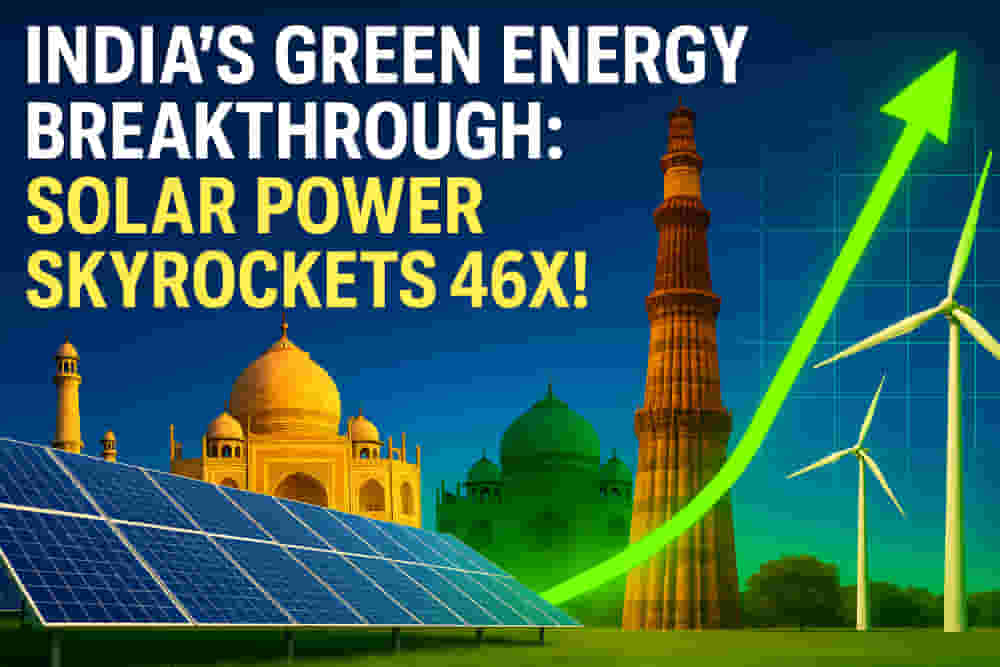
India's Renewable Energy Leap: Minister Goyal Details Record Growth and Global Leadership
Commerce Minister Piyush Goyal announced remarkable achievements in India's green energy sector, highlighting a monumental 46-fold increase in solar power capacity over the last eleven years. This significant growth underscores India's successful transition from a state of power scarcity to one of power security and sustainability. The minister emphasized that this transformation is the result of a clear national vision and sustained governmental efforts.
Solar and Wind Power Surge
India has firmly established itself as the world's third-largest producer of solar power. The nation's journey towards renewable energy dominance is further evidenced by a substantial 2.5-fold increase in wind power capacity, which has grown from 21 gigawatts in 2014 to an impressive 53 gigawatts by 2025. This expansion signifies a robust commitment to harnessing clean energy sources.
Diversification in Energy Infrastructure
Beyond solar and wind, India has emerged as the fourth-largest global refining hub, actively working to boost its refining capacity by an additional 20 percent. The country's natural gas infrastructure is also expanding, with 25,923 kilometers of natural gas pipelines now operational out of a total of 34,238 kilometers authorized. In the coal sector, India recorded its highest-ever production of 1,048 million tonnes in the fiscal year 2025, concurrently reducing coal imports by approximately 8 percent.
Nuclear Energy and Green Hydrogen Future
Looking ahead, the proposed Sustainable Harnessing and Advancement of Nuclear Energy for Transforming India Bill, 2025 (SHANTI Bill), currently before Parliament, aims to significantly propel nuclear energy development. This legislation is designed to encourage both public and private sector participation, including public-private partnerships, and promote the widespread adoption of small modular reactors. These advanced reactors are expected to help eliminate power cuts and increase the renewable energy mix. The National Green Hydrogen Mission is another key initiative, targeting the production of 5 million tonnes per year by 2030, with the goal of reducing fossil fuel imports by over ₹1 lakh crore.
Sustainable Energy Pillars and Global Responsibility
Minister Goyal outlined India's power sector strategy, built on five core pillars: universal access, affordability, availability, financial viability, and sustainability, coupled with global responsibility. India holds the distinction of being the first G20 nation to achieve the objectives set forth by the Paris Agreement. Currently, 50 percent of the country's installed power capacity is derived from non-fossil fuel sources, a testament to its progressive energy policies and commitment to a greener future as it approaches its 100th year of Independence in 2047.
Impact
This comprehensive push towards renewable and sustainable energy sources is set to profoundly impact India's economic landscape. It enhances energy independence, reduces reliance on volatile fossil fuel markets, and attracts substantial domestic and international investment into the energy sector. The growth in solar, wind, and nuclear power, supported by initiatives like the Green Hydrogen Mission, promises greater energy security, potentially lower energy costs for consumers and industries, and significant job creation. It positions India as a key player in the global fight against climate change, enhancing its geopolitical standing. The positive trajectory of the renewable energy sector suggests significant growth opportunities for companies operating within it.
Impact Rating: 9/10
Difficult Terms Explained
- Solar power capacity: The maximum amount of electricity a solar power system can generate.
- Renewable energy: Energy derived from natural sources that replenish themselves over time, such as solar, wind, and hydro power.
- Power surplus: A situation where the electricity generated exceeds the demand.
- SHANTI Bill: A proposed legislation in India aimed at boosting nuclear energy development and adoption.
- Small modular reactors (SMRs): Compact, factory-built nuclear reactors designed for easier deployment and enhanced safety features, intended to supplement large nuclear power plants.
- National Green Hydrogen Mission: A government program to promote the production and adoption of green hydrogen, a fuel produced using renewable energy, to reduce fossil fuel dependency.
- Paris Agreement: An international treaty adopted by many countries to limit global warming by reducing greenhouse gas emissions.
- Non-fossil fuel sources: Energy generation methods that do not rely on burning fossil fuels like coal, oil, or natural gas; includes solar, wind, nuclear, and hydro power.