 Whalesbook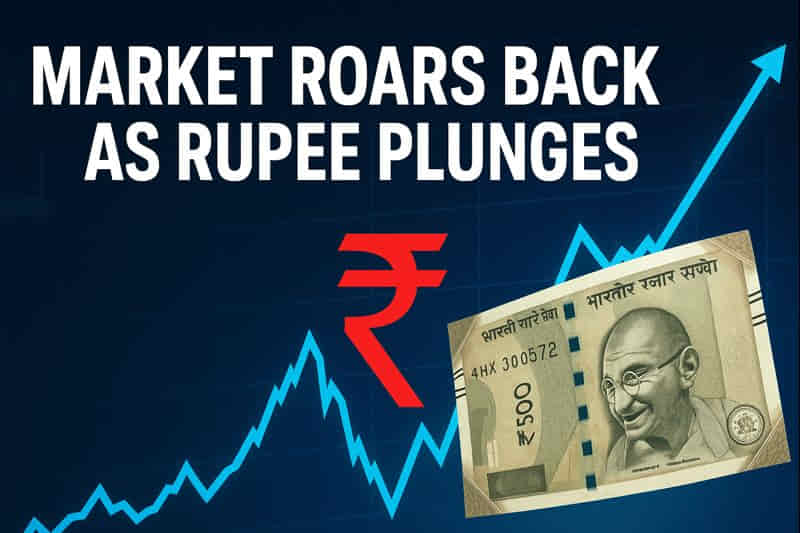
Market Resilience Amidst Currency Woes
Indian equity markets demonstrated remarkable resilience on Monday, staging a strong comeback from sharp intraday declines to end largely flat. The benchmark S&P BSE Sensex concluded the trading session down by 54 points at 85,213, while the Nifty 50 index registered a marginal dip of 20 points, settling at 26,027. This performance halted a two-session rally and highlighted a tug-of-war between supportive sector-specific actions and broader market pressures.
Banking and IT Stocks Lead the Charge
Gains in banking stocks played a crucial role in cushioning the market's fall. The Nifty Bank index climbed 72 points, ending at 60,213, with notable advances from IDFC First Bank, Federal Bank, and AU Small Finance Bank. Simultaneously, information technology (IT) shares recovered from early weaknesses. This rebound was significantly influenced by the Indian rupee's sharp depreciation.
Rupee Hits All-Time Low Against Dollar
The Indian rupee plunged to a fresh record low against the US dollar, trading at 90.79. This currency weakness provided a tailwind for IT exporters, whose earnings are often boosted by a weaker rupee when converted back into local currency. Coforge, an IT services firm, saw its stock price rebound by approximately 2% from its session lows, reflecting this dynamic.
Midcap and Broader Indices Underperform
In contrast to the large-cap resilience, the broader market segments faced selling pressure. The midcap index shed 71 points, indicating ongoing profit-taking in certain mid-sized companies. This divergence suggests that investor sentiment was mixed, with large-cap stability being supported by specific sectors rather than widespread optimism.
Notable Individual Stock Movements
Several individual stocks captured investor attention with significant price action. Amber Enterprises surged 3% following positive commentary from its management and a favorable brokerage report. InterGlobe Aviation, the parent company of IndiGo, rose 2% after announcing operational efficiency, having conducted 2,050 flights on December 13 with no cancellations, assuaging concerns over recent service disruptions.
However, not all stocks experienced positive momentum. Urban Company shares declined 4% as a shareholder lock-in period expired. Matrimony.com saw its stock slide over 5% after its board approved a share buyback program for up to 893,000 shares at ₹655 each. Vascon Engineers was a bright spot in construction, gaining 3% after securing a significant order worth ₹260 crore from the Navi Mumbai Municipal Corporation.
Other Key Stock Performances
Hindustan Zinc continued its strong upward trend, marking a 15% gain over the past five trading sessions. Vodafone Idea's stock, however, fell more than 2% despite reports of potential adjustments to its adjusted gross revenue dues. Wakefit, a home furnishings company, had a subdued market debut, closing its first trading day down over 3%. Geojit Financial Services experienced a sharp jump of 8% amid substantial trading volume, with approximately 15% of its equity changing hands in a block deal. KEC International added 2% to its value, having won orders totalling ₹1,150 crore for its transmission, distribution, and civil engineering divisions in India.
Impact
The market's ability to recover from intraday lows indicates underlying investor demand, particularly in sectors like banking. However, the record low for the rupee poses a dual challenge and opportunity: it benefits export-oriented IT firms but could fuel inflation and increase import costs for various industries. The continued pressure on midcaps suggests caution among some investors, who may be reallocating capital towards more stable large-cap names or specific growth stories. The performance of these sectors and currency movements will be closely watched for future market direction.
Impact Rating: 7/10
Difficult Terms Explained
- Benchmark Indices: Major stock market indexes that represent the overall market's performance (e.g., Sensex, Nifty 50).
- Midcap Index: An index tracking the performance of medium-sized companies in the stock market.
- Profit-Taking: The act of selling an asset after its price has risen to secure profits.
- Depreciation: A decrease in the value of a currency relative to another currency.
- Block Deal: A large transaction of shares that occurs privately between two parties, often outside the regular stock exchange.
- Adjusted Gross Revenue (AGR): A revenue-sharing model used in India's telecom sector.