

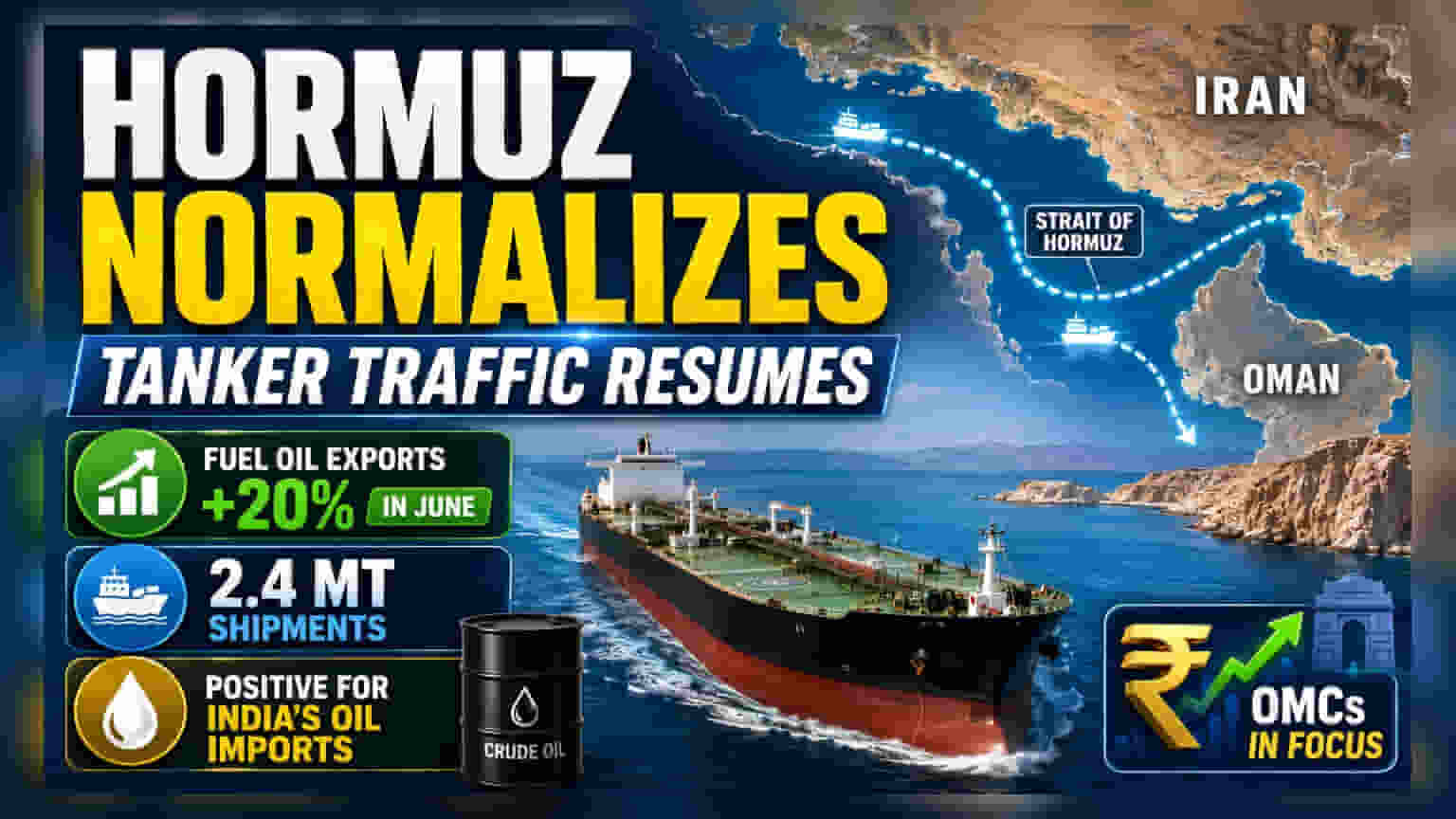
Middle Eastern fuel oil exports have climbed over 20% as the Strait of Hormuz reopens after 100 days of disruption. While this provides some relief to global supply chains, export volumes remain well below pre-conflict averages. Indian investors should monitor how this affects crude oil prices and the profit margins of Oil Marketing Companies (OMCs), given the limited nature of the current recovery.
What Happened
The Strait of Hormuz is returning to normal operations after more than 100 days of significant disruption. Tanker traffic has resumed, and Middle Eastern fuel oil exports are projected to hit a four-month high this month. Data indicates that export volumes are set to reach approximately 2.4 million metric tons in June, marking an increase of over 20 percent compared to May. This rise is attributed to increased shipments passing through the strait, alongside active supply diversions from key producers like Iraq and Saudi Arabia, which are utilizing alternative routes to maintain export levels.
Why It Matters For Indian Investors
For Indian investors, the Strait of Hormuz is a critical artery for energy security, as a large portion of India’s crude oil imports pass through this route. Any disruption typically creates uncertainty in global oil prices. The resumption of traffic may help ease supply-side concerns, which is generally viewed as a positive for oil-importing nations like India.
Lower or stabilized crude oil prices can improve the operating environment for Indian Oil Marketing Companies (OMCs) such as Indian Oil Corporation (IOCL), Bharat Petroleum (BPCL), and Hindustan Petroleum (HPCL). When global oil supply is stable, these companies face less volatility in their raw material costs. If the supply increase leads to more stable or lower crude prices, it may support the marketing margins of these companies, provided they can pass on the benefits or maintain retail pricing at favorable levels.
The Reality of Supply Recovery
While the reopening is a step forward, it is important for investors to temper expectations. The projected export volume of 2.4 million metric tons remains significantly lower than the pre-conflict monthly average of 5.5 million to 6.0 million tons. Experts have indicated that this recovery is unlikely to be substantial or immediate.
Furthermore, persistent issues such as banking and payment challenges related to Iranian trade, along with tight regional supply balances, are expected to limit the scale of the export rebound. With the onset of peak summer demand, the market may struggle to see a major surplus, meaning the impact on global oil prices could be moderate rather than dramatic. Investors should avoid assuming this event alone will lead to a sharp decline in oil prices.
What Investors Should Track
Moving forward, the primary monitorable for investors is the trend in global crude oil benchmarks, such as Brent Crude. A sustained return to normal shipping volumes would be a positive signal. Investors should also watch the quarterly commentary from Indian OMCs regarding their gross refining margins and under-recoveries, as these will directly reflect the impact of global supply and pricing changes. Finally, geopolitical developments in the region remain a key variable that could influence supply stability in the coming months.