

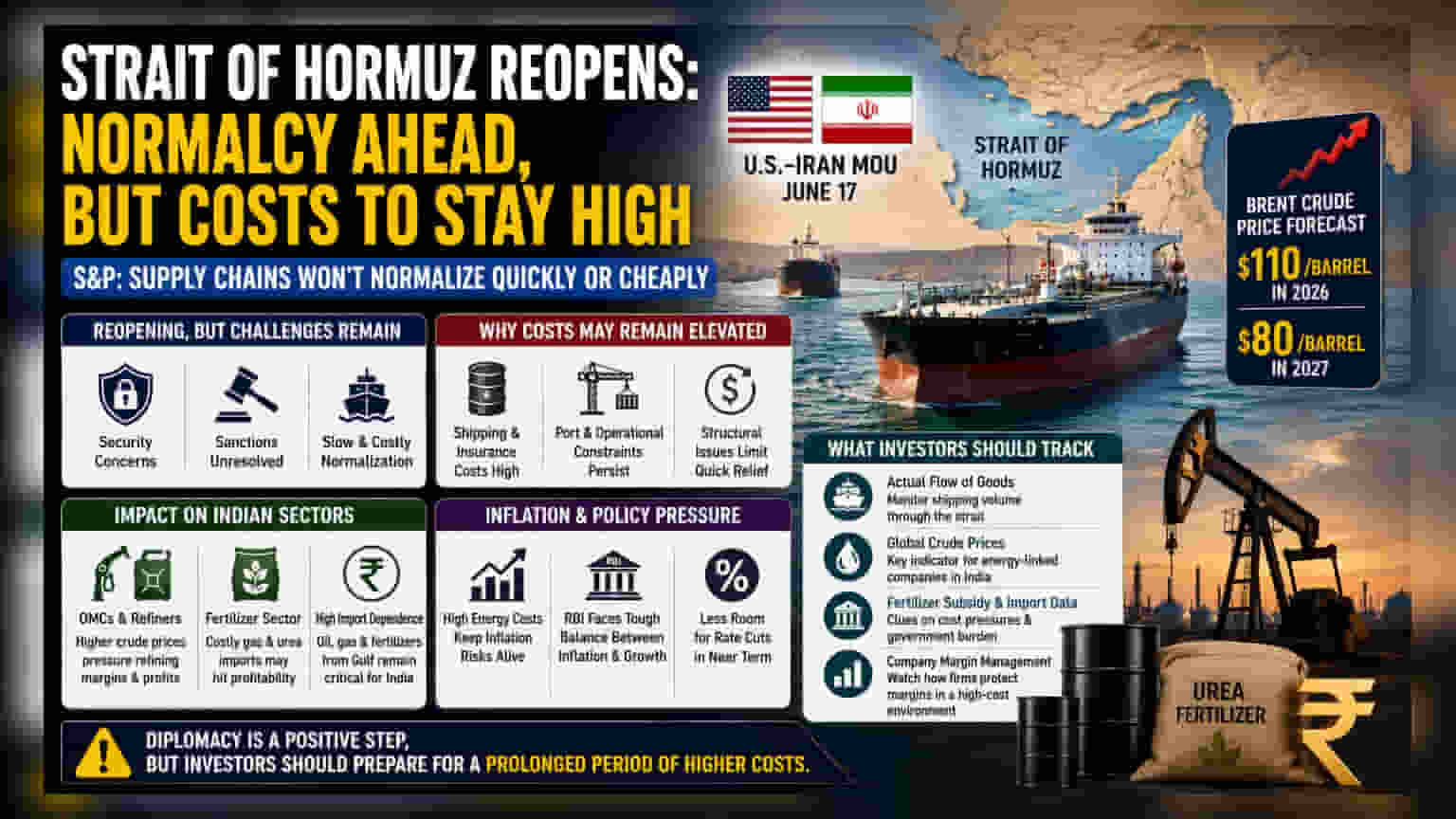
The reopening of the Strait of Hormuz, following a US-Iran agreement, is unlikely to bring immediate price relief, according to S&P Global Ratings. For Indian investors, this suggests continued pressure on energy and fertilizer import costs. With Brent crude forecast to average $110 per barrel in 2026, companies relying on these imports face lingering margin and inflation risks.
What Happened
The Strait of Hormuz is beginning to reopen following a memorandum of understanding (MOU) between the United States and Iran on June 17. While this development is a positive diplomatic step for global trade, S&P Global Ratings has cautioned that the normalization of supply chains will be neither quick nor inexpensive. The agency notes that critical issues, such as security concerns and existing sanctions, remain unresolved, which could prevent a smooth return to pre-conflict operations.
Why Costs May Remain Elevated
Investors should note that the reopening does not mean an immediate drop in energy prices. S&P Global Ratings has projected Brent crude prices to average $110 per barrel in 2026, only declining to $80 in 2027. This forecast suggests that even with increased access to the strait, structural constraints in shipping, insurance, and port operations will likely keep input costs high for some time. For businesses and consumers, this means that energy and freight costs may not drop as quickly as the headline news might suggest.
Impact on Indian Sectors
India is highly dependent on imports from the Gulf region for critical commodities, including crude oil, natural gas, and fertilizers. This makes the country particularly sensitive to any delays in shipping through the Strait of Hormuz.
Oil Marketing Companies (OMCs) and industries relying on imported fuel are likely to monitor these developments closely. If crude prices remain elevated, as predicted by the agency, these companies may continue to face pressure on their refining margins and profitability. Similarly, the fertilizer sector, which relies heavily on gas-linked nitrogen and imported urea from Gulf suppliers, could face ongoing supply chain volatility. If the cost of these raw materials remains high, it can impact the production costs for local manufacturers and potentially increase the government’s subsidy burden.
Inflation and Policy Pressure
Beyond specific industries, the cost of energy affects the broader economy. High input prices can act as a hurdle for manufacturing and logistics, impacting the final prices of goods. For the Reserve Bank of India (RBI), the situation creates a difficult balance. If energy prices remain high, it keeps inflation concerns alive. Policymakers must then navigate the trade-off between keeping interest rates tight to manage inflation and supporting economic growth. A prolonged period of expensive energy could limit the room for any monetary policy relief.
What Investors Should Track
Investors may look for updates on three key areas in the coming months. First, the actual flow of goods through the strait, which will indicate if operational bottlenecks are clearing. Second, the movement of global crude oil prices, which serves as a benchmark for energy-linked companies in India. Third, any updates on government fertilizer subsidies and import data, which will provide clues on how domestic manufacturers are coping with raw material costs. Observing how companies manage their operational margins in this environment will be essential to understanding their long-term performance.