

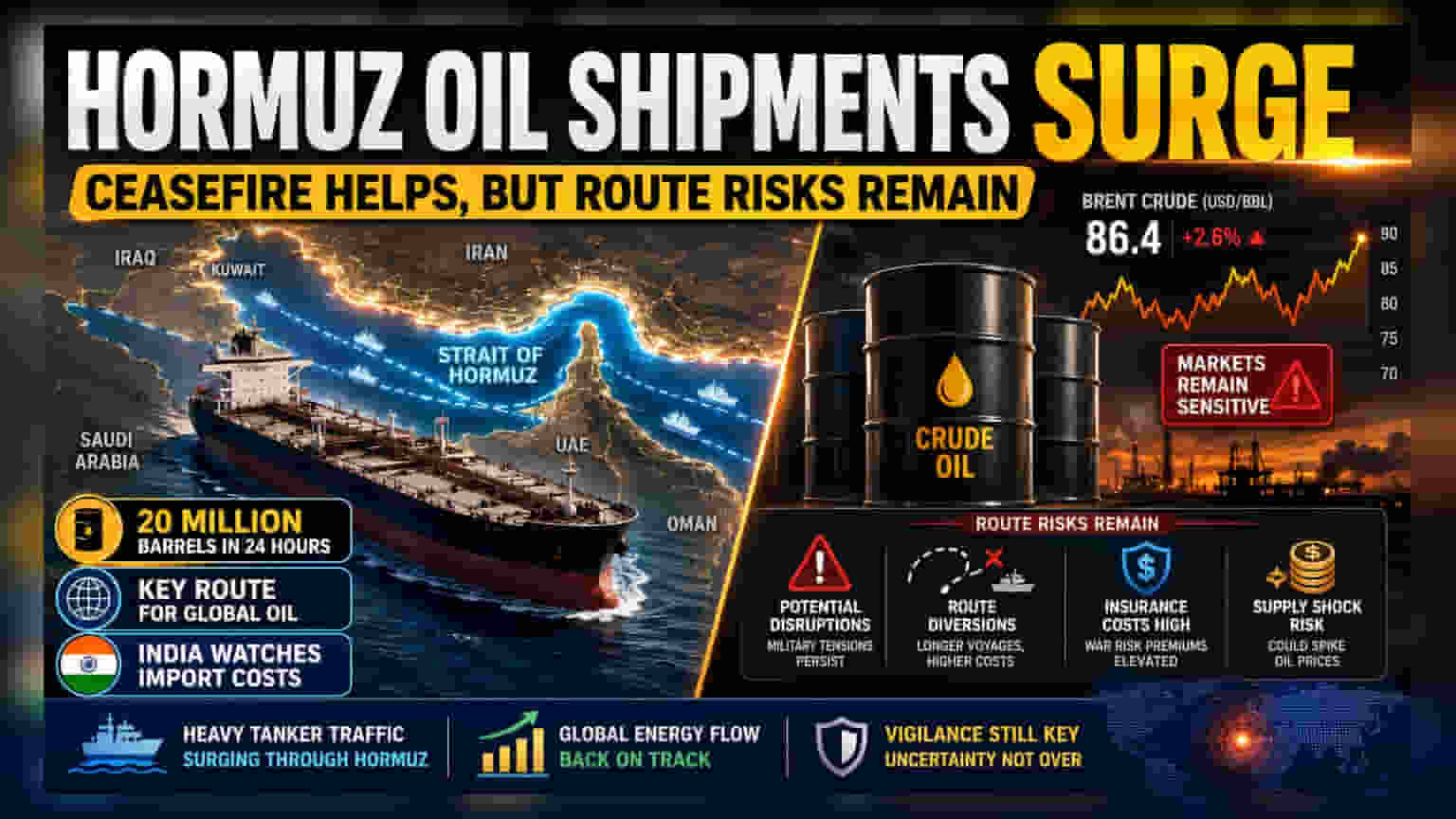
Crude oil shipments through the Strait of Hormuz have reached their highest level since February following a recent ceasefire. However, concerns persist over safety in the central waterway and new route controls enforced by Iran. As this region handles one-fifth of global oil consumption, the supply chain instability is a critical monitorable for Indian energy markets and import costs.
What Happened
Crude oil shipments passing through the Strait of Hormuz have surged this week, marking the highest volume since the regional conflict escalated in February. According to reports, approximately 20 million barrels of crude exited the strait in a single 24-hour period, a figure that US Energy Secretary Chris Wright noted represents about one-fifth of daily global oil consumption. This increase follows a recent ceasefire agreement that has partially reopened the key waterway. Data from Kpler shows a daily uptick in tanker traffic, though the overall volume of vessels remains below the pre-conflict average of 125 ships per day.
Why the Route Risk Matters
The Strait of Hormuz is a vital chokepath for global energy supplies. While the immediate ceasefire has allowed for a resumption of some trade, the operational environment remains unstable. Shipping traffic is not returning to standard patterns. Instead of utilizing the central waterway—which is reportedly unusable due to the risk of underwater mines—vessels are currently navigating closer to the Omani coastline. This shift in routing and the potential for restricted access to the central channel introduce delays and operational inefficiencies for global oil logistics.
Navigational Challenges and Operational Costs
Operational risks have intensified due to new demands from Iranian authorities. The Revolutionary Guards have stated that safe passage is now contingent on vessels using specific routes designated by Tehran. Reports have surfaced of tankers being instructed to alter their courses to adhere to these northern Iranian routes, with some vessels even performing u-turns after attempting to transit through Omani-side waters. These navigation disputes, combined with the presence of a UN-led evacuation scheme for vessels trapped in the Gulf since June 23, suggest that shipping lanes remain subject to high levels of uncertainty. The inability to use optimal routes may also impact shipping insurance costs and fuel efficiency for tankers.
What This Means for Indian Investors
India remains highly dependent on crude oil imports from the Middle East. Any disruption to the supply chain through the Strait of Hormuz can have direct implications for Indian Oil Marketing Companies (OMCs) like IOCL, BPCL, and HPCL. If shipping routes become restricted, unreliable, or more expensive to traverse, it could add a premium to the cost of landing crude oil in India. While domestic fuel pricing mechanisms are often managed by the government, sustained supply chain volatility can pressure the margins of refining companies and increase the country's import bill. Investors should also watch for any impact on upstream companies like ONGC and Oil India, as global oil price benchmarks like Brent are highly sensitive to disruptions in this region.
What Investors Should Track
Investors should closely monitor global crude oil price benchmarks for any signs of a 'risk premium' being added due to the ongoing navigation uncertainty. Key monitorables include updates on shipping insurance rates for the Gulf region, government statements regarding the security of oil supply lines, and the operational status of the central shipping lanes. Additionally, the stability of the ceasefire and any further regulatory or security announcements from regional authorities will be critical indicators of whether the current recovery in shipping volumes can be sustained.