 Whalesbook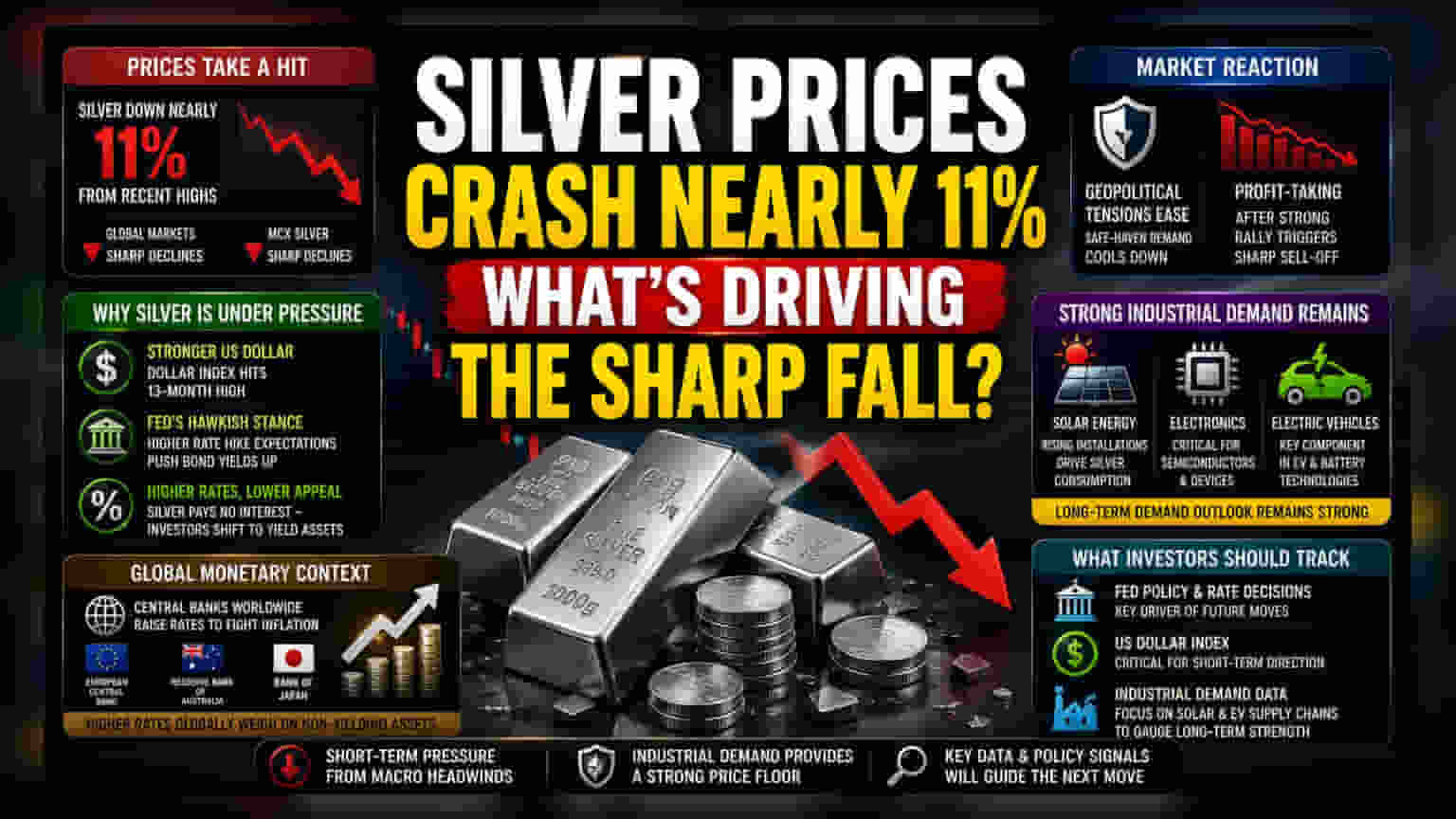
Silver prices have declined by nearly 11% this week, driven by a stronger US dollar and expectations of tighter monetary policy from the Federal Reserve. Rising interest rates often make non-yielding assets like silver less attractive compared to bonds, triggering profit-booking by investors. Despite this short-term volatility, the metal’s long-term outlook remains tied to consistent industrial demand from the solar and electric vehicle sectors, which may continue to provide support even as macro-economic pressures persist.
What Happened
Silver prices have faced a significant correction this week, shedding nearly 11% from their recent highs. This sharp decline has impacted both international markets and the domestic Indian market, where MCX Silver also saw notable intraday losses. The drop follows a period of rallying prices, leading to a wave of profit-taking by market participants.
Why The Price Is Under Pressure
The primary driver behind this decline is a combination of a stronger US Dollar and a shift in the US Federal Reserve's monetary stance. The US Dollar Index has climbed to a 13-month high, creating a challenging environment for precious metals. When the dollar strengthens, commodities priced in the currency, such as silver, become more expensive for buyers holding other currencies, which typically weighs on global demand.
Furthermore, recent commentary from Federal Reserve Chair Kevin Warsh has reinforced expectations of a strict interest rate policy. Many Fed officials have signaled the possibility of additional rate hikes later this year to curb persistent inflation. This development has pushed bond yields higher. Because silver does not provide interest income—unlike bonds or bank deposits—higher interest rates often make it a less attractive option for some investors, who may shift capital toward yield-generating assets.
How The Market Reacted
Following the strengthening dollar and the Fed's stance, silver has struggled to hold its gains. The correction has been further intensified by the cooling of geopolitical tensions. During times of global instability, silver often benefits from being a safe-haven asset, similar to gold. However, as international diplomatic discussions progress and tensions ease, the urgency for safe-haven buying has reduced, contributing to the recent sell-off.
The Industrial Demand Factor
While macroeconomic headwinds are causing short-term price volatility, the fundamental demand for silver remains a key area of focus for investors. Unlike assets that rely solely on market sentiment, silver has a strong industrial use case. Significant demand continues to come from the solar energy sector, electronics manufacturing, and the production of electric vehicles. Analysts observing the market suggest that these core industries provide a floor for the metal's price, as the need for silver in green energy transitions and advanced technology remains structurally high regardless of short-term price fluctuations.
Global Monetary Context
The pressure on silver is not an isolated event but part of a broader global trend. Central banks in other regions, including the European Central Bank, the Reserve Bank of Australia, and the Bank of Japan, have also moved to increase policy rates to combat rising energy and living costs. This synchronized global effort to manage inflation and stabilize currencies has broadly contributed to the current environment, where non-yielding assets face competition from higher interest rates.
What Investors Should Track
Moving forward, investors may want to monitor several key indicators that will likely influence silver's trajectory. First, any further updates on US Federal Reserve policy and interest rate decisions will remain critical. Second, the movement of the US Dollar Index will continue to serve as a primary guide for short-term price direction. Finally, data regarding industrial demand, specifically from the solar and electric vehicle supply chains, will be essential for understanding whether the current correction is purely driven by macroeconomic adjustments or if it signals a change in the metal's long-term growth story.

