

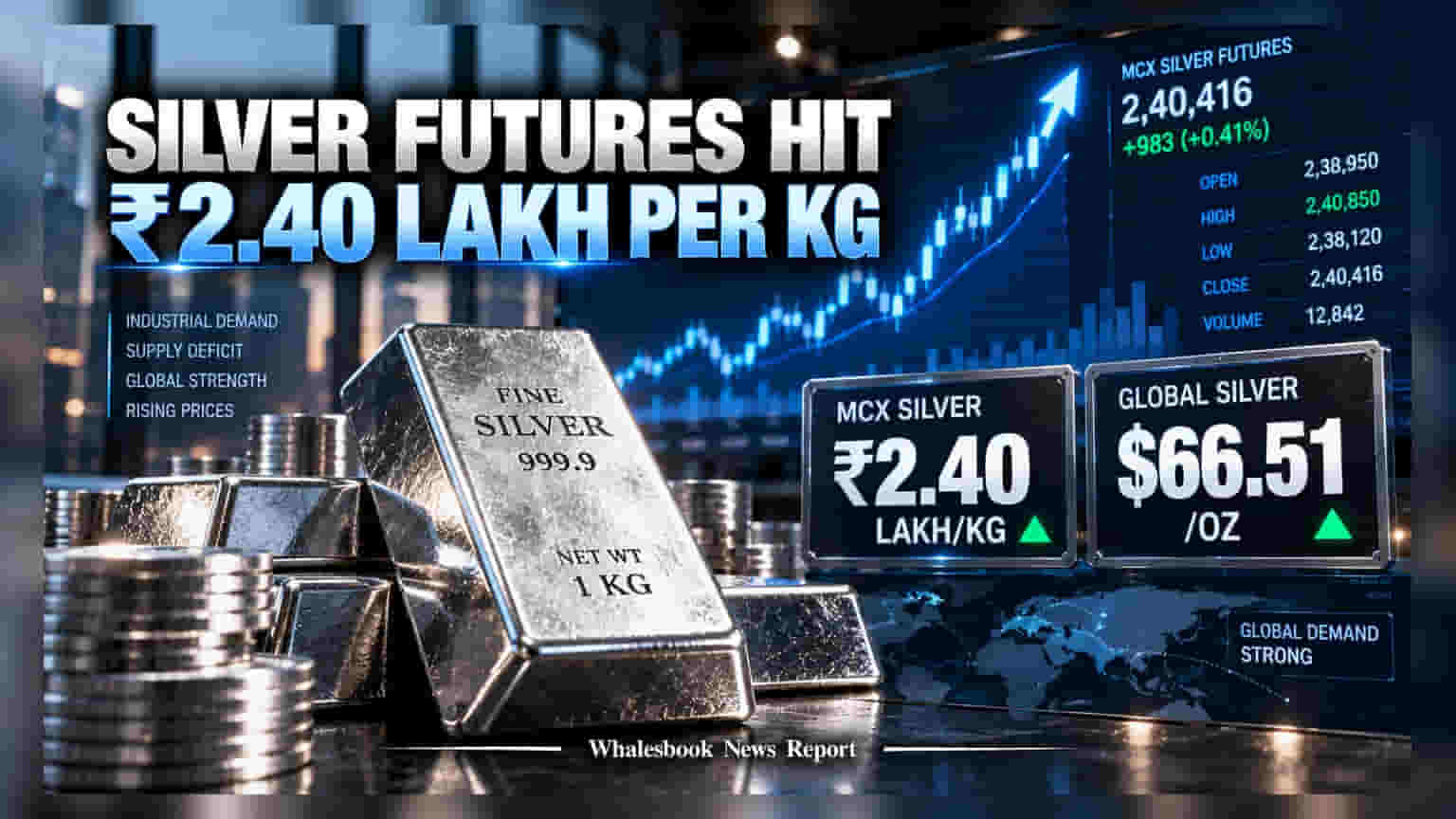
Silver futures for December delivery rose to ₹2,40,416 per kg on the Multi Commodity Exchange, tracking a 1.17% gain in international prices. The commodity continues to see demand support from a projected physical supply deficit, though macro factors like interest rate expectations remain key variables for investors.
Silver futures for December delivery on the Multi Commodity Exchange (MCX) moved up by 0.41% on Wednesday, reaching ₹2,40,416 per kilogram. This price action follows a broader trend of strength in global bullion markets, where international silver futures advanced 1.17% to touch $66.51 per ounce. The rise in domestic prices is attributed to fresh buying interest from traders reacting to the stronger international cues.
Global Trends and Domestic Impact
Indian silver futures typically track international trends alongside currency movements. When overseas prices rise, it often creates a floor for domestic contracts. The current uptick in Indian futures is a direct response to this global momentum, as international markets continue to price in various economic indicators. For investors, the correlation between global silver strength and the MCX contract price remains a primary monitorable, as changes in the US dollar and global precious metal sentiments often result in immediate price adjustments in domestic trading.
The Role of Supply Deficits
Beyond immediate trading positions, the silver market is influenced by fundamental supply and demand dynamics. The industry is currently facing a projected physical supply deficit for the sixth consecutive year, with the shortfall estimated at 46.3 million ounces for 2026. Because silver is widely used in industrial applications—such as electronics, solar panels, and automotive manufacturing—in addition to its traditional role as a precious metal, this structural supply constraint provides a baseline of support for prices. Businesses that rely on silver as a key input now face an environment where prices remain at elevated absolute levels, impacting their cost structures.
Risks and Market Variables
Investors and market participants are currently balancing this support with broader macroeconomic risks. Market sentiment remains sensitive to upcoming US inflation data and potential interest rate adjustments by the US Federal Reserve, with current market pricing suggesting a roughly 60% probability of a 25-basis-point rate hike. Higher interest rates typically put pressure on non-yielding assets like precious metals by increasing the opportunity cost of holding them.
Furthermore, geopolitical instability near the Strait of Hormuz is contributing to energy price fluctuations, which indirectly impacts bullion sentiment. For jewellers and industrial consumers, the current volatility poses a challenge in hedging and inventory management. The next phase for silver prices will likely depend on whether global demand can sustain these levels amidst potential shifts in US monetary policy and whether fresh trading volumes on domestic exchanges continue to support the current price discovery process.