

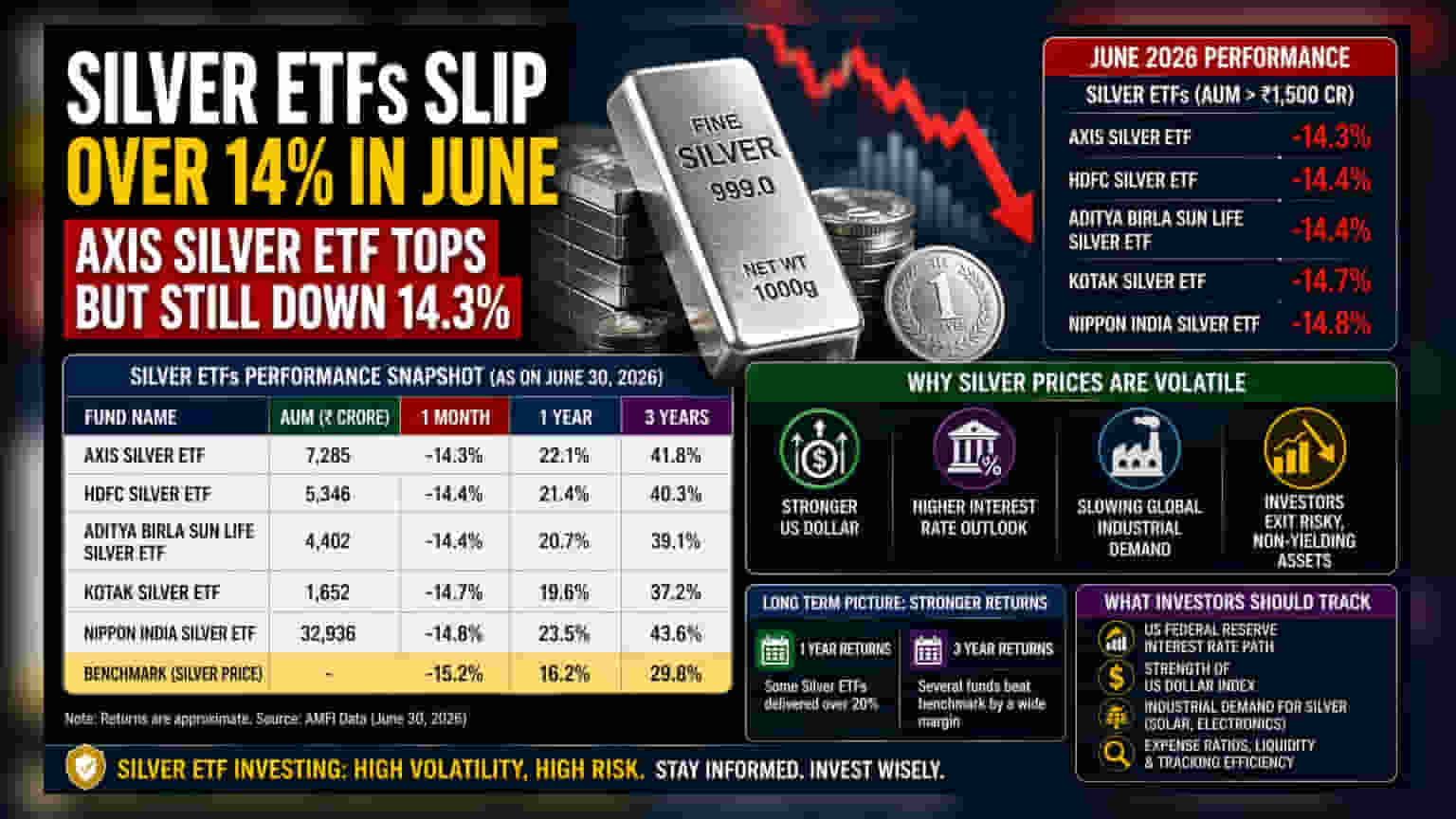
Silver ETFs in India faced a sharp correction of over 14% in June 2026, driven by a strengthening US dollar and shifting interest rate expectations. While the recent monthly performance has been negative, longer-term data highlights the high volatility and cyclical nature of precious metal investments.
What Happened
Silver exchange-traded funds (ETFs) in India experienced a difficult month in June 2026, with most major schemes posting losses of over 14%. As of June 30, 2026, the Axis Silver ETF, despite being the top performer in its category for the month, recorded a decline of 14.3%. Other major funds, including the HDFC Silver ETF and Aditya Birla Sun Life Silver ETF, followed closely with losses of 14.4%. This broad decline reflects a challenging period for investors in commodity-based financial products.
The Performance Context
Within the silver ETF segment, which includes schemes with over Rs 1,500 crore in assets under management (AUM), there remains a wide range of fund sizes. The Nippon India Silver ETF continues to be the largest, with a corpus exceeding Rs 32,936 crore. While the one-month performance was uniformly negative, long-term investors have seen a different picture. For instance, data indicates that certain silver ETFs have delivered substantial returns over one- and three-year horizons, with some funds outpacing their benchmarks significantly over the last year. This variance highlights that silver, as an asset class, is prone to sharp short-term price swings that can differ greatly from its performance over several years.
Why Silver Prices Are Volatile
Silver occupies a unique position in global markets, acting as both a precious metal and an industrial input. This dual identity makes it more sensitive to macroeconomic data than gold. The sharp correction in June 2026 was largely linked to a strengthening US dollar and a shift in market expectations regarding Federal Reserve interest rate policies. When the US dollar strengthens and interest rates are expected to remain high or increase, non-yielding assets like silver often lose appeal for investors. Furthermore, because silver is widely used in industries like solar panels and electronics, any concerns about slowing global manufacturing can dampen demand, compounding the downward pressure from speculative capital exiting the market.
Understanding Investment Risks
Investors in silver ETFs must account for high inherent volatility. Unlike equity funds, where long-term earnings growth often supports prices, silver prices are primarily driven by global demand-supply dynamics, currency movements, and investor sentiment. The recent drop is a reminder that silver ETFs do not generate regular income (like dividends or interest) and can be subject to 'tracking error,' where the fund's price movement may temporarily deviate from the physical silver price due to market liquidity and demand-supply mismatches on the exchange.
What Investors Should Track Next
For those invested in or considering silver ETFs, the focus should remain on broader economic indicators rather than just monthly price movements. Key monitorables include the US Federal Reserve's interest rate trajectory, the strength of the US dollar index, and global industrial demand for silver, particularly from the solar and electronics sectors. Given that silver tends to be more volatile than gold, experts often suggest keeping such allocations limited within a diversified portfolio. Investors may also want to monitor the expense ratios and liquidity (trading volumes) of their specific ETFs to ensure efficient entry and exit.