

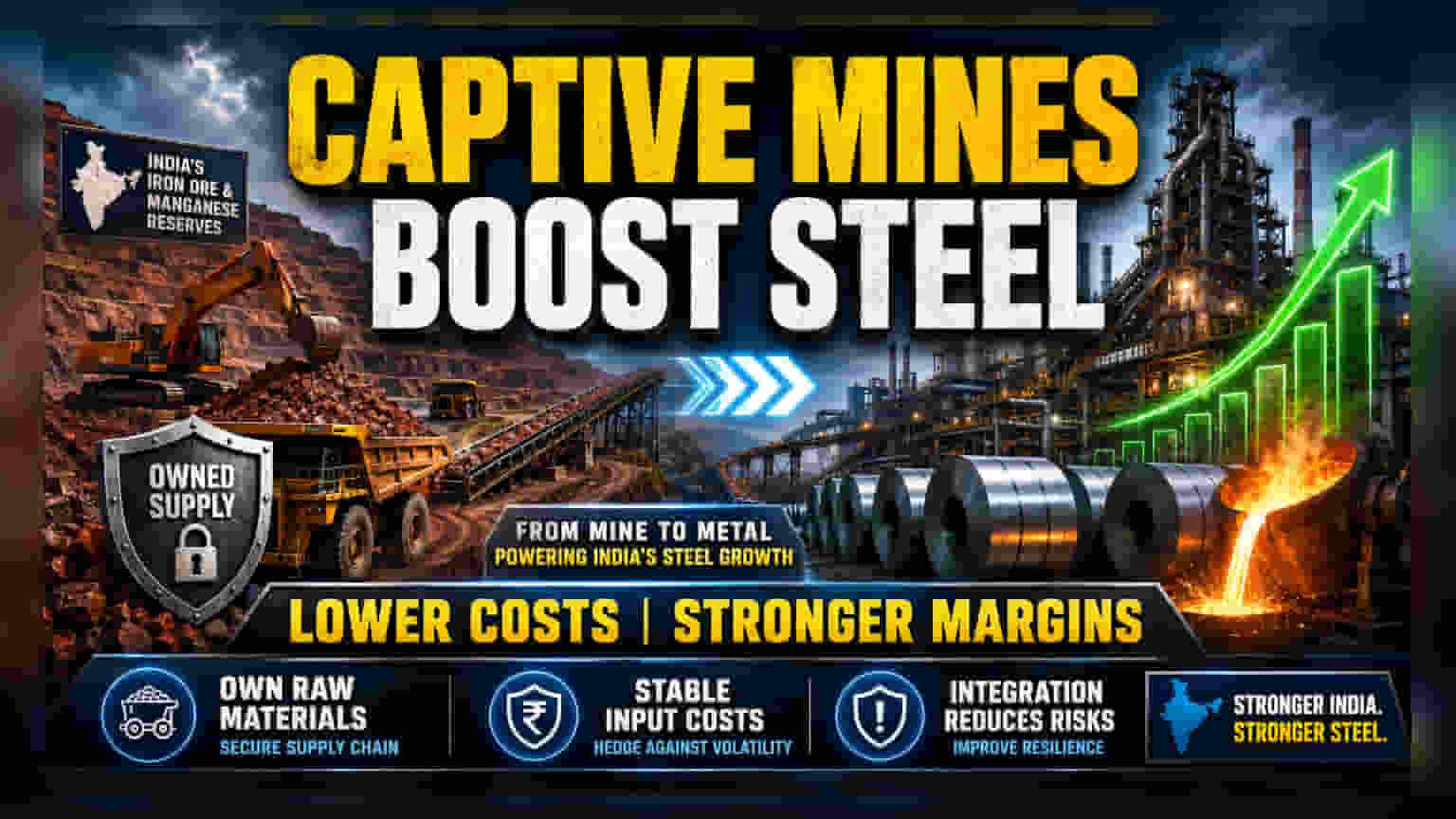
Companies like Sandur Manganese and Sarda Energy utilize captive mines to secure raw materials, helping them withstand market price volatility. While this strategy supports operating margins, investors must look beyond the mining strength to the costs of integration and commodity cycle risks. The current market valuation reflects this operational focus.
The Advantage Of Captive Mining
In the metal and steel sector, the ability to control costs often separates the winners from the rest. While many steel manufacturers depend on open-market purchases for raw materials like iron ore, manganese, and coal, companies with 'captive' mines have a different structure. By owning their supply sources, players like Sandur Manganese & Iron Ores and Sarda Energy & Minerals can avoid the volatility of market prices, allowing them to keep production costs more stable and predictable.
This control is a significant business advantage because it helps insulate the bottom line from the sudden price spikes often seen in commodities. When the market price of iron ore rises, a captive miner does not face the same cost pressure as a manufacturer that must buy from the open market. This allows them to maintain profitability even when the broader steel cycle faces headwinds.
Sandur Manganese: Integration And Margin Shifts
Sandur Manganese & Iron Ores Limited offers a clear view of how this strategy works. The company controls significant iron ore and manganese reserves in Karnataka, with leases extending until 2033. This direct ownership has historically allowed the company to generate standalone operating profit margins exceeding 40%, a level rarely seen in re-rolling or pure manufacturing businesses that lack captive sources.
However, the company’s business profile has shifted following the acquisition of Arjas Steel, a specialty steel manufacturer. While this acquisition helps in moving up the value chain, it has changed the consolidated financials. The integration of steel manufacturing has moderated the consolidated operating margins to approximately 24%, as the business now includes the costs and margins associated with steel production rather than just mining. For investors, this means the company is no longer a pure-play miner, and evaluating its performance requires looking at the combined impact of its mining and manufacturing divisions.
Financial Health And The Debt Trade-Off
Any major acquisition like Arjas Steel brings changes to the balance sheet. While Sandur Manganese has seen significant growth in recent years, with a 5-year stock performance of 472%, the increased debt for acquisitions and expansion is a factor to consider. Despite this, the company maintains a reported debt-to-equity ratio near 0.31x and a return on capital employed (ROCE) of 24%. These metrics suggest that, so far, the company has managed the capital spending on expansion without over-leveraging its balance sheet.
Understanding The Risks
Investors should keep in mind that owning mines does not eliminate all risks. Even with captive raw materials, these companies are still deeply tied to the global and domestic steel cycle. If steel prices drop significantly or demand slows down, even a low-cost producer will feel the impact on revenue.
Furthermore, mining is a regulated sector. While the leases are secure until 2033, regulatory changes or environmental policies can always impact operations in the mining industry. There is also the 'integration risk.' When a mining company expands into steel manufacturing, as Sandur has, it must prove that it can manage the complexities of a new business line—such as production efficiency, changing customer preferences, and global competition—as effectively as it managed its mining operations.
What Investors Should Track
For investors, the story is no longer just about the mines. It is about how well the company balances its mining advantage with the demands of its new steel manufacturing business. Important monitorables include the success of the Arjas Steel integration, the consistency of production volumes across both divisions, and how the company manages its debt in future expansion phases. Additionally, commodity price trends remain a key influence, as they dictate the final selling price of the company's output regardless of how efficiently it sources its raw materials.