

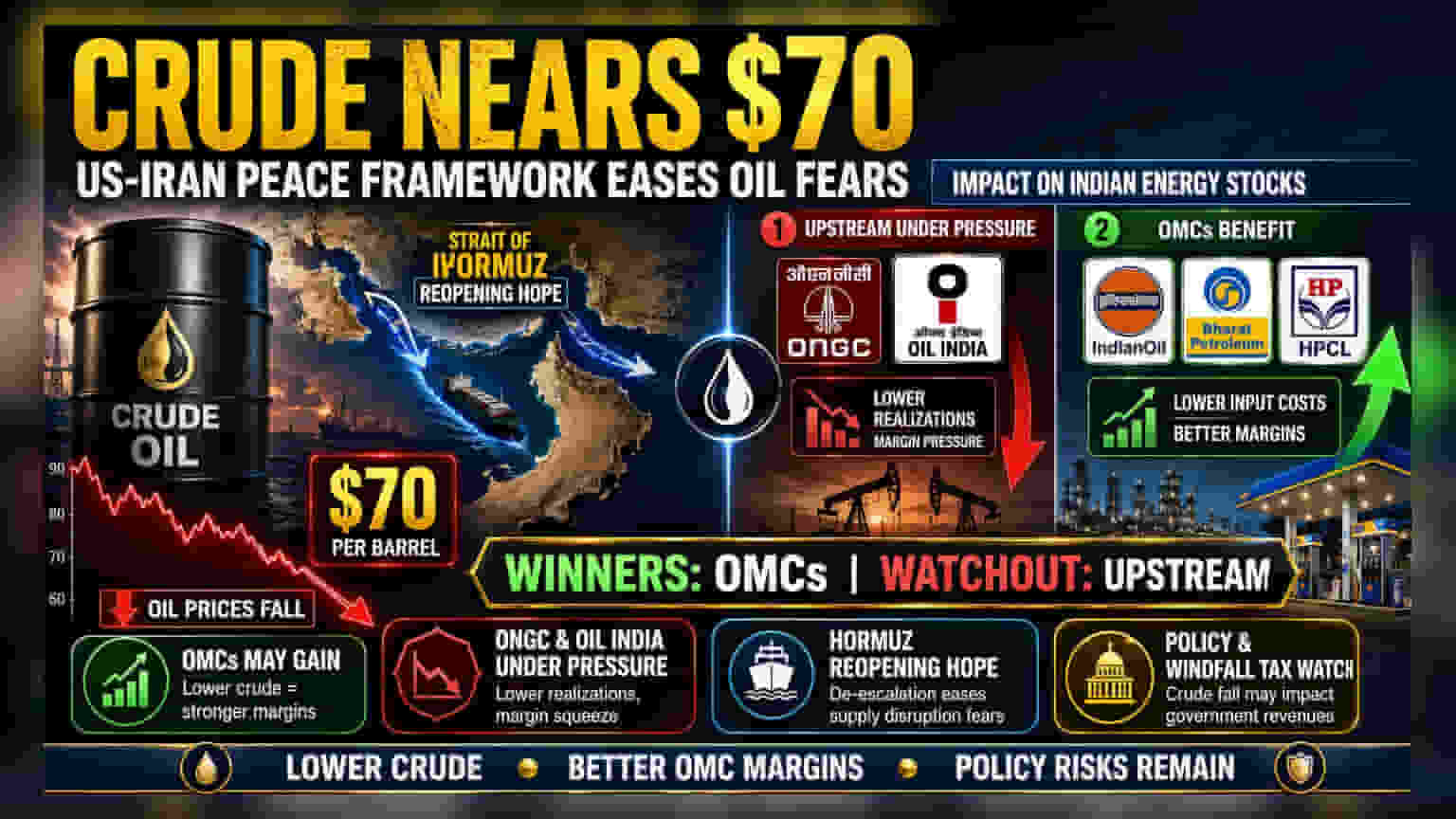
Oil prices have retreated toward $70 per barrel as geopolitical tensions ease following a framework agreement between the U.S. and Iran. This price correction creates divergent impacts for Indian energy companies, typically favoring oil marketing firms while potentially pressuring upstream producers.
What Happened
Global crude oil prices have fallen, with benchmarks nearing the $70 per barrel level following reports of a framework peace agreement between the United States and Iran. President Donald Trump indicated that the two nations have reached a consensus to ease tensions, which includes plans to reopen the Strait of Hormuz—a vital maritime chokepoint for global oil supplies. This development marks a significant shift from the volatility seen earlier this year when supply concerns and regional conflict pushed prices substantially higher.
Impact on Indian Energy Stocks
For investors in the Indian energy sector, crude oil prices act as a double-edged sword, affecting upstream and downstream companies in opposite ways.
Upstream companies, such as Oil and Natural Gas Corporation (ONGC) and Oil India Limited, are primarily involved in the exploration and production of crude oil. These companies generally benefit when international oil prices rise, as their per-barrel realization improves. Conversely, a sustained decline in crude prices often compresses their profit margins, as they sell their output at lower market-linked rates.
In contrast, Oil Marketing Companies (OMCs) like Indian Oil Corporation (IOCL), Bharat Petroleum Corporation (BPCL), and Hindustan Petroleum Corporation (HPCL) tend to benefit when crude prices fall. These companies import crude oil to refine into fuel products like petrol, diesel, and aviation turbine fuel. Lower input costs for crude oil can lead to improved refining and marketing margins, provided the companies can maintain stable retail fuel prices.
The Regulatory And Policy Context
Beyond global commodity prices, Indian oil companies operate within a sensitive regulatory environment. Historically, during periods of high oil prices, the government has adjusted special duties—commonly referred to as windfall taxes—on domestic crude production to balance public revenue and manage inflationary pressures. While the government has previously adjusted these policies based on global market conditions, the interaction between global price volatility and domestic regulatory interventions remains a key monitorable for investors.
Furthermore, upstream companies also face limitations through price caps on natural gas produced from legacy fields, which can prevent them from fully capitalizing on global price surges. Investors often track how these regulatory factors, alongside global price trends, influence the actual profitability of these firms.
What Investors Should Track
While the current news suggests a potential cooling of geopolitical tensions, oil markets remain notoriously volatile. The stability of this price decline will depend on the final implementation of the U.S.-Iran agreement, actual supply flows through the Strait of Hormuz, and broader global demand trends.
Investors may monitor the following:
- Crude Price Sustainability: Whether prices stabilize at current levels or if further volatility emerges from geopolitical shifts.
- OMC Margin Recovery: Whether lower input costs translate into sustained earnings growth for marketing companies.
- Upstream Operational Performance: How upstream producers manage volume growth and cost efficiency in a lower-realization environment.
- Government Policy Updates: Any changes in fuel pricing policies or duties that could impact sector-wide margins.