 Whalesbook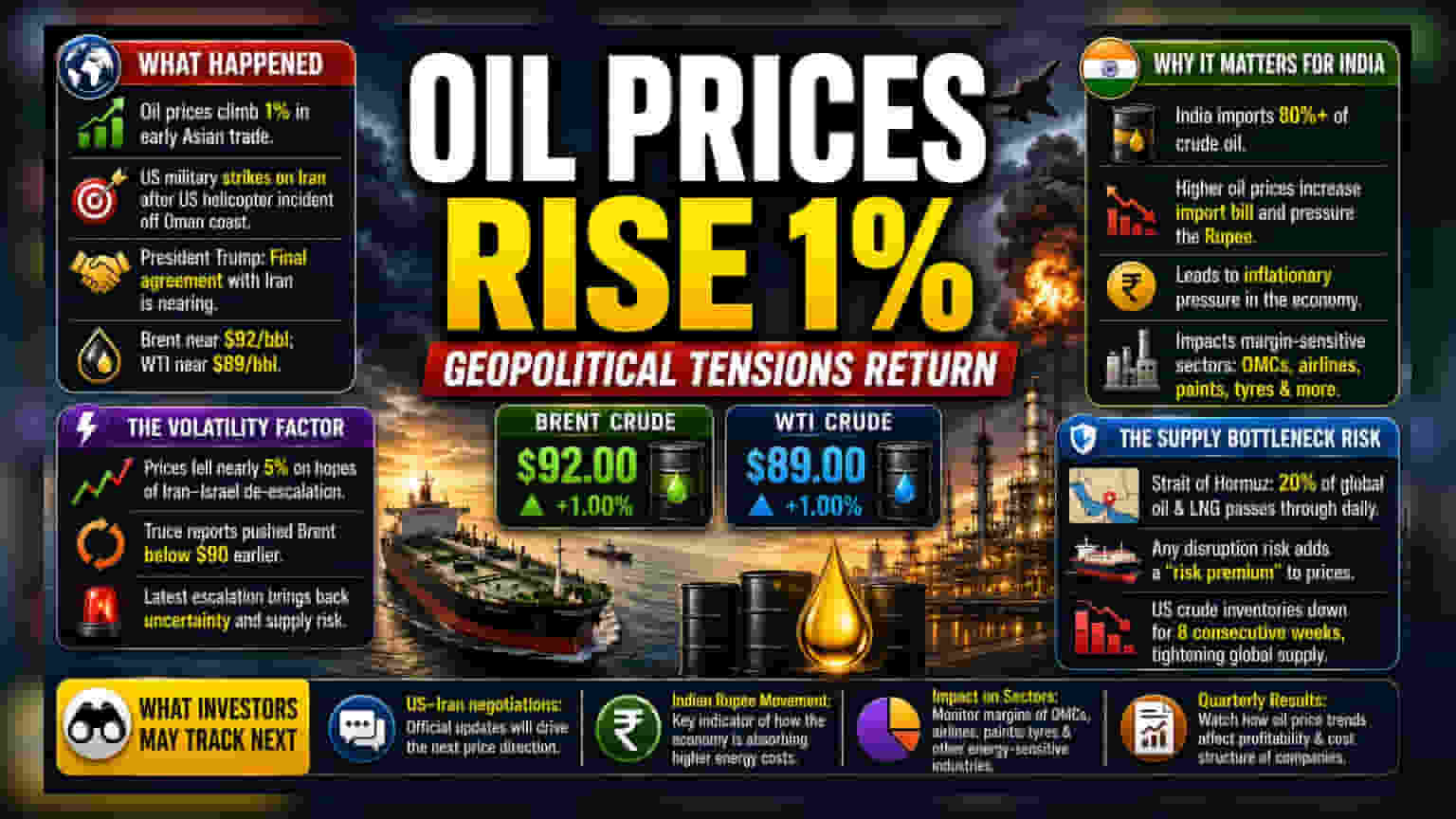


Global oil prices rose 1% as US-Iran tensions flared following recent military strikes. After a brief period of price drops, uncertainty has returned to the commodity markets. For Indian investors, the main focus is how rising crude costs may impact the Rupee, domestic inflation, and energy-dependent sectors like oil marketing companies and aviation.
What Happened
Global oil markets saw a shift in sentiment as prices climbed 1% in early Asian trade. This move followed a volatile session where prices had previously fallen sharply by nearly 5% due to hopes of de-escalation between Iran and Israel. The renewed price increase comes after US military strikes on Iran, launched following an incident involving a US helicopter off the coast of Oman. While President Donald Trump suggested that a final agreement between the two nations is nearing, the military action has reintroduced uncertainty into the global energy market. Brent crude futures are currently trading near $92 per barrel, while West Texas Intermediate (WTI) is near $89.
Why This Matters for the Indian Market
For Indian investors, crude oil is a critical macro variable. India imports more than 80% of its crude oil requirements. When global oil prices rise, it increases the country's import bill. This can put pressure on the Indian Rupee, as more dollars are required to pay for the same amount of oil. Furthermore, higher crude prices often lead to inflationary pressure within the economy. For the stock market, this typically impacts sectors that are sensitive to energy costs, such as Oil Marketing Companies (OMCs), airlines, paints, and tyre manufacturers, whose profit margins can be squeezed when raw material costs rise.
The Volatility Factor
The sharp swing in oil prices highlights how sensitive the energy market is to geopolitical news. The market had initially cooled down following reports of a truce between Iran and Israel, which had pushed Brent crude below $90 earlier. However, the latest escalation shows that supply risks are still very much present. Markets often react quickly to such news, leading to the rapid price movements observed in the last 48 hours.
The Supply Bottleneck Concern
A significant risk factor that investors are monitoring is the Strait of Hormuz. This narrow waterway is one of the world's most critical transit points, with approximately 20% of global oil and liquefied natural gas passing through it daily. Any disruption or fear of blockage in this region tends to create an automatic "risk premium" on oil prices, as traders worry about the ability to move energy supplies to global markets. The persistent decline in US crude oil inventories, which have fallen for eight consecutive weeks, adds further tightness to the global supply picture.
What Investors May Track Next
Investors may keep an eye on several factors in the coming days. First, any official communication regarding the status of US-Iran negotiations will be critical to watch, as it will determine if the conflict de-escalates or worsens. Second, movements in the Indian Rupee will be an important indicator of how the domestic economy is absorbing the higher energy costs. Finally, market participants will watch for any impact on the margins of energy-heavy industries in the next quarterly results. While individual stock reactions will depend on specific company fundamentals, the broader macro environment will remain tied to global oil price trends.