 Whalesbook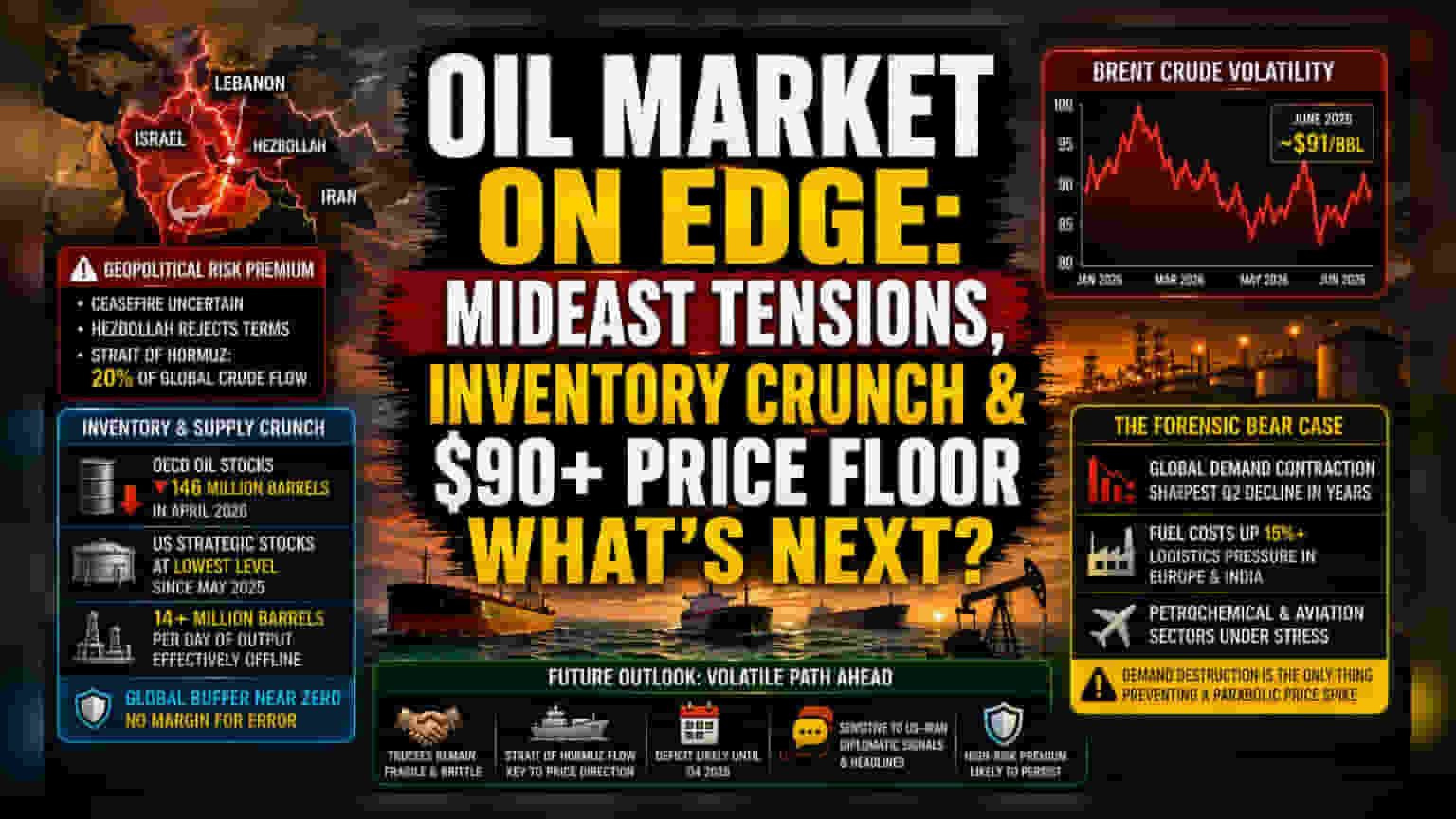


The Geopolitical Risk Premium
Global oil benchmarks remain in a state of high-stakes volatility as the market attempts to discount conflicting signals from the Middle East. While recent reports of a conditional ceasefire between Israel and Lebanon initially cooled prices, the rally failed to sustain as Hezbollah’s rejection of the terms reignited supply concerns. This oscillation underscores a market governed less by traditional demand fundamentals and more by the status of the Strait of Hormuz, a critical conduit for nearly 20% of global seaborne crude. As of early June 2026, Brent crude is navigating a complex landscape where even minor diplomatic friction can trigger sharp price swings.
The Inventory and Supply Crunch
Beneath the surface of daily price action lies a structural deficit that has persisted since the onset of the regional conflict in early 2026. Data from the International Energy Agency reveals a staggering reduction in global buffers, with OECD on-land stocks plummeting by 146 million barrels in April alone. The US strategic cushion, often seen as the market's final defense, has similarly depleted to levels unseen since May 2025. This rapid inventory draw—compounded by the effective shutdown of over 14 million barrels per day in regional output—has left the global energy market with virtually no margin for error. Consequently, even if a formal diplomatic breakthrough occurs, industry analysts warn that supply restoration will be a slow, multi-month process, keeping the floor price of Brent effectively anchored in the $90-plus territory.
The Forensic Bear Case
From a risk-averse perspective, the primary threat to the current price floor is not a sudden peace deal, but a sharp, demand-side collapse. The May 2026 IEA assessment highlights a concerning contraction in global demand, the most pronounced seen in the second quarter. If the global economic environment continues to deteriorate—particularly within the petrochemical and aviation sectors—the resulting loss in consumption could override the geopolitical supply risk. Furthermore, logistics sectors in Europe and India are already reporting unsustainable fuel-cost pass-through pressures exceeding 15%, forcing energy-intensive manufacturers to ration production. This destruction of demand is, ironically, the only factor currently preventing a more parabolic spike in prices.
Future Outlook
Market participants are now bracing for an volatile third quarter. While official forecasts from institutions like the IEA and major trading houses suggest a stabilization range, the reality is dictated by the durability of current truces. Unless seaborne trade through the Strait of Hormuz resumes with consistent volume, the market will likely remain in deficit until the final quarter of 2026. Investors should expect continued sensitivity to every headline involving US-Iran diplomatic backchannels, as the market remains heavily biased toward maintaining a high-risk premium to account for potential infrastructure damage and extended export restrictions.