 Whalesbook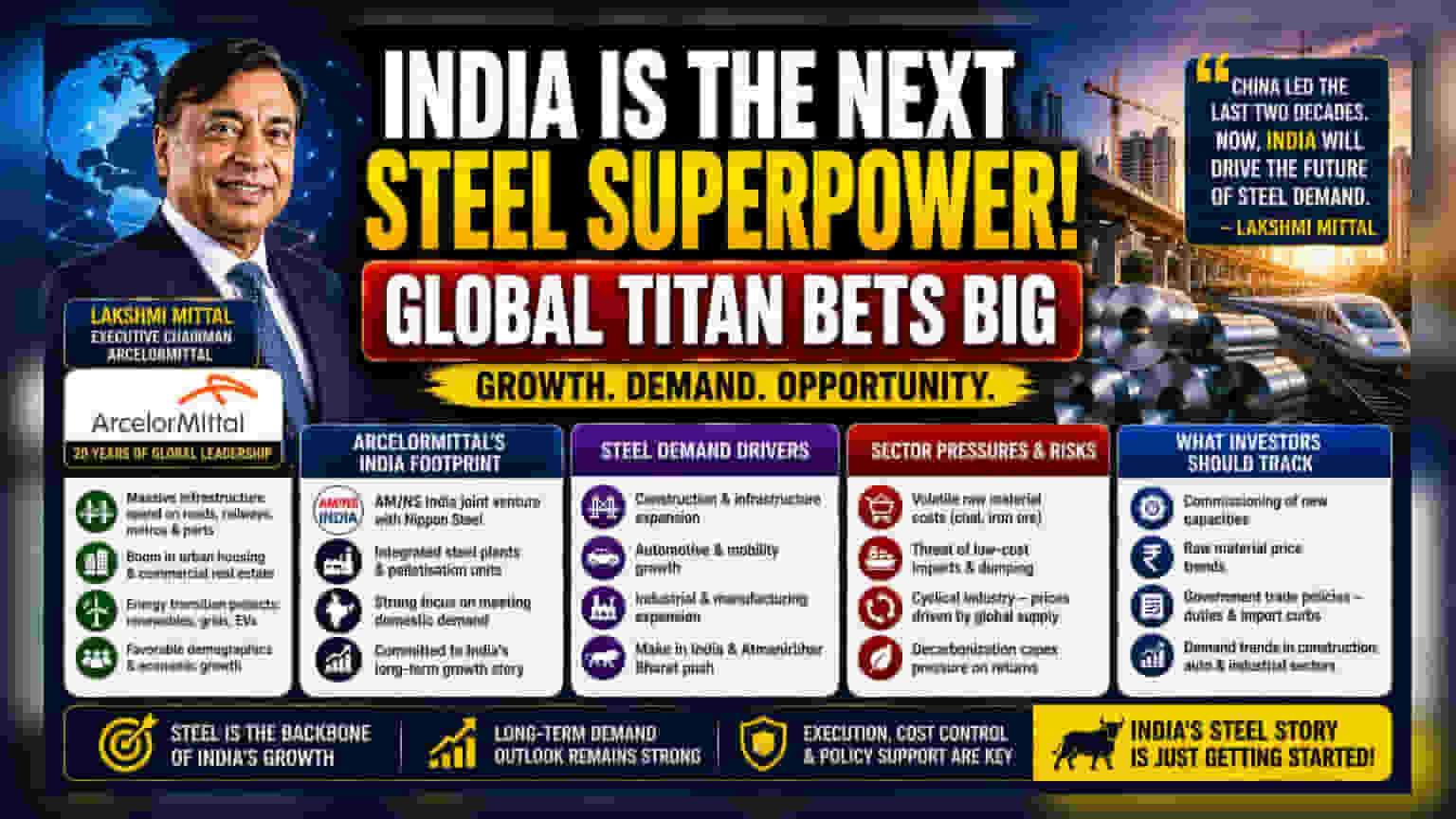
ArcelorMittal Executive Chairman Lakshmi Mittal says India is set to lead global steel demand, fueled by infrastructure and urbanization. For Indian investors, this macro trend highlights long-term sector potential, though challenges like input costs and import pressures remain. We break down the impact on the domestic steel industry and what stakeholders should watch.
What Happened
Lakshmi Mittal, Executive Chairman of global steel giant ArcelorMittal, recently identified India as the primary engine for future global steel demand. Speaking at the Global Steel Dynamics Forum in New York, Mittal highlighted that while China led the last two decades of industry growth, the mantle is now shifting to India. He attributed this shift to the country's massive ongoing infrastructure projects, rapid urban housing growth, and significant investments in energy transition infrastructure. This outlook comes as ArcelorMittal, one of the world’s largest steel producers, approaches its 20th anniversary.
Why This Matters For Investors
For Indian stock market investors, this commentary serves as a high-level validation of the domestic 'steel story.' The steel industry is often viewed as a proxy for a nation's economic health. When global leaders confirm that India is the next major growth market, it reinforces the long-term thesis for Indian steel companies. The demand for steel is directly linked to the country’s capital spending on roads, railways, real estate, and industrial projects. As these sectors grow, steel manufacturers—ranging from large integrated players to smaller rebar producers—generally see higher volume consumption.
The India Business Context
ArcelorMittal has a strong footprint in India through its joint venture with Nippon Steel, known as AM/NS India. This partnership operates integrated steel plants and pelletisation units, emphasizing the company's commitment to capturing domestic demand. However, the Indian steel landscape is also defined by large domestic giants such as Tata Steel, JSW Steel, and SAIL. These companies are actively expanding their production capacities to meet the anticipated rise in domestic consumption. The broader industry trend is a shift toward higher-value products, such as those used in the automotive and energy sectors, moving away from simple commodity steel.
Sector Pressures And Risks
While the demand outlook is optimistic, the steel sector remains inherently cyclical and faces several verified risks. Steelmakers are highly sensitive to the cost of raw materials, particularly coking coal and iron ore. Volatility in these input prices can quickly squeeze profit margins if the companies cannot pass the costs on to customers.
Another significant issue is the threat of low-priced imports. To protect domestic manufacturers, the Indian government has previously imposed safeguard duties on certain imported steel products to curb dumping from other countries. Investors should be aware that the steel sector's profitability is often tied to these government trade policies and the global price of steel, which can fluctuate based on supply-demand imbalances in other major economies like China and Vietnam. Furthermore, the industry is under pressure to decarbonize, which requires massive capital spending on new, cleaner technology, potentially impacting short-term cash flow.
How Investors May Read This
Market participants typically look for signs of 'execution' when companies promise expansion. While the long-term macro trend looks strong, quarterly results often reveal the impact of the risks mentioned above. If steel prices remain soft due to global oversupply, even strong volume growth might not lead to a linear rise in profits. The industry is currently moving through a phase where efficiency and cost control are just as important as capacity expansion.
What Investors Should Track
Investors may want to monitor several key indicators in the coming quarters. First, track the commissioning of new production capacities to see if companies are meeting their expansion timelines. Second, keep an eye on raw material price trends, as these are the biggest drivers of margin variability. Third, stay updated on government trade policies, such as import duties or changes in export incentives, as these can drastically change the competitive landscape for domestic players. Finally, listen for management commentary on demand from key consuming sectors like construction and automotive to gauge the strength of the underlying steel consumption.