

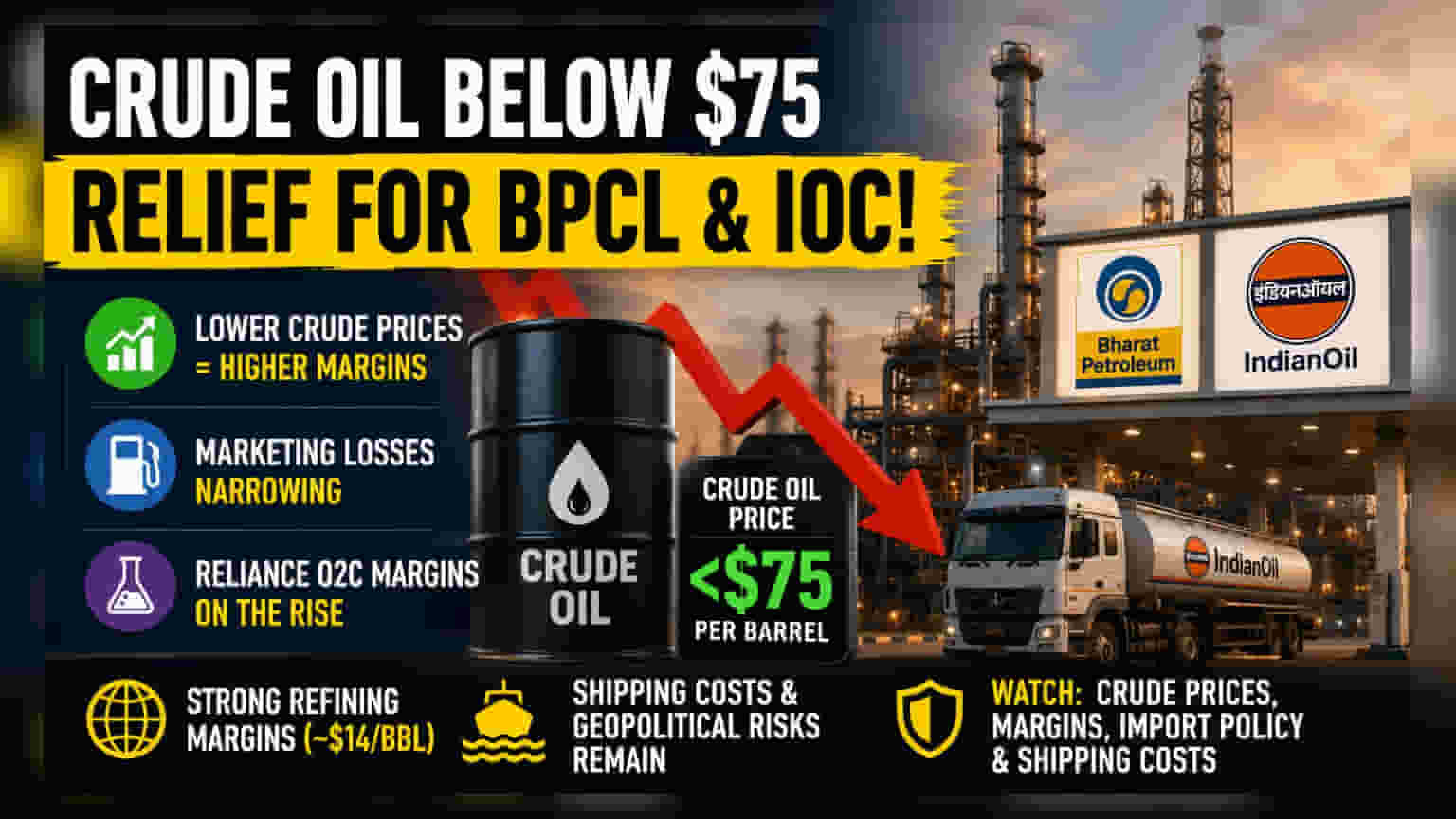
Brokerage firm Jefferies notes that Bharat Petroleum and Indian Oil Corporation stand to benefit as crude oil prices dip below $75 per barrel. Lower input costs are helping reduce losses on fuel sales, while refining margins remain resilient. Reliance Industries is also expected to gain from improved petrochemical spreads amid global supply disruptions.
What Happened
Global brokerage firm Jefferies has highlighted potential relief for Indian oil marketing companies (OMCs) following a decline in global crude oil prices, which have fallen below $75 per barrel. The brokerage noted that this price correction is a positive development for Bharat Petroleum Corporation (BPCL) and Indian Oil Corporation (IOC), as it directly lowers the cost of raw material imports. For Indian refiners, who import over 85% of their oil needs, stable or lower crude prices are essential for maintaining stable profit margins.
The Profit Equation for BPCL and IOC
For companies like BPCL and IOC, the profit calculation depends on two main factors: refining margins and marketing margins. Refining margins represent the profit made from turning crude oil into finished products like petrol and diesel. Marketing margins represent the profit made from selling these fuels at retail petrol pumps.
Jefferies stated that marketing losses on fuel sales are narrowing. Because retail fuel prices in India have been adjusted, lower crude costs mean that these companies lose less money (or make more profit) on every liter sold. The brokerage also noted that refining margins—known as Gross Refining Margins or GRMs—are currently holding up well at around $14 per barrel, compared to roughly $5 per barrel before recent global conflicts began. This indicates that while crude prices have softened, the demand for refined fuel products remains strong enough to keep refining profitability healthy.
Reliance Industries and Petrochemicals
Beyond the state-owned refiners, Reliance Industries is also expected to benefit from the current market environment. The company, which operates one of the world's largest refining and petrochemical complexes, is seeing higher profitability in its Oil-to-Chemicals (O2C) segment. Jefferies reported a significant rise in petrochemical margins, largely driven by ongoing production disruptions at major facilities in the Middle East, such as in Iran and Saudi Arabia. These regional production challenges have created a supply gap, allowing efficient producers to capture better margins on chemical products.
Risks and Uncertainties
While the outlook appears positive, the energy sector faces several ongoing risks that investors should consider. Geopolitical tensions remain a key factor. Although shipping routes, particularly through the Strait of Hormuz, are recovering, they are not yet back to normal operational levels. This has kept freight and shipping costs higher than average, which acts as an added expense for importers.
Furthermore, India’s reliance on Russian crude imports is a significant monitorable. Changes in international sanctions or the potential expiry of waivers regarding Russian oil imports could force Indian refiners to source crude from more expensive markets, which would pressure margins. Additionally, the regulatory environment in India—where the government has historically influenced retail fuel pricing—remains a factor that can impact the profitability of OMCs regardless of global crude price trends.
What Investors Should Track
Investors monitoring this sector should keep an eye on three specific areas. First, the stability of global crude oil prices is paramount; any sharp rebound could quickly erase the margin benefits noted by analysts. Second, track official commentary regarding refining margins, as these are highly sensitive to global demand and supply disruptions. Finally, monitor any updates on import policy and shipping costs, as these factors will determine whether the current improvement in margins can be sustained throughout the year.