 Whalesbook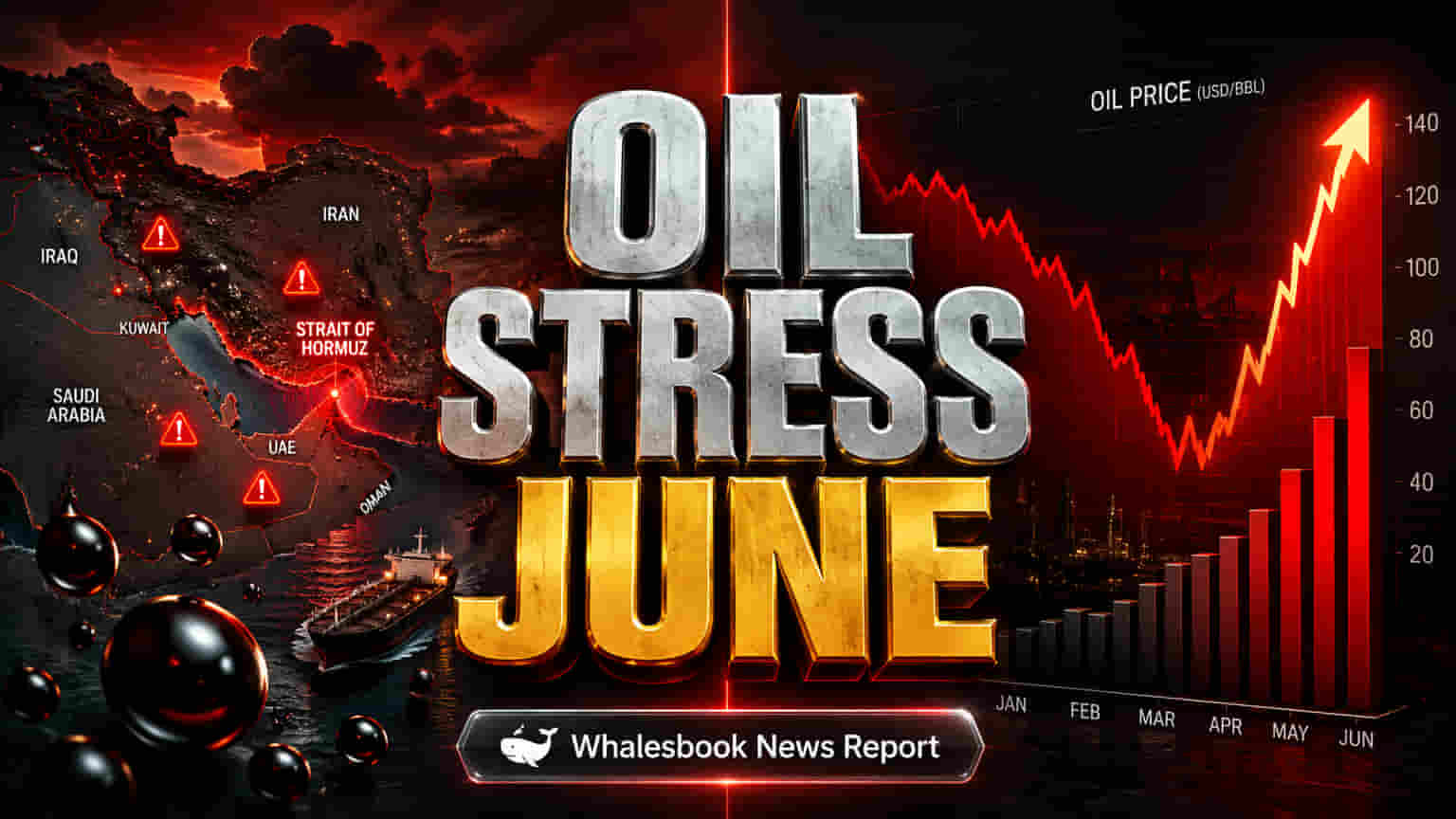


Operational Fragility Exposed
JPMorgan Chase's recent analysis paints a stark picture of impending "operational stress" on global oil inventories, potentially by mid-June. This critical juncture arises not from a complete disappearance of oil, but from a severe depletion of accessible stockpiles. The world started 2026 with an ample 8.4 billion barrels of stored oil, yet only an estimated 0.8 billion barrels are realistically available without straining the system. With approximately 280 million barrels already drawn down, the remaining usable inventory of roughly 580 million barrels faces exhaustion as early as next month, posing a significant threat to the smooth functioning of the global energy supply chain. This situation is distinct from typical supply/demand imbalances, highlighting a systemic vulnerability in the network's circulating volume.
Geopolitical Tensions and Shipping Routes
The warning is amplified by ongoing volatility in oil markets, directly linked to escalating Middle East tensions and concerns over critical transit routes like the Strait of Hormuz. Brent crude futures for July delivery saw a 1.21% decline to $108.54 a barrel on Tuesday, May 5, 2026, while U.S. West Texas Intermediate (WTI) crude fell 1.76% to $100.50 a barrel. This market reaction follows President Donald Trump's decision to temporarily halt "Project Freedom," a military initiative aimed at escorting commercial vessels through the Strait of Hormuz. Trump cited progress in negotiations with Iran, a move that some analysts believe was premature, potentially exacerbating supply concerns. The Strait of Hormuz, responsible for about one-fifth of global oil and natural gas flows, has faced significant disruptions since late February due to conflict.
The Analytical Deep Dive
While JPMorgan highlights the immediate inventory crunch, other market analyses show many factors at play. The International Energy Agency (IEA) reported that global observed oil inventories fell by 85 million barrels in March, with stocks outside the Middle East Gulf drawn down significantly. The EIA forecasts that global oil inventories will increase through 2026, exerting downward pressure on prices, driven by rising production and strategic stockpiling. This forecast differs from JPMorgan's view of immediate stress. However, recent data from the EIA in April indicated that production shut-ins in the Middle East have been substantial, reaching 9.1 million barrels per day, a figure expected to decline in May but contributing to a projected inventory draw of 5.1 million barrels per day in Q2 2026. Historically, disruptions to the Strait of Hormuz have led to sharp price spikes, such as Brent crude surpassing $100 per barrel in early April and reaching $114.44 on May 4, 2026, amidst renewed tensions. Goldman Sachs, while trimming near-term forecasts following a truce, maintains upside risks, warning that extended Hormuz disruptions could push Brent to $120 per barrel in Q3 2026. The current market environment is marked by persistent inflation concerns; the IMF has declared its "adverse scenario" of 2.5% global growth and 5.4% inflation as the operating reality, warning that prolonged conflict with oil near $125 per barrel could de-anchor inflation expectations. This elevated price environment puts significant pressure on economies, particularly in Asia and Europe, which face higher import costs. The Brent-WTI spread has widened significantly due to increased transportation costs from disrupted navigation through the Strait of Hormuz.
Deeper Supply Risks Emerge
Several factors beyond current stock levels add to the risk of operational stress. The global oil market's dependence on narrow routes like the Strait of Hormuz, handling about 20% of global oil supply, creates an inherent weakness in the system. The US military reported initial success with "Project Freedom," letting merchant ships pass, but the overall situation remains unstable and easily affected by further geopolitical events. The Strait of Hormuz effectively being closed since late February is called the biggest disruption to world energy supply since the 1970s energy crisis, affecting oil, LNG, and fertilizer shipments. Goldman Sachs estimates global observable inventories dropped by 7.1 million barrels a day in April. Many countries, particularly in Asia, rely more heavily on Middle Eastern crude and have had to cut demand or find pricier alternatives. Ongoing tensions and the US shifting away from escorting vessels could encourage more disruptions, potentially leading to lasting higher prices and wider economic strain, as JPMorgan predicts. The IMF's note that inflation could stay high means sustained high energy prices might lead to more monetary policy tightening, significantly slowing global growth.
Future Outlook
Major financial institutions offer varied outlooks. Goldman Sachs, after adjusting near-term forecasts, still projects upside risks, with potential for Brent crude to average $115/bbl in Q4 2026 under severe disruption scenarios. The EIA anticipates Brent crude prices to peak at $115/b in Q2 2026 before gradually falling, but forecasts prices to remain elevated, averaging $76/b in 2027 due to lingering supply uncertainties. J.P. Morgan, however, previously projected Brent crude to average around $60/bbl in 2026, citing soft supply-demand fundamentals and unlikely protracted disruptions, though acknowledging brief geopolitical rallies. The current market pricing reflects reduced probabilities of extreme price spikes like $150/bbl for WTI, influenced by the "Project Freedom" pause, but underlying supply risks persist.