 Whalesbook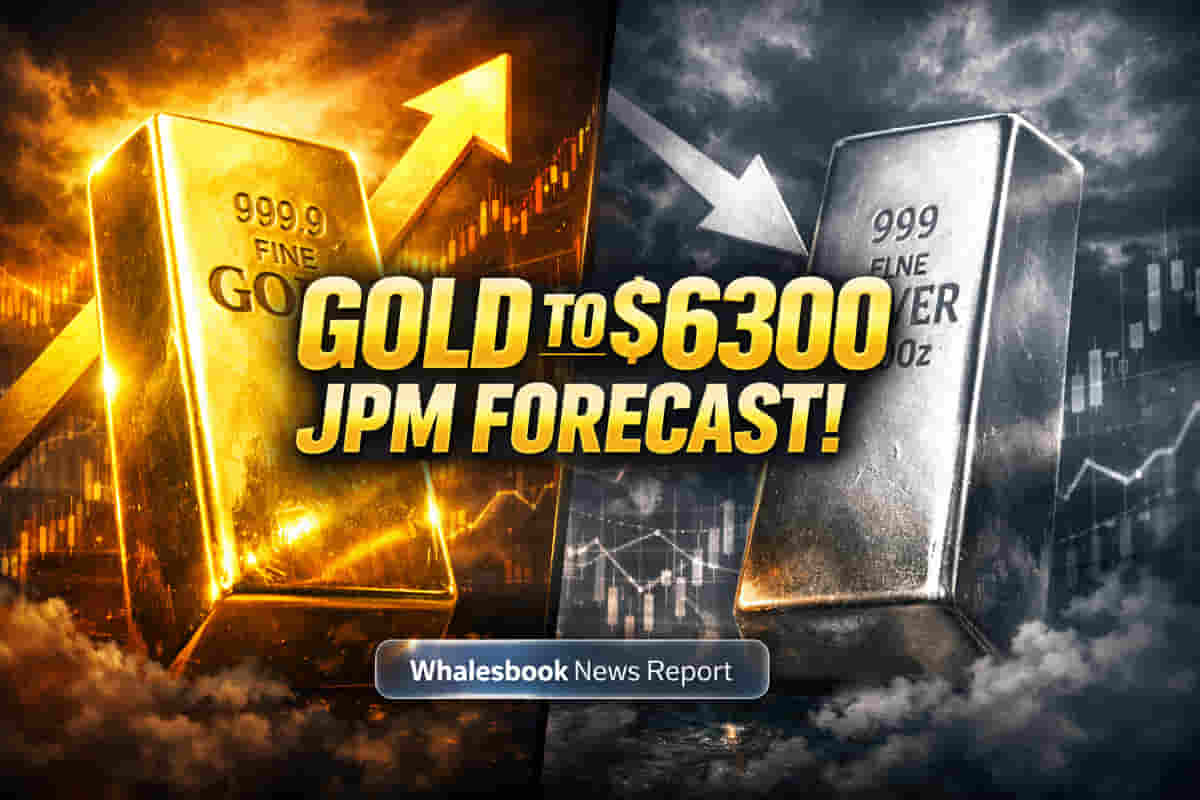


### Gold's Ascent: A New Forecast and Enduring Demand
JPMorgan Chase has amplified its bullish outlook on gold, raising its long-term price projection to $4,500 per ounce and maintaining its ambitious target of $6,300 per ounce by the close of 2026. This recalibration signals strong conviction in sustained institutional demand and the ongoing trend of portfolio diversification. The precious metals sector has been on a remarkable trajectory; spot gold experienced approximately a 20% year-to-date gain by February 24, 2026, reaching a three-week high of $5,248.89 per ounce. This follows a significant rally exceeding 64% in 2025.
Multiple financial institutions echo this optimistic sentiment. Goldman Sachs forecasts gold at $5,400 by year-end 2026, attributing this to sustained central bank buying and anticipated Federal Reserve rate cuts. Deutsche Bank reiterated a $6,000 target, with UBS setting its sights at $6,200. Market data on February 26, 2026, showed gold trading around $5,180 per ounce, reflecting a 0.41% increase from the prior day. Historically, gold has demonstrated a positive correlation with periods of Federal Reserve easing; Fed rate cuts typically reduce the opportunity cost of holding non-yielding assets and can weaken the U.S. dollar, both acting as tailwinds for gold prices. Central bank purchases remained historically elevated in 2025, totaling 863.3 tonnes, despite a 21% year-on-year decline from 2024's record levels. This demand, though moderated by high prices, remains well above the 2010–2021 average. Investment activity also surged, with global gold ETF holdings growing by 801 tonnes in 2025, the second-strongest year on record, complemented by accelerated bar and coin buying.
### Silver's Divergent Trajectory: Volatility and Industrial Appeal
In contrast to gold's consistent upward revision, the outlook for silver presents a more complex narrative. While Bank of America acknowledges gold's potential to reach $6,000 per ounce, its view on silver is more reserved in the near term, cautioning of potential additional downward pressure. Spot silver traded around $90.70 per ounce on February 25, 2026, a retreat from its late January record high of $121.64. However, other analysts foresee significant upside. Citi forecasts silver could reach $150 per ounce within three months, citing strong Chinese buying and dollar weakness. Goldman Sachs expects silver to average $85-100 per ounce in 2026, identifying it as a strategic metal for the green transition.
The gold-to-silver ratio has compressed dramatically, falling from over 100:1 in April 2025 to approximately 59:1 by mid-February 2026, indicating silver's significant outperformance. This compression suggests a market rebalancing, with silver bulls arguing for further ratio contraction. The iShares Silver Trust (SLV) traded at $79.08 on February 24, 2026, with a market cap of $43.53 billion. The metal's volatility is exacerbated by exceptionally tight inventories in London vaults, making the market highly sensitive to capital flows, according to Goldman Sachs. Industrial demand from sectors like AI, solar panels, and electronics also underpins silver's appeal. Despite recent pullbacks, Bank of America projects silver prices could surpass $100 per ounce later this year.
### The Forensic Bear Case: Inflation Risks and Policy Uncertainty
While the bullish consensus for gold is strong, potential headwinds exist. Persistent inflation concerns could influence Federal Reserve policy, potentially delaying anticipated rate cuts. Two Fed officials indicated on February 26, 2026, that there was little inclination to adjust monetary policy, citing improving labor market conditions and persistent inflation. This stance challenges the market's pricing of multiple rate reductions for the year. Historically, Fed rate cuts are generally bullish for gold, but the context matters; gold performs best when rate cuts coincide with economic slowdowns or inflation concerns, prompting a search for safe-haven assets. If inflation remains stubbornly high, it could lead to a stronger dollar, which historically has exerted downward pressure on gold prices. Furthermore, the increasing volatility in both gold and silver markets, as noted by Goldman Sachs concerning silver, suggests that price movements might be driven more by speculative flows and options activity than by fundamental supply-demand dynamics alone.
### Future Outlook and Consensus
The consensus among leading financial institutions points to continued strength in gold prices through 2026, with forecasts generally ranging between $5,400 and $6,000 per ounce. JPMorgan's $6,300 target and Deutsche Bank's $6,000 forecast are notable. The World Gold Council anticipates a continuation of strong central bank demand into 2026, driven by persistent economic and geopolitical uncertainty. For silver, while near-term volatility is expected, the underlying drivers of industrial demand and potential for further ratio compression with gold suggest sustained interest, with targets frequently exceeding $100 per ounce and reaching as high as $150-$170 in some optimistic scenarios.