 Whalesbook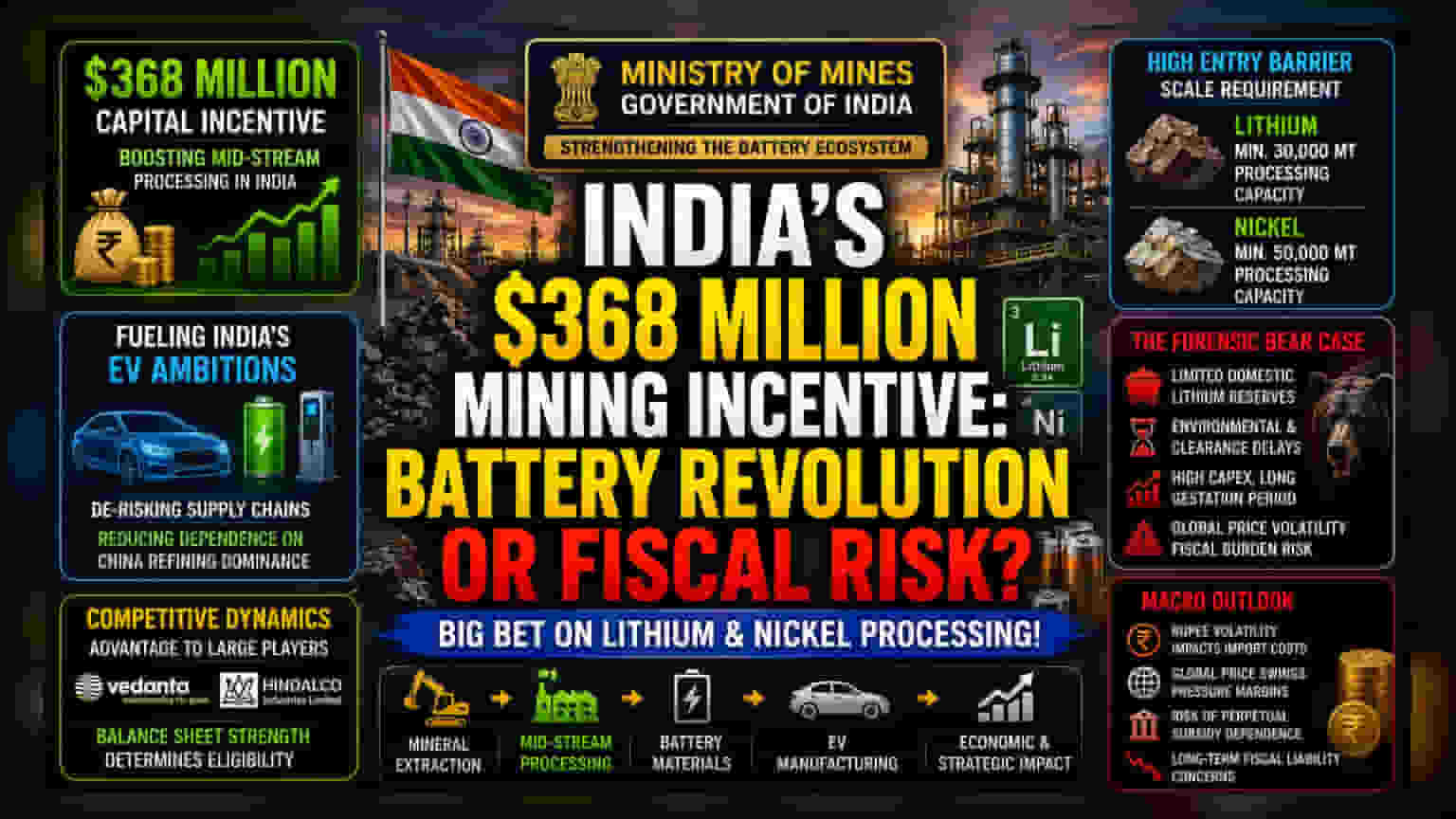


The Incentive Structural Shift
The Indian Ministry of Mines is positioning this $368 million capital injection as a foundational pillar for the domestic battery ecosystem. By targeting mid-stream processing, the government is attempting to decouple its electric vehicle ambitions from a heavy reliance on Chinese-dominated refining markets. The financial structure functions as a production-linked incentive, though the effectiveness of such capital hinges on whether domestic firms can navigate the high barrier to entry established by the current production mandates.
The Scale Trap and Competitive Dynamics
Requiring a minimum processing capacity of 30,000 metric tons for lithium and 50,000 tons for nickel effectively narrows the beneficiary pool to large-scale industrial entities. Unlike emerging startups that typically focus on modular or proprietary extraction technologies, this policy rewards massive, capital-intensive infrastructure. This echoes the strategy seen in the broader semiconductor incentive programs, where initial capital expenditure (CapEx) requirements frequently act as a filter. Investors should monitor how this affects current players like Vedanta or Hindalco, who possess the balance sheet capacity to meet these thresholds, versus smaller miners who may struggle to secure the necessary funding to reach these industrial scales.
The Forensic Bear Case
Despite the government's optimism, the success of this program remains tied to raw material acquisition. The incentive focuses on processing, but it does not resolve the upstream challenge of domestic ore availability. India currently holds limited proven reserves of battery-grade lithium compared to the “Lithium Triangle” in South America or Australian deposits. Furthermore, previous infrastructure initiatives in the mining sector have been plagued by lengthy environmental clearance timelines and land acquisition disputes, which can erode the net present value of these incentives. If the regulatory approval process for these massive plants mirrors the historical delays observed in other heavy industries, the fiscal stimulus may fail to generate meaningful capacity before the 2030 EV adoption deadlines arrive.
Macro-Economic Outlook
Market participants should watch for potential shifts in the Indian rupee’s volatility regarding import costs for raw concentrate. Because the policy incentivizes local processing rather than total vertical integration, the country remains vulnerable to global price fluctuations in lithium carbonate and nickel matte. If domestic processing costs remain above the landing price of refined material from existing global refiners, these plants may require perpetual government subsidies to maintain operations, creating a long-term fiscal liability that could impact future sector valuations.