

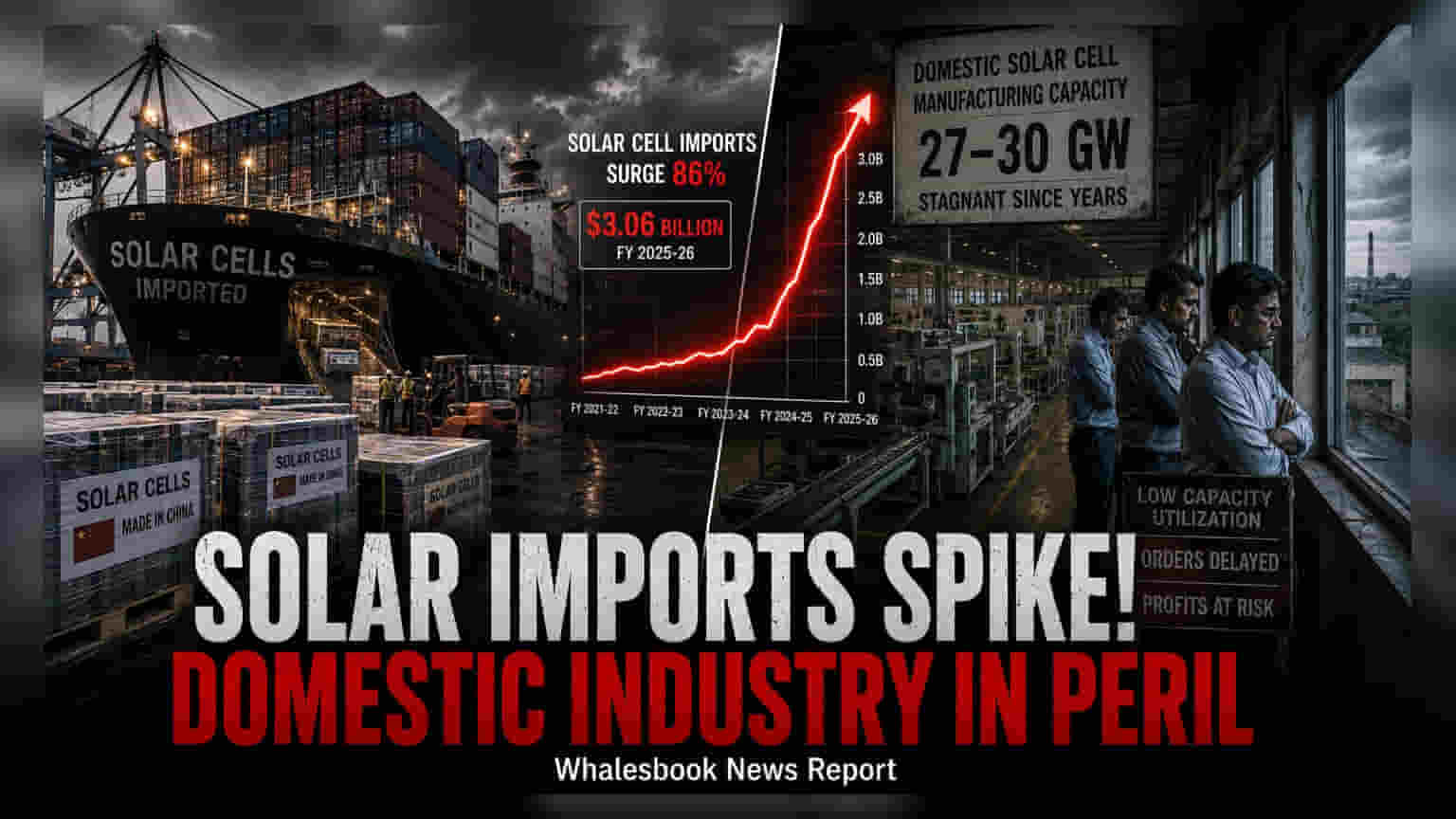
Solar cell imports reached $3.06 billion in FY 2025-26, rising 86% despite government push for domestic manufacturing. A new mandate requiring local cells for specific projects has triggered supply shortages and factory shutdowns for smaller module makers. Investors should note the widening gap between India's 200 GW module assembly capacity and its limited 30 GW cell manufacturing capacity, which creates significant margin pressure and project risks.
India’s aggressive push toward renewable energy faces a significant supply chain hurdle. In FY 2025-26, solar cell imports surged by 86% to reach $3.06 billion, highlighting a critical dependence on foreign suppliers for the technology-intensive core of solar panels. While India has scaled its solar module assembly capacity to over 200 GW, the domestic capacity to manufacture solar cells—the key component—remains stagnant at approximately 27 to 30 GW. This structural imbalance forces module manufacturers to rely heavily on imports to meet the country's rising demand for solar power.
Capacity Mismatch and Operational Risks
The gap between module assembly and cell manufacturing creates a fragile supply chain. Solar cells account for nearly half the value of a finished module, making them the most critical technology component. Because India lacks sufficient domestic cell production to feed its massive module assembly lines, manufacturers are highly sensitive to global price fluctuations and supply delays. The current situation has effectively created a bottleneck: module manufacturers are operating with low capacity utilization or relying on expensive, imported components, which directly squeezes their profit margins.
The Impact of New Policy Mandates
The operational environment became more complex on June 1, 2026, when the government implemented a mandate requiring the use of domestically produced solar cells for net-metering, open-access, and certain rooftop solar projects. While the goal of this policy is to force long-term localization and reduce import dependency, the immediate effect has been supply disruption. Because domestic production of cells is not yet sufficient to meet the new requirement, many small and mid-sized module manufacturers have faced acute shortages. Reports indicate that approximately one-third of these smaller firms have had to halt operations, unable to secure the necessary cells to fulfill orders or comply with the new domestic content rules.
Investor Perspective on Value Chain
Investors looking at the solar sector should distinguish between different business models. Companies that have vertically integrated their operations—meaning they produce both solar cells and modules—may be better positioned to navigate these shortages. They are less reliant on third-party supply and can control their input costs better. Conversely, pure-play module assemblers face a dual challenge: they are struggling with the higher cost of domestic cells (where available) and the potential loss of business for projects where domestic cells are mandatory but unavailable.
Beyond immediate manufacturing issues, this situation introduces project execution risk. If solar power developers cannot source the required modules because cell supply is tight, the commissioning of utility-scale projects may be delayed. Such delays can trigger penalty clauses in power purchase agreements and lead to revenue recognition issues for the power producers involved. Looking ahead, the most critical monitorable will be the commissioning timelines for the 14+ GW of new cell capacity currently under construction. Investors will also need to track whether global solar cell prices remain stable and if the government provides any interim relief to help smaller manufacturers bridge the gap until domestic production scales up.