

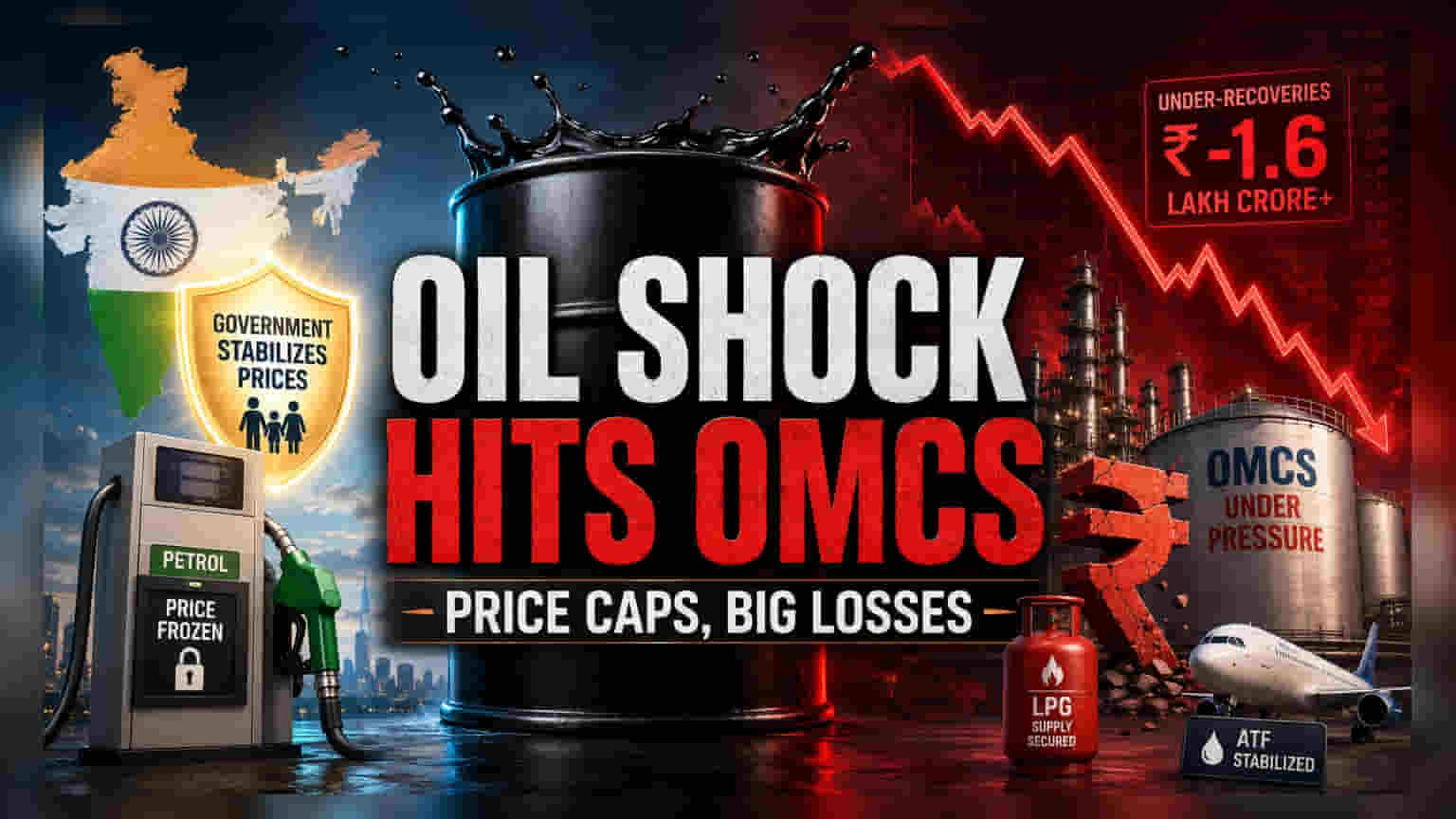
The Indian government managed a recent oil price shock through fuel price caps and supply-side measures. While this stabilized retail fuel and airline operations, it placed a heavy financial burden on state-run Oil Marketing Companies (OMCs). These companies are now facing estimated quarterly losses of ₹1 lakh crore to ₹1.2 lakh crore due to selling fuel below cost.
Managing the Oil Shock
India recently navigated a period of intense oil market volatility through a series of government interventions. To prevent sharp spikes in fuel costs for the public, authorities implemented excise duty cuts and directed Oil Marketing Companies (OMCs) to hold fuel prices steady for over two months. This strategy was designed to protect consumers and prevent panic during the disruption.
Beyond basic retail fuel, the government took steps to stabilize the aviation sector. A ₹10,000 crore Aviation Turbine Fuel (ATF) price stabilization fund was approved. This fund allows airlines to purchase jet fuel at a fixed rate, with OMCs absorbing the losses from these below-cost sales. Additionally, to address potential supply shortages, the government invoked the LPG Control Order, mandating that refineries maximize LPG production. This successfully increased daily domestic LPG output from 35,000 tonnes to 54,000 tonnes within a week.
The Financial Impact on OMCs
These measures have come at a significant cost to the balance sheets of OMCs. When the companies are forced to sell fuel at prices lower than the cost of procurement—a situation known as under-recovery—their profit margins are directly affected.
Estimates suggest that current-quarter losses for OMCs could fall between ₹1 lakh crore and ₹1.2 lakh crore. The daily under-recovery is currently estimated at approximately ₹650 crore. This financial strain is partly due to the fact that OMCs were purchasing crude oil at higher prices during the disruption, while retail prices remained capped. For instance, while the import cost of an LPG cylinder rose significantly, the price for consumers under the Ujjwala Yojana was kept at ₹642, creating a wide gap between cost and selling price.
Inventory and Operational Context
Operating in this environment requires significant inventory management. Indian Oil Corporation Limited (IOCL), for example, maintains a buffer of roughly 40-45 million barrels of crude oil, providing approximately 28 days of coverage. While this inventory helps ensure supply security, holding it during a period of high procurement costs adds to the pressure on the companies' cash flows.
What Investors Should Watch Next
Investors may keep a close eye on a few key areas following this event. First, the upcoming quarterly financial results of the state-run OMCs will be the primary indicator of how these under-recoveries have impacted net profits and debt levels. Second, any potential government compensation or subsidy support to offset these losses will be crucial, as this would improve the companies' financial position. Finally, the trajectory of crude oil prices will determine if the daily under-recovery continues or begins to narrow, as lower global prices would ease the pressure on these companies.