

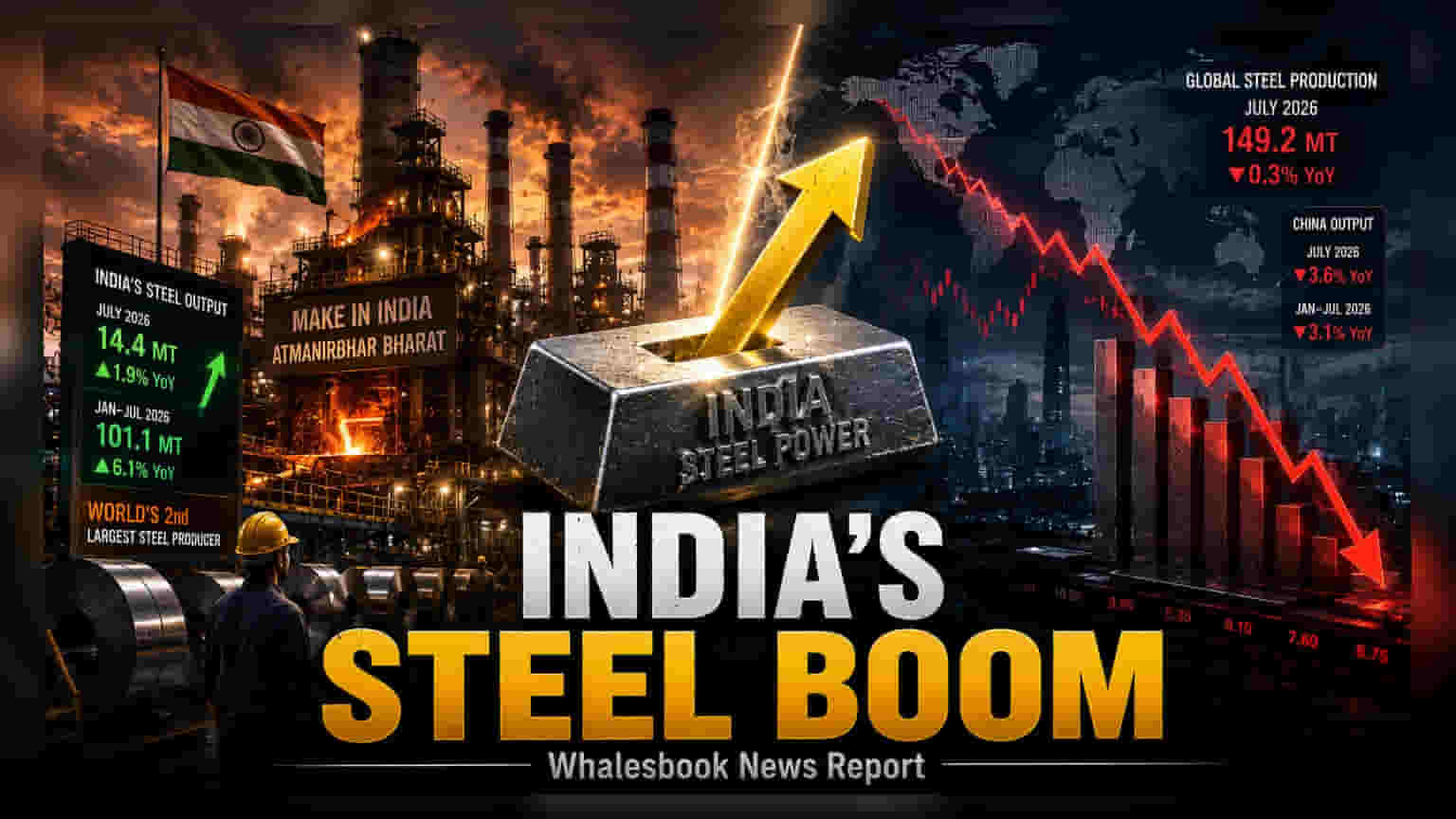
India produced 14.4 million tonnes of crude steel in July 2026, marking a 1.9% increase even as global production dipped. The growth highlights India's resilience against the global slowdown, though investors continue to watch for impacts from import competition and raw material price volatility.
India’s steel sector demonstrated resilience in July 2026, with crude steel production climbing 1.9% year-on-year to 14.4 million tonnes. This growth stands in contrast to the global trend, where production across 70 reporting countries slipped by 0.3% to 149.2 million tonnes during the same period. For the January–July 2026 window, India recorded a stronger performance, with output rising 6.1% to 101.1 million tonnes, cementing the nation’s status as the world's second-largest steel producer.
Divergent Trends and the China Factor
The gap between India’s production trajectory and the global average is largely driven by different regional economic conditions. While India's growth is supported by steady domestic demand from infrastructure and construction projects, major global producers are facing pressure. China, the world's largest steel producer, saw its output contract by 3.6% in July, with a 3.1% decline for the year to date.
When global production falls and major markets like China slow down, it often leads to uncertainty in global steel prices. For Indian investors, the key implication is monitoring how this global dip influences the balance between domestic consumption and international trade. While India is a major producer, the industry remains sensitive to global price trends that can affect export realisations and import pricing.
Key Monitorables for the Sector
While rising output signals strong domestic demand, the steel industry faces several operational realities that investors track closely to understand long-term profitability. Raw material costs, particularly for coking coal, remain a significant variable. Since coking coal is largely imported, price volatility can create sudden pressure on operating margins for steel manufacturers.
Another critical area for the sector is the competitive landscape. As global demand remains uneven, Indian steelmakers must manage competition from imports. Even with domestic growth, the industry faces the challenge of balancing high capital spending, which is necessary for capacity expansion and green energy transitions, against the risk of margin compression if domestic prices do not hold up against imported steel products.
Looking ahead, market participants will likely focus on India's finished steel consumption trends and whether the current production pace can be sustained through the second half of the year. The industry's ability to maintain high capacity utilisation while managing input costs and import pressures will remain a defining factor for financial performance in the coming quarters.