

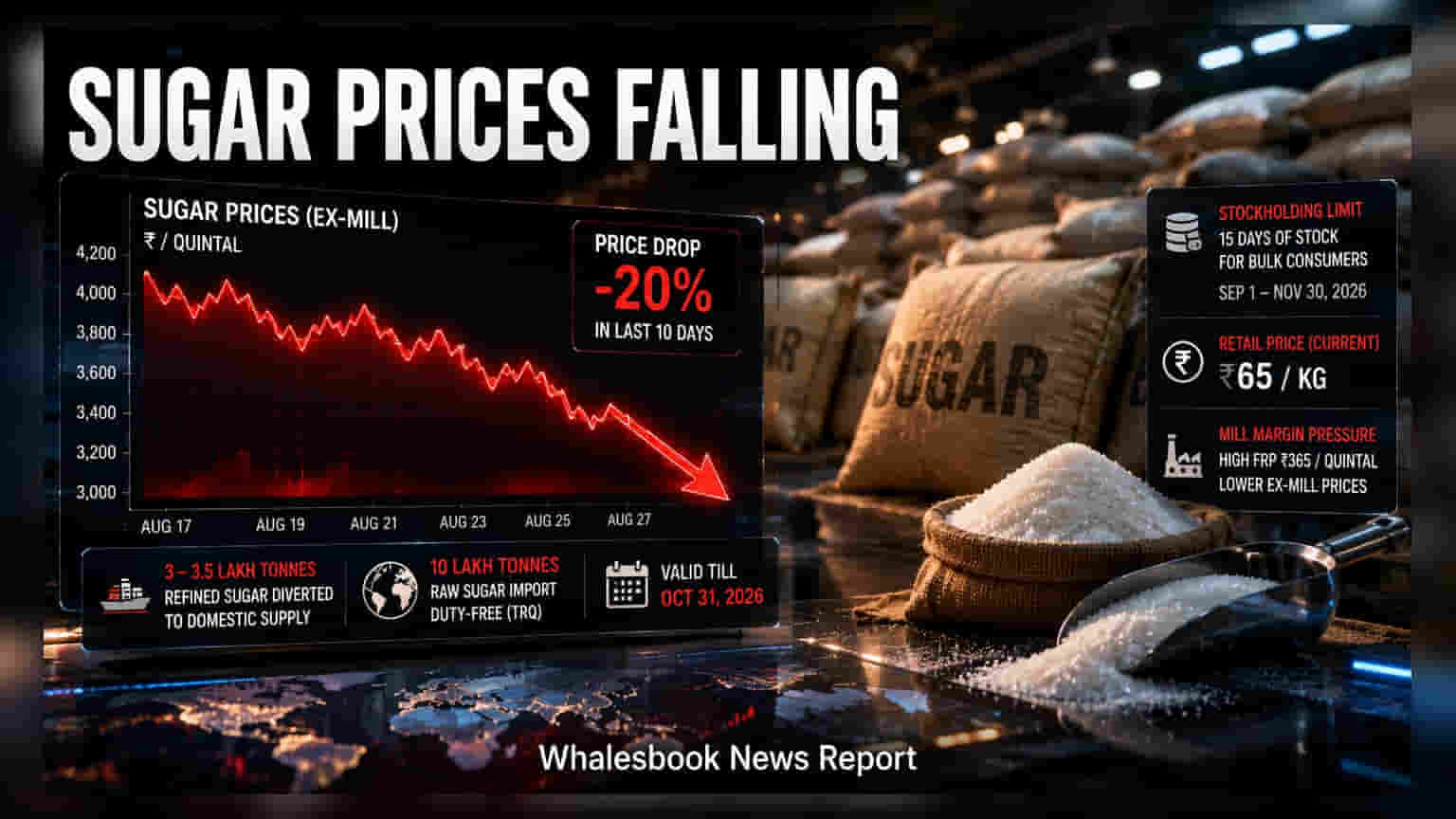
Domestic sugar prices have fallen by 20% at the wholesale level following government moves to ease supply constraints. Authorities have allowed duty-free imports of 10 lakh tonnes and diverted 3.5 lakh tonnes of export-bound sugar to the local market. While this curbs retail inflation, it shifts the focus to profit margins for sugar companies, who face high sugarcane procurement costs.
The domestic sugar market is undergoing a significant price correction as the government implements measures to increase supply and control inflation ahead of the festive season. Ex-mill sugar prices have retreated by approximately 20% over the last ten days, reversing a trend of sharp increases that were largely driven by speculative hoarding rather than actual production shortages.
To stabilize the market, the government has cleared the diversion of 3 to 3.5 lakh tonnes of refined sugar—originally intended for export—into the domestic supply chain. Furthermore, the administration has authorized the duty-free import of 10 lakh tonnes of raw sugar under a Tariff Rate Quota, which remains valid through October 31, 2026. These combined efforts aim to ensure that domestic buffer stocks remain sufficient to meet demand during the high-consumption months of the year.
The Impact on Sugar Mill Margins
While the drop in wholesale sugar prices provides relief for retail inflation, it creates a challenging environment for sugar producers. Indian sugar mills are currently operating under a high-cost structure, with the Fair and Remunerative Price (FRP) of sugarcane for the 2026-27 season fixed at ₹365 per quintal. When ex-mill sales prices fall, mills face a potential squeeze on their profit margins, as the cost of raw material procurement remains fixed and high. Investors tracking sugar companies should monitor whether these firms can maintain profitability if wholesale sugar realizations stay at these lower levels for an extended period.
New Regulatory Constraints
Beyond supply adjustments, the government has tightened regulations on inventory management to prevent future price manipulation. New rules have been introduced that cap stockholding limits for bulk consumers at 15 days of stock, effective from September 1 to November 30, 2026. This move is designed to force existing inventory into the market and prevent large buyers from hoarding sugar to drive up prices.
What Investors Should Monitor Next
The retail price of sugar, currently hovering around ₹65 per kg, has yet to fully reflect the 20% correction seen at the ex-mill (wholesale) level. The key monitorable for the coming weeks will be how quickly this wholesale price reduction translates into lower costs for the end consumer. Additionally, while the current supply measures provide short-term stability, the long-term outlook for the sector remains tied to the 2026-27 crop cycle. Investors should track updates on weather patterns and acreage, as any potential supply disruption could reignite price volatility regardless of current government interventions.