

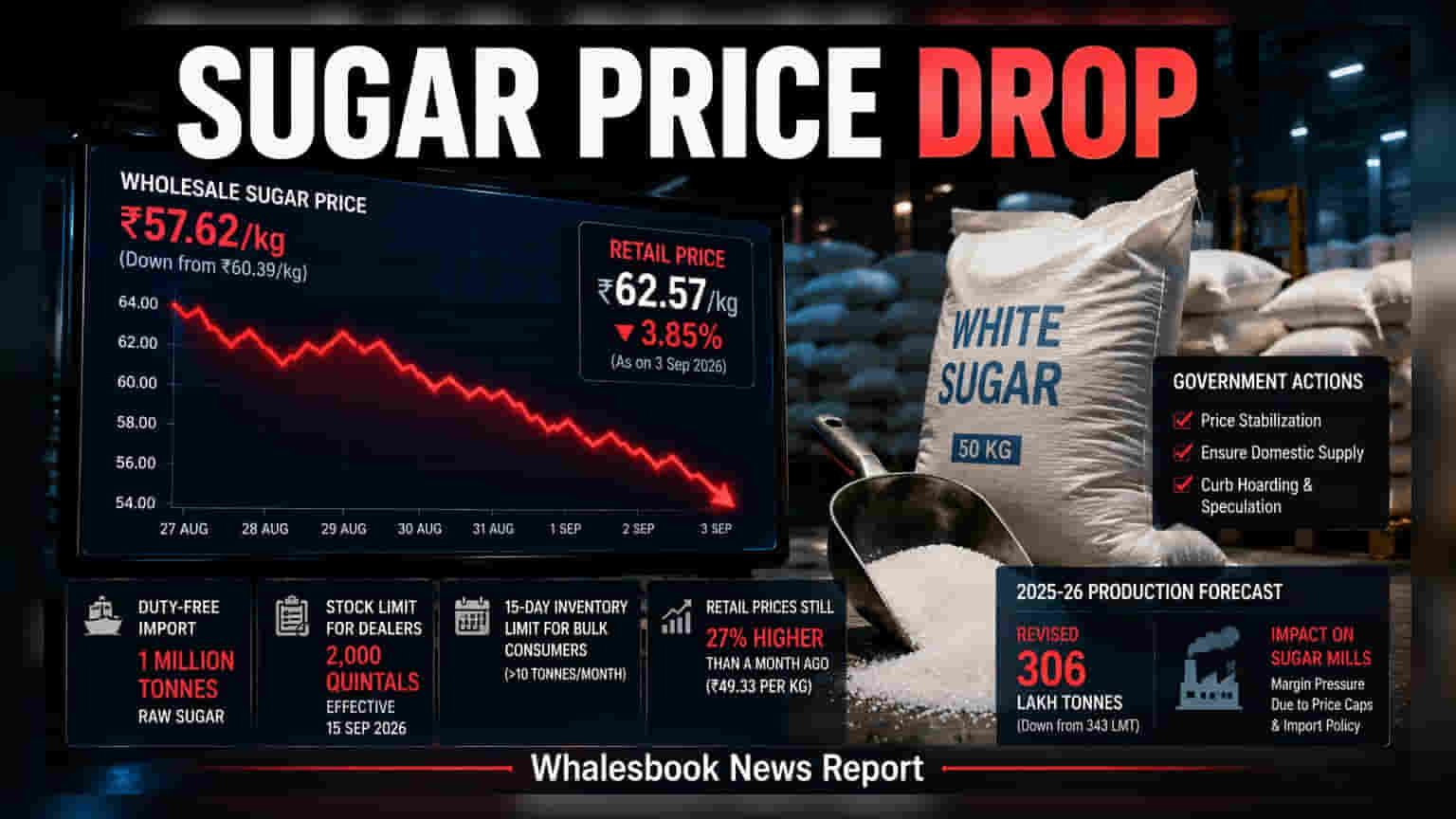
Retail sugar prices in India have fallen 3.85% to ₹62.57 per kg following government orders to increase imports and cap dealer inventory. While wholesale rates have dropped to ₹57.62 per kg, retail prices still remain 27% higher than last month. Investors are now tracking how these new regulatory stock limits may impact the profit margins of domestic sugar mills.
Retail sugar prices across India have retreated by 3.85% to ₹62.57 per kg as of September 3, 2026, responding to swift government intervention in the commodities market. To manage domestic supply and curb price volatility, the government has authorized the duty-free import of 1 million tonnes of raw sugar. Additionally, new regulatory measures include stricter stockholding limits, with dealer inventory caps reduced to 2,000 quintals effective September 15, 2026, and a 15-day inventory restriction for bulk consumers purchasing over 10 tonnes monthly.
Wholesale Price Impact and Retail Lag
The government's efforts have successfully pushed wholesale sugar prices down to ₹57.62 per kg, compared to ₹60.39 per kg just one week ago. However, consumers are seeing a slower decline at the retail level. This is primarily due to a structural time lag in the supply chain. Retailers typically hold inventory purchased at higher market rates and remain reluctant to lower prices until they liquidate these older stocks. Industry trends indicate that retail price adjustments generally trail wholesale movements by approximately ten days as these supply chains reset.
Impact on Sugar Producers
For investors in sugar manufacturing companies, these regulatory actions present a complex outlook. While the government maintains that domestic availability is sufficient, it has revised the 2025-26 production forecast downward to 306 lakh tonnes, significantly lower than the initial estimate of 343 lakh tonnes. When the government enforces import quotas and inventory caps to control prices, sugar mills may find it difficult to benefit from the price spikes that typically occur during supply constraints. This creates potential margin pressure for producers, as their ability to pass on cost increases is limited by government intervention.
Sector and Consumer Context
Despite the recent dip, retail sugar prices are still 27% higher than they were a month ago, when the average stood at ₹49.33 per kg. This continues to create input cost pressure for FMCG and packaged food companies that rely heavily on sugar as a raw material. While the current policy measures aim to stabilize prices, the margin for error remains thin, with annual domestic demand consistently sitting between 280 and 285 lakh tonnes.
Investors may track the next set of quarterly results for major sugar producers to see if these inventory limits and pricing controls impact operating margins. The long-term performance of these stocks will likely depend on whether the government continues to rely on import interventions to keep prices in check, or if domestic production stabilizes in the coming months.