 Whalesbook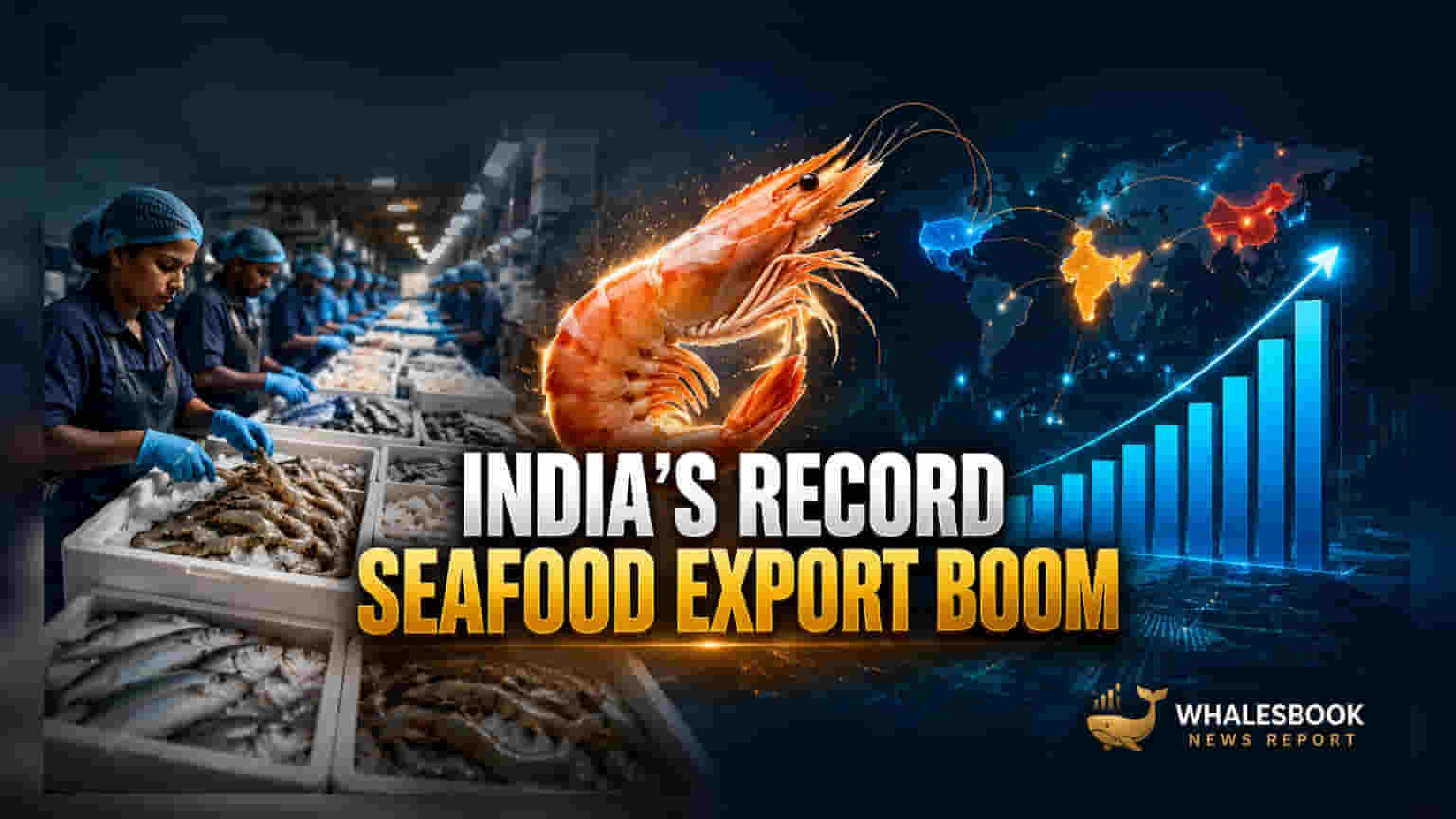


The Valuation Gap
The record-breaking $8.46 billion in export value obscures a growing divergence between total revenue and core market sustainability. While the Marine Products Export Development Authority (MPEDA) emphasizes the topline growth of 13.16 percent in rupee terms for the frozen shrimp category, the underlying trade data reveals a narrowing margin of safety. The industry is currently contending with a bifurcated global demand profile: robust volume absorption in China contrasted sharply by a double-digit decline in U.S. purchasing activity. This suggests that while Indian exporters have successfully bypassed domestic saturation, they remain highly susceptible to shifting regulatory and consumption patterns in their largest legacy markets.
The Analytical Deep Dive
When benchmarking against previous fiscal periods, the shift in trade partners is stark. The 19.51 percent volume drop in U.S. shipments reflects a cooling of consumer discretionary spending in North America, compounded by intensifying competition from Latin American producers like Ecuador, who often benefit from more favorable proximity and logistics costs. Unlike historical performance, where the U.S. market acted as a reliable engine for premium-priced shrimp, the current reliance on China—which now leads in total volume imports at 4,90,369 metric tonnes—introduces significant geopolitical and price-sensitivity risks. Diversification into dried seafood and cuttlefish, which saw a 78.05 percent jump in rupee value, is a necessary pivot, yet these segments lack the scale to offset volatility in the primary frozen shrimp channel.
The Forensic Bear Case
From a risk-management perspective, the sector’s dependence on a single product category—frozen shrimp accounting for over 66 percent of dollar earnings—is a structural weakness that limits pricing power. Smaller exporters, in particular, remain vulnerable to sudden antidumping duties or sanitary-phytosanitary measures that have historically plagued Indian seafood access to the European Union and the United States. Furthermore, the extreme concentration of shipping activity through the Visakhapatnam and JNPT hubs creates a logistical bottleneck; any disruption at these ports acts as a systemic threat to the entire supply chain. Management teams across the sector are also facing increasing pressure to modernize processing infrastructure to meet stringent global sustainability certifications, a capital-intensive requirement that could compress operating margins in the near term.
The Future Outlook
Analysts expect the focus for the remainder of the 2026 calendar year to remain on capturing market share in Southeast Asia to compensate for stagnant U.S. demand. Future guidance suggests that exporters who successfully transition from bulk commodity supply to value-added, processed seafood will likely command higher margins. However, the overall sector trajectory remains tethered to global inflation metrics and the ability of producers to navigate the escalating costs of cold-chain logistics and energy-intensive processing.