

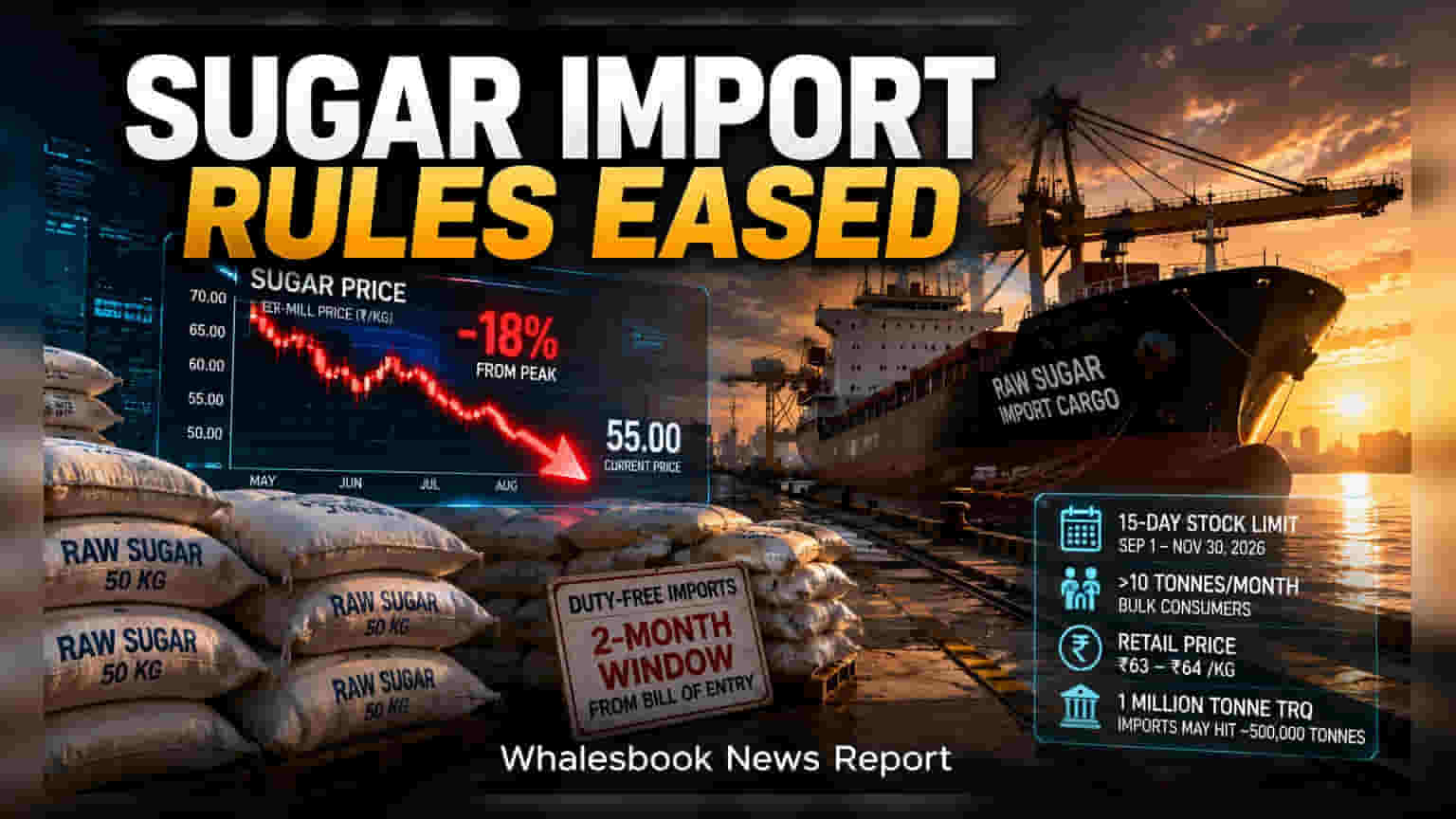
The government has replaced the fixed October 31 deadline for duty-free sugar imports with a two-month rolling window to assist refiners with logistics. While this eases operations, domestic ex-mill prices have corrected by 18%, causing importers to scale back their plans. Investors should monitor how these shrinking import margins and new bulk stock-holding limits impact the profitability of sugar refiners in the coming months.
The Directorate General of Foreign Trade (DGFT) has updated the rules for duty-free raw sugar imports, replacing the fixed October 31, 2026, deadline with a more flexible two-month window. Under this new mandate, importers have two months from the date of filing their Bill of Entry to refine and sell the imported stock. This change aims to provide relief to the industry, which has been struggling with logistical delays, including port congestion in Brazil, that made the previous fixed timeline impractical.
While the policy shift offers operational flexibility, the commercial incentive to import has weakened. Domestic ex-mill sugar prices have corrected by approximately 18% from their recent peak of ₹67 per kg, settling at around ₹55 per kg. For refiners, this sharp fall in wholesale prices narrows the profit margin between imported raw sugar costs and local selling prices. Industry estimates suggest that of the government's 1-million-tonne tariff-rate quota (TRQ), actual imports may struggle to reach the 500,000-tonne mark as refiners reassess their risk and inventory costs.
Despite the cooling in ex-mill prices, the government continues to prioritize the management of retail food inflation. Officials have implemented a 15-day stock-holding limit for bulk sugar consumers—those utilizing more than 10 tonnes per month—effective from September 1 to November 30, 2026. This regulatory step is designed to prevent inventory hoarding and stabilize supply, as retail prices remain relatively elevated at ₹63 to ₹64 per kg compared to the falling wholesale rates.
For investors, the current environment presents a mix of challenges. Shrinking margins in the refining business could impact the profitability of companies that were previously banking on imports to boost their earnings. Furthermore, the sector remains highly sensitive to policy decisions regarding the upcoming 2026-27 season, particularly the government's stance on sugarcane diversion to ethanol. Any adjustments to the ethanol blending mandate will be a critical factor for the industry, as it dictates how much sugar remains available for the domestic market. Investors should track these inventory levels, refining volumes, and any further policy shifts as the new crushing season approaches.