

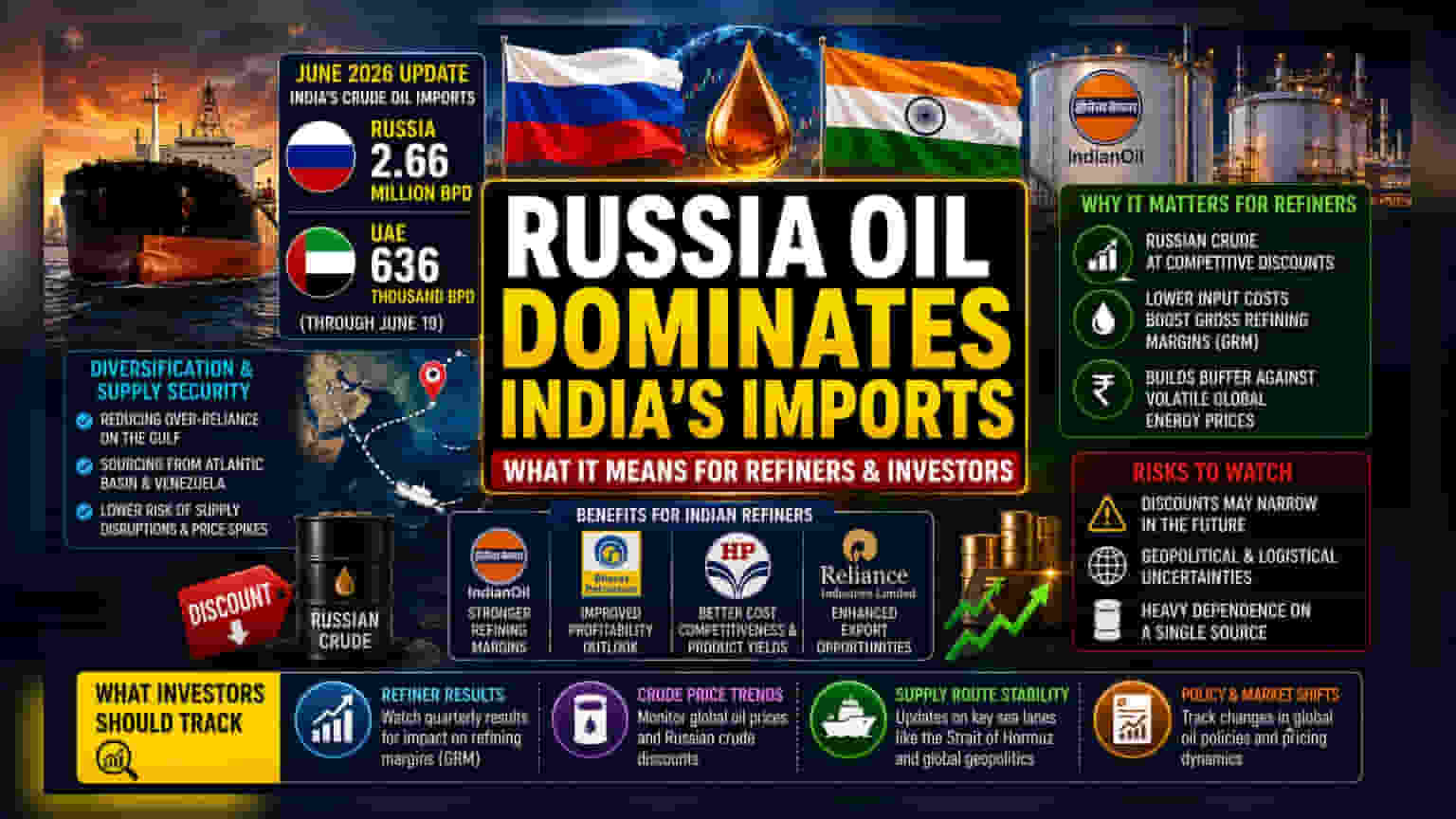
India’s crude oil imports from Russia rose to 2.66 million barrels per day in June, up from 1.91 million in May. This strategy helps secure energy supplies amidst supply chain uncertainties. For investors, this shift is a key driver for the profit margins of Indian oil refining companies.
What Happened
India has significantly increased its reliance on Russian crude oil, with daily imports hitting 2.66 million barrels per day (bpd) in June 2026. This marks a sharp rise from the 1.91 million bpd recorded in May. Meanwhile, imports from the United Arab Emirates (UAE) remained steady, averaging 636,000 bpd through June 19. This data confirms Russia’s position as the leading oil supplier to India, as the country continues to prioritize secure and cost-effective energy sources.
Why This Matters For Refiners
For Indian oil refining companies—such as Indian Oil Corporation (IOC), Bharat Petroleum (BPCL), Hindustan Petroleum (HPCL), and private players like Reliance Industries—the source of crude oil directly impacts profitability. Russian crude has historically been available at competitive discounts compared to other global benchmarks. When Indian refiners source cheaper oil, it often helps expand their Gross Refining Margins (GRM), which is essentially the profit made from converting crude oil into fuel products like petrol, diesel, and jet fuel. Increased intake of discounted Russian barrels acts as a buffer against volatile global energy prices.
Diversification and Supply Security
The move to increase Russian imports is part of a broader strategy to secure energy supply lines. India has historically relied heavily on the Gulf region for oil. However, geopolitical complexities, including concerns regarding the Strait of Hormuz—a vital maritime route for global energy transit—have prompted New Delhi to broaden its supplier base. By sourcing more from the Atlantic Basin and Venezuela alongside Russia, India is attempting to minimize the risk of supply disruptions that could spike energy costs.
The Geopolitical Context
Global energy markets are currently reacting to evolving conditions in the Middle East. While there are expectations that oil flows through the Strait of Hormuz may stabilize following reports of a US-Iran ceasefire, the recovery is likely to be gradual. Different fuel types will likely see different speeds of normalization, with Liquefied Petroleum Gas (LPG) expected to recover faster than crude oil or Liquefied Natural Gas (LNG).
Risks and Market Realities
While the reliance on Russian crude supports profit margins, it does introduce specific risks. If global discounts on Russian oil narrow or disappear, the cost advantage for Indian refiners could diminish. Furthermore, relying heavily on a single source of supply requires constant monitoring of geopolitical relations and logistical routes. Investors should also watch for any shifts in global oil policy or changes in the pricing gap between Russian crude and Middle Eastern alternatives.
What Investors Should Track
Investors should keep an eye on the quarterly financial results of major Indian oil companies to see if the increased reliance on Russian crude is translating into sustained or improved refining margins. Additionally, monitoring global crude oil price trends and any official updates on the stability of energy supply routes will be crucial for understanding the sector's performance in the coming months.