

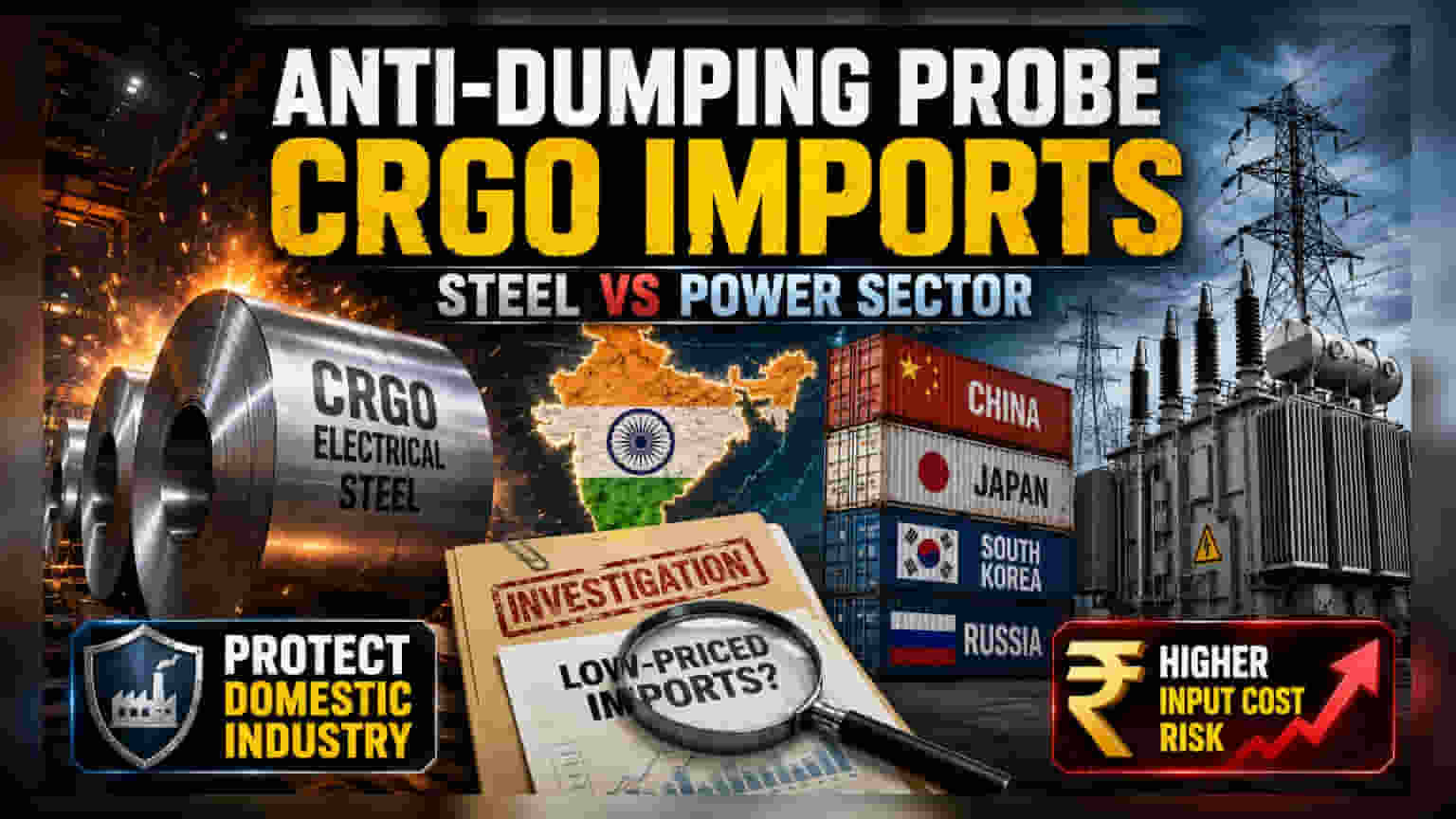
The Directorate General of Trade Remedies (DGTR) has launched an anti-dumping investigation into CRGO electrical steel imports from countries including China and Japan. The move follows a complaint from JSW JFE Electrical Steel. While aimed at protecting domestic production, the investigation highlights a significant risk for power equipment manufacturers, as India relies heavily on imports to meet its massive grid expansion needs.
What Happened
The Directorate General of Trade Remedies (DGTR), the government body responsible for trade investigations, has officially started a probe into the import of Cold Rolled Grain Oriented (CRGO) electrical steel and amorphous metal. The investigation covers imports originating from China, Japan, South Korea, and Russia. This move was triggered by a complaint from JSW JFE Electrical Steel Nashik Pvt. Ltd., the only domestic manufacturer of this specialized steel in India.
The core allegation is that these countries are selling CRGO steel in the Indian market at unfairly low prices, known as dumping. The company claims this practice is hurting the local steel industry. The DGTR will now examine if these imports are entering the country below their fair value and causing injury to domestic production.
Why It Matters For The Power Sector
CRGO steel is a vital component for manufacturing transformers, which are essential for the country's power transmission and distribution network. India has ambitious plans to expand its power grid, with massive investments planned through 2032. This includes adding thousands of kilometers of transmission lines and significantly increasing transformer capacity.
The challenge for investors is that India currently imports approximately 90% of its CRGO steel requirements. Domestic production capacity is currently very small—estimated at 40,000 to 50,000 tonnes—compared to the projected annual demand of 400,000 to 450,000 tonnes. If the government decides to impose anti-dumping duties, it could lead to a sharp rise in the cost of CRGO steel. Transformer manufacturers, who are already operating in a competitive environment, may face pressure to absorb these higher raw material costs or pass them on to utility companies.
The Balancing Act
For investors, this situation presents a classic trade-off between protecting local manufacturing and ensuring cost-effective infrastructure development. The complainant, JSW JFE Electrical Steel, became the sole domestic producer in early 2025 after acquiring a plant in Nashik. The government is now forced to weigh the health of this domestic unit against the potential impact on transformer costs.
Critically, the industry has noted that imported CRGO coils are already subject to strict quality certification by the Bureau of Indian Standards (BIS). This suggests the current probe is focused entirely on the pricing and competitive landscape rather than any concerns about the quality of the imported steel. If duties are implemented, it could change the cost structure for various listed companies that supply power equipment to the government and private sector.
What Investors Should Track
The most important monitorable for investors is the progress and outcome of the DGTR investigation. Specifically, investors should track:
- Whether the government recommends imposing new duties and the specific rate of such levies.
- Management commentary from major transformer and power equipment companies regarding their raw material cost inflation and ability to pass on price hikes.
- Updates on the domestic production capacity ramp-up, as the current gap between supply and demand is significant.
- Any changes in the government’s timeline for the power grid expansion, as higher equipment costs could influence project execution schedules.