

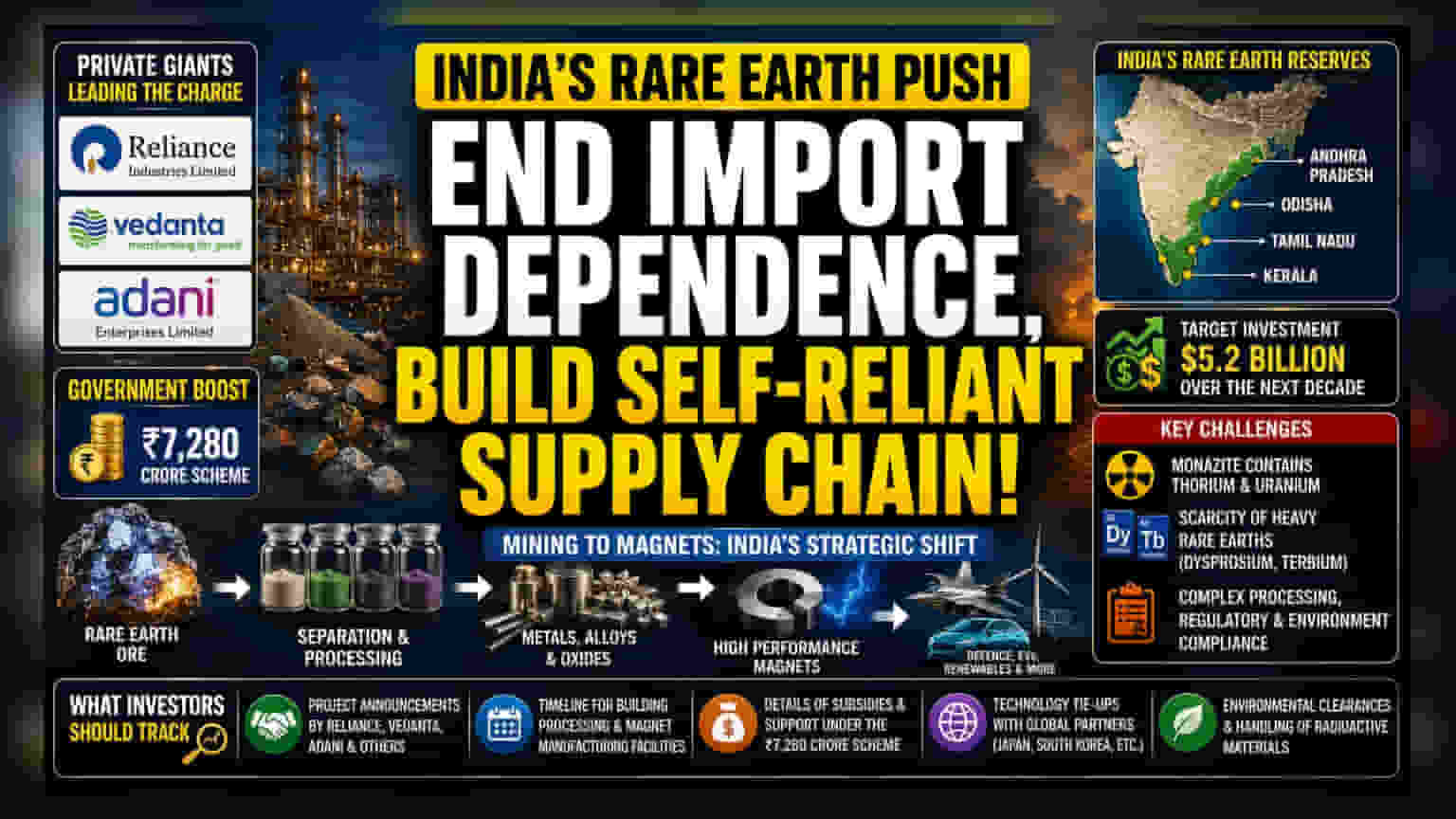
India is looking to boost its rare earth processing capabilities, inviting major firms like Reliance Industries, Vedanta, and Adani Enterprises to join the effort. The government has launched a ₹7,280 crore scheme to create integrated magnet manufacturing facilities, aiming to cut dependence on global supply chains.
What Happened
The Indian government is pushing to develop the country’s rare earth processing capabilities, seeking to end reliance on global suppliers, particularly China. To achieve this, the government is looking to bring in major private sector players, including Reliance Industries, Vedanta, and Adani Enterprises. The initiative focuses on building a complete industrial chain—from mining raw ore to producing high-performance magnets used in defense, electric vehicles, and renewable energy.
To kickstart this, the government has approved a ₹7,280 crore scheme. This plan aims to set up an integrated capacity of 6,000 tonnes per annum for manufacturing permanent magnets. The government is also targeting roughly $5.2 billion in total investment for the rare earth and titanium sectors over the next decade.
The Strategic Shift
India has significant reserves of rare earth minerals, especially in beach sands across coastal states like Andhra Pradesh, Odisha, Tamil Nadu, and Kerala. However, the country has historically lacked the facilities to process these raw materials into high-value products like separated oxides, metals, and alloys. Currently, public sector firm IREL (India) Limited manages much of this, but large-scale industrial processing is missing.
By involving private conglomerates, the government aims to bridge this "missing middle" of the value chain. Reliance, Vedanta, and Adani are among the companies that have shown interest in the space, particularly for facilities in Andhra Pradesh, a state which holds massive beach sand mineral resources.
The Processing Challenge
While the plan is ambitious, investors should understand the complexities involved. The primary challenge is not just the volume of ore, but its nature. Indian monazite deposits often contain radioactive elements like thorium and uranium. This complicates the mining and processing process, as it requires strict regulatory compliance and specialized handling, which can increase operational costs and time for project execution.
Furthermore, the composition of India’s rare earth reserves is skewed toward light rare earths. There is a notable scarcity of heavy rare earths, such as dysprosium and terbium, which are essential for magnets that perform well in high-temperature environments. This means that while India can build processing capacity, it may still face hurdles in sourcing specific materials required for high-end technology applications.
How Investors May Read This
This move represents a long-term strategic play rather than an immediate revenue driver for the companies involved. Success will depend on the government’s ability to create a clear, bankable framework that handles regulatory and environmental risks efficiently.
Investors should view this as a potential growth area that requires high capital spending and carries execution risk. Because the sector involves radioactive materials and complex technology, projects may face delays if environmental clearances or technology partnerships with global experts—such as those from Japan or South Korea—do not materialize as expected.
What Investors Should Track Next
For shareholders and market observers, the next important milestones will be the formal project announcements by the interested private firms. Key monitorables include the timeline for setting up these facilities, the specific details of the government subsidies or support under the ₹7,280 crore scheme, and any progress in technology tie-ups. Additionally, monitoring how companies manage the environmental and regulatory requirements for handling radioactive minerals will be crucial to assessing the long-term viability and profitability of these investments.