

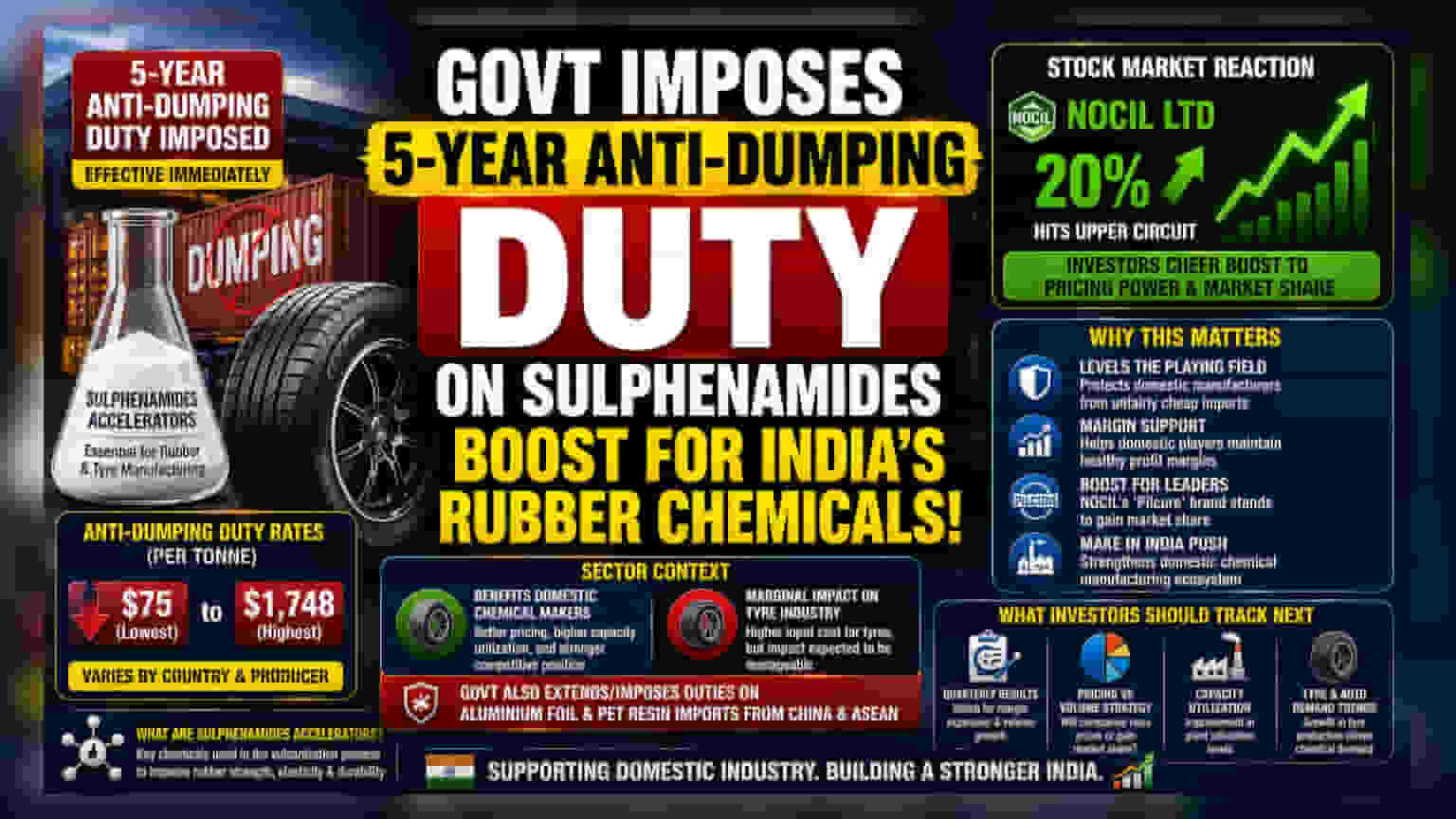
India has introduced a five-year anti-dumping duty on 'Sulphenamides Accelerators' imported from China, the European Union, and the United States, with levies ranging from $75 to $1,748 per tonne. This regulatory move aims to protect domestic manufacturers from unfairly priced imports and resulted in a 20% surge in shares of leading local producer NOCIL.
What Happened
The Indian government has imposed a five-year anti-dumping duty on the import of 'Sulphenamides Accelerators,' a chemical essential for rubber and tyre manufacturing. The decision follows a recommendation from the Directorate General of Trade Remedies (DGTR), the commerce ministry's investigation wing, which concluded that these chemicals were being exported to India at prices below their fair market value. This practice, known as dumping, was found to cause financial injury to domestic manufacturers. The finance ministry's notification, effective immediately, sets varying duty rates between $75 and $1,748 per tonne, depending on the country of origin and the specific producer.
How The Stock Reacted
The market responded sharply to this development, particularly regarding domestic chemical producers. NOCIL Ltd, India's largest manufacturer of rubber chemicals, saw its share price surge by 20% during the session, hitting the upper circuit limit. Investors appeared to interpret the protectionist measure as a catalyst for improved pricing power and potential market share gains for the domestic leader, which manufactures these accelerators under its 'Pilcure' brand.
Why This Matters For The Business
Sulphenamides are primary accelerators used in the vulcanization process—a critical step in turning raw rubber into durable tyre compounds. By making imported alternatives more expensive, the government is essentially creating a level playing field for domestic firms. Historically, the domestic rubber chemical industry has faced intense competition from low-priced imports, which kept selling prices suppressed. With the imposition of these duties, domestic companies like NOCIL may find it easier to defend their margins against cheaper foreign rivals.
Sector Context And Risks
While this duty benefits domestic manufacturers, it is worth noting the impact on the downstream sector. The tyre and rubber processing industries are major consumers of these chemicals. Tyre companies often manage their raw material costs tightly, and the sudden increase in the cost of imported chemicals could have a marginal impact on their input expenses. However, this is a standard regulatory measure used globally to prevent predatory pricing.
Investors should also note that the Indian government has concurrently extended duties on aluminium foil imports from China, Malaysia, Thailand, and Indonesia, and imposed a new duty on PET resin from China. This indicates an active regulatory stance to protect domestic manufacturing capacity.
What Investors Should Track Next
Moving forward, the key factor for investors will be whether domestic producers use this opportunity to raise prices or to increase their sales volume by winning back clients who previously preferred cheaper imports. Investors may monitor the company’s upcoming quarterly results for any margin expansion or changes in capacity utilization. Additionally, tracking the demand trends in the domestic tyre and automotive sectors will remain essential, as the rubber chemical industry's growth is heavily tied to tyre production volumes.