

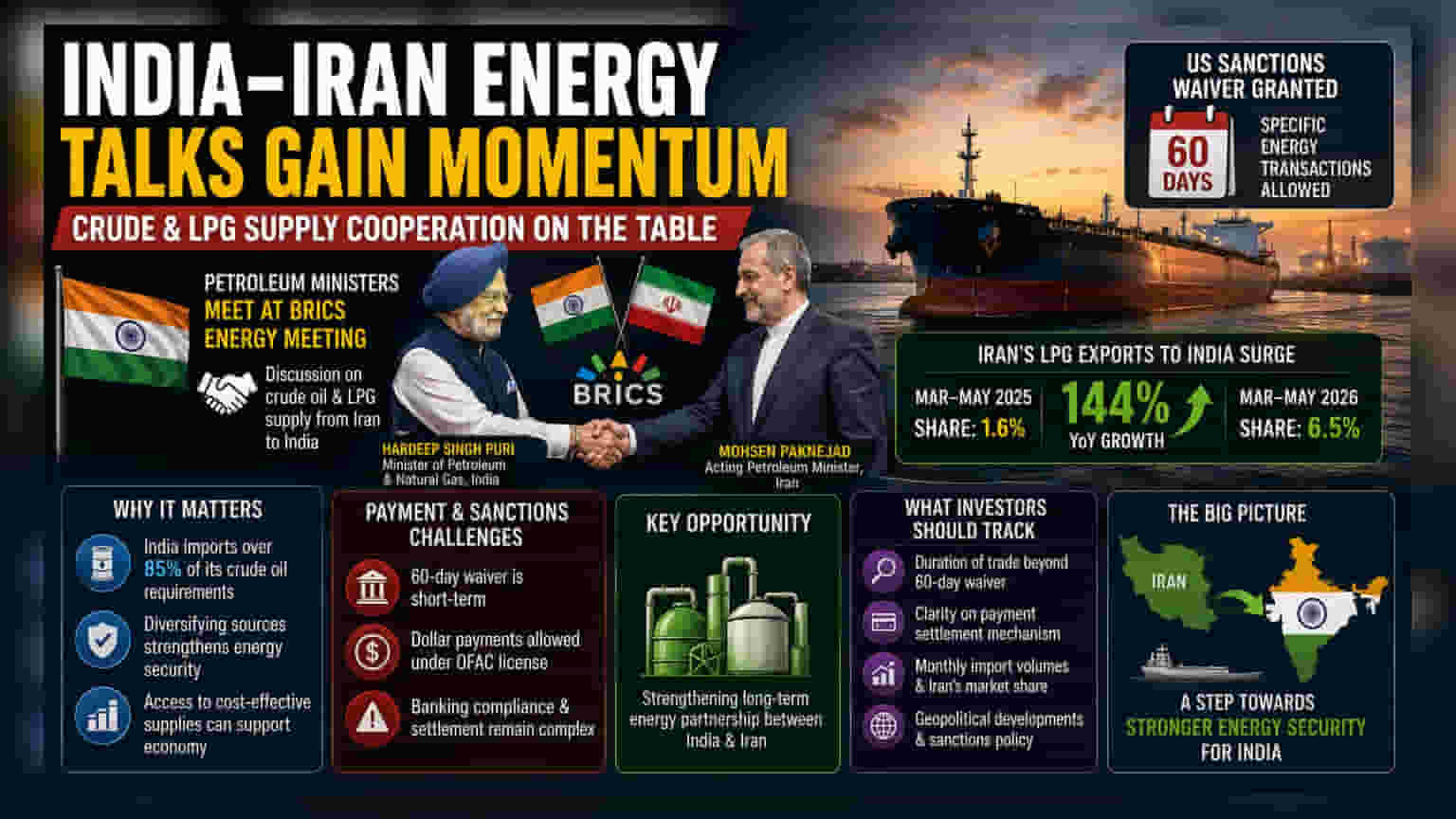
India’s Oil Minister Hardeep Singh Puri held talks with Iran’s petroleum minister to discuss increasing crude and LPG imports. While a 60-day US sanctions waiver provides a short window for trade, complex payment terms and the temporary nature of this relief remain critical factors for investors to watch.
What Happened
India’s Minister of Petroleum and Natural Gas, Hardeep Singh Puri, met with Iran’s acting Petroleum Minister, Mohsen Paknejad, on the sidelines of the BRICS Energy Ministers’ meeting. The discussion focused on potential cooperation in the energy sector, specifically targeting the supply of crude oil and refined products like liquefied petroleum gas (LPG) from Iran to India.
The talks follow a recent 60-day sanctions waiver granted by the US, allowing for specific energy transactions with Iran. This development comes at a time when India, the world’s third-largest energy consumer, is actively looking for ways to strengthen its energy security and diversify its import sources.
The Energy Import Context
India imports over 85% of its crude oil requirements. Because of this high dependence on imports, any move to secure more cost-effective supplies is closely tracked by market analysts. Iran has historically been an important supplier, though trade has been restricted due to long-standing international sanctions.
Recent data shows that Iran is already increasing its presence in the Indian market, particularly in LPG. Between March and May 2026, India’s LPG imports from Iran grew by 144% year-on-year, pushing Iran’s share of India’s total LPG imports to 6.5%, up from just 1.6% in the same period a year earlier. This indicates that trade channels between the two countries are already active.
Why Payment and Sanctions Matter
While the 60-day sanctions waiver offers a window for increased imports, it is a short-term measure. The primary challenge for Indian companies remains the payment mechanism. While the US Office of Foreign Assets Control (OFAC) has issued a license permitting dollar-denominated payments for these specific transactions, the complexity of international banking compliance when dealing with Iran remains high.
Investors may note that the lack of clear, long-term payment terms is a significant risk factor. Any uncertainty in settlement processes can lead to supply disruptions or increased costs for importing companies. Furthermore, once the 60-day waiver period expires, future trade will depend on whether this window is extended or if other arrangements are made.
What Investors Should Track
For investors monitoring energy stocks and the broader economy, the key monitorables are not just the intent to trade, but the execution of these deals.
- Duration of Trade: Watch if the 60-day waiver period results in sustained import volumes or if it remains a temporary spike.
- Payment Settlement: Any official clarity on how payments will be processed without violating long-term sanctions will be essential for trade stability.
- Import Volumes: Keep an eye on monthly energy import data to see if Iran’s share of India’s crude and LPG imports continues to rise beyond the current levels.
- Geopolitical Developments: The stability of the regional situation and its impact on future US sanctions policy will be the ultimate factor in determining if this energy cooperation can become a long-term reality.