

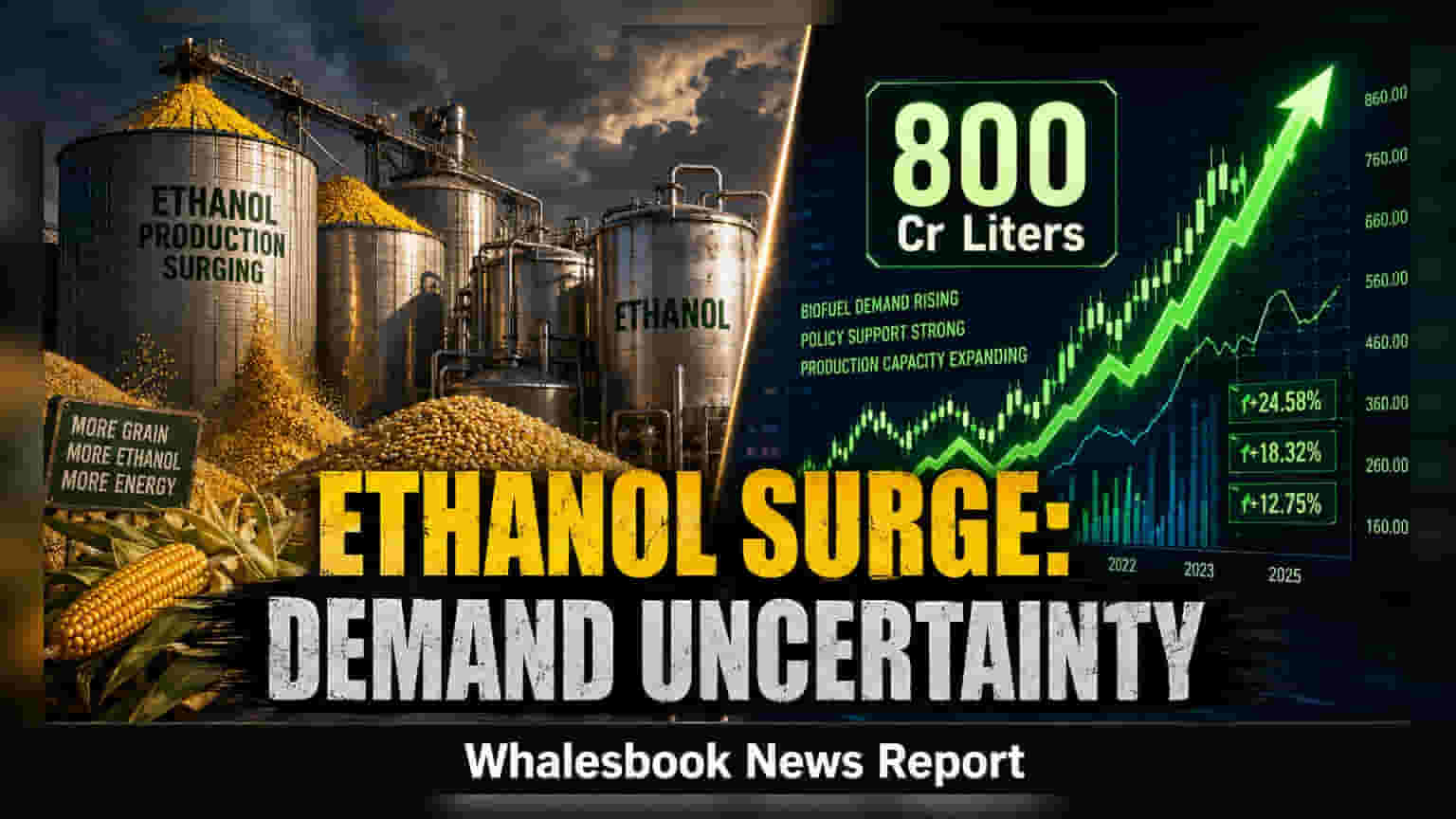
India’s ethanol production has surpassed 800 crore liters for the current supply year, driven largely by grain-based feedstocks rather than sugarcane. While this production milestone is significant, investors should track demand-side constraints, as government blending targets remain capped at 20%, raising questions about future capacity utilization.
India’s ethanol program has reached a new volume landmark, crossing 800 crore liters for the 2025-26 Ethanol Supply Year (ESY). This milestone reflects the government’s push to increase domestic biofuel production to reduce oil imports and support agricultural income. However, the data reveals a significant transformation in how this fuel is produced, which has important implications for both the sugar and grain industries.
The Shift Toward Grain Feedstocks
The most notable trend in recent months is the move away from sugarcane toward grain-based sources. In July, grain-based feedstocks—primarily maize and surplus grain from the Food Corporation of India (FCI)—accounted for approximately 76% of all ethanol produced, totaling 71 crore liters. In contrast, the contribution from sugarcane-based sources, such as molasses and juice, fell to 24%.
This shift is primarily driven by market dynamics. When sugar prices are high, mills often prioritize sugar production over converting sugarcane into ethanol. By relying more on grains, the industry has managed to keep ethanol supplies steady even when sugarcane diversion fluctuates. For investors, this means that companies in the distillery and sugar sectors are no longer tied solely to the sugarcane harvest cycle, but are now more exposed to the price and availability of grains like maize.
The Demand Conundrum
While production capacity has clearly expanded, the focus for the industry and investors is shifting toward whether this supply can be fully used. A significant hurdle is that the government has maintained its ethanol blending target at 20%. Industry associations, including the All India Distillers' Association, have pointed out that without an increase in blending targets or the widespread adoption of flex-fuel vehicles, the industry faces the risk of oversupply relative to current demand.
Furthermore, technical challenges persist. Blending ethanol into diesel remains difficult due to technical specifications, limiting its use primarily to petrol engines. This creates an infrastructure bottleneck where distilleries have built the capacity to produce more ethanol, but the market’s ability to consume it is currently capped by policy and vehicle technology.
Risks and Investor Monitorables
The reliance on grain-based ethanol introduces new variables for investors. First is the risk of food price inflation. If the government perceives that ethanol production is diverting too much grain away from food supply, it may impose restrictions, as seen in past decisions regarding the use of FCI rice. Second is the issue of feedstock cost volatility. Unlike sugarcane, which has a government-determined price, grain prices can fluctuate based on monsoon patterns, harvest cycles, and export policies.
Investors should closely track two main developments next. First, any future policy announcements regarding higher blending targets or incentives for flex-fuel vehicle adoption, which would signal a clearer demand path. Second, the movement in raw material prices, particularly maize, as these costs directly impact the profit margins of standalone distilleries and sugar mills that have diversified into ethanol production.